
Catalogue Search | MBRL


Are you sure you want to remove the book from the shelf?

{{itemTitle}}
196
result(s) for
"English language -- Political aspects -- United States"
Sort by:

Desiring the bomb : communication, psychoanalysis, and the atomic age
\"A timely interdisciplinary study that applies psychoanalysis and the rhetorical tradition of the sublime to examine the cultural aftermath of the Atomic Age\"-- Provided by publisher.
Book

Press \ONE\ for English
Press \"ONE\" for Englishexamines how Americans form opinions on language policy issues such as declaring English the official language, printing documents in multiple languages, and bilingual education. Deborah Schildkraut shows that people's conceptions of American national identity play an integral role in shaping their views. Using insights from American political thought and intellectual history, she highlights several components of that identity and shows how they are brought to bear on debates about language. Her analysis expands the range of factors typically thought to explain attitudes in such policy areas, emphasizing in particular the role that civic republicanism's call for active and responsible citizenship plays in shaping opinion on language issues.
Using focus groups and survey data, Schildkraut develops a model of public conceptions of what it means to be American and demonstrates the complex ways in which people draw on these conceptions when forming and explaining their views. In so doing she illustrates how focus group methodology can help yield vital new insights into opinion formation.
With the rise in the use of ballot initiatives to implement language policies, understanding opinion formation in this policy area has become imperative. This book enhances our understanding of this increasingly pressing concern, and points the way toward humane, effective, and broadly popular language policies that address the realities of American demographics in the twenty-first century while staying true to the nation's most revered values.
eBook


Seven stories of threatening speech
Ruth A. Miller demonstrates the potential of taking nonhuman linguistic activity—such as the running of machine code—as an analytical model. Via a lively discussion of 19th-century pro- and antisuffragists, Miller tells a new computational story in which language becomes a thing that executes physically or mechanically through systems, networks, and environments, rather than a form for human recognition or representation. Language might be better understood as something that operates but never communicates, that sorts, stores, or reproduces information but never transmits meaning. Miller makes a compelling case that the work that speech has historically done is in need of reevaluation. She severs the link between language and human as well as nonhuman agency, between speech acts and embodiment, and she demonstrates that current theories of electoral politics have missed a key issue: the nonhuman, informational character of threatening linguistic activity.
This book thus represents a radical methodological initiative not just for scholars of history and language but for specialists in law, political theory, political science, gender studies, semiotics, and science and technology studies. It takes posthumanist scholarship to an exciting and essential, if sometimes troubling, conclusion.
“It is an erudite work by a scholar of enormous talent, who advances a thesis that is richly insightful and deeply provocative.”
—Mary Hawkesworth, Rutgers University
eBook


Language Rights and the Law in the United States
This book is provides a comprehensive review of the legal status of minority languages in the U.S. It also provides the historical and political context for the legal manoeuvring that culminated in landmark civil rights victories. All of the major cases in the U.S. concerning language rights are discussed in detail and in an easily accessible manner to the non-legal audience. The topics range from the English-only movement to consumer law, employment discrimination to international law.
eBook

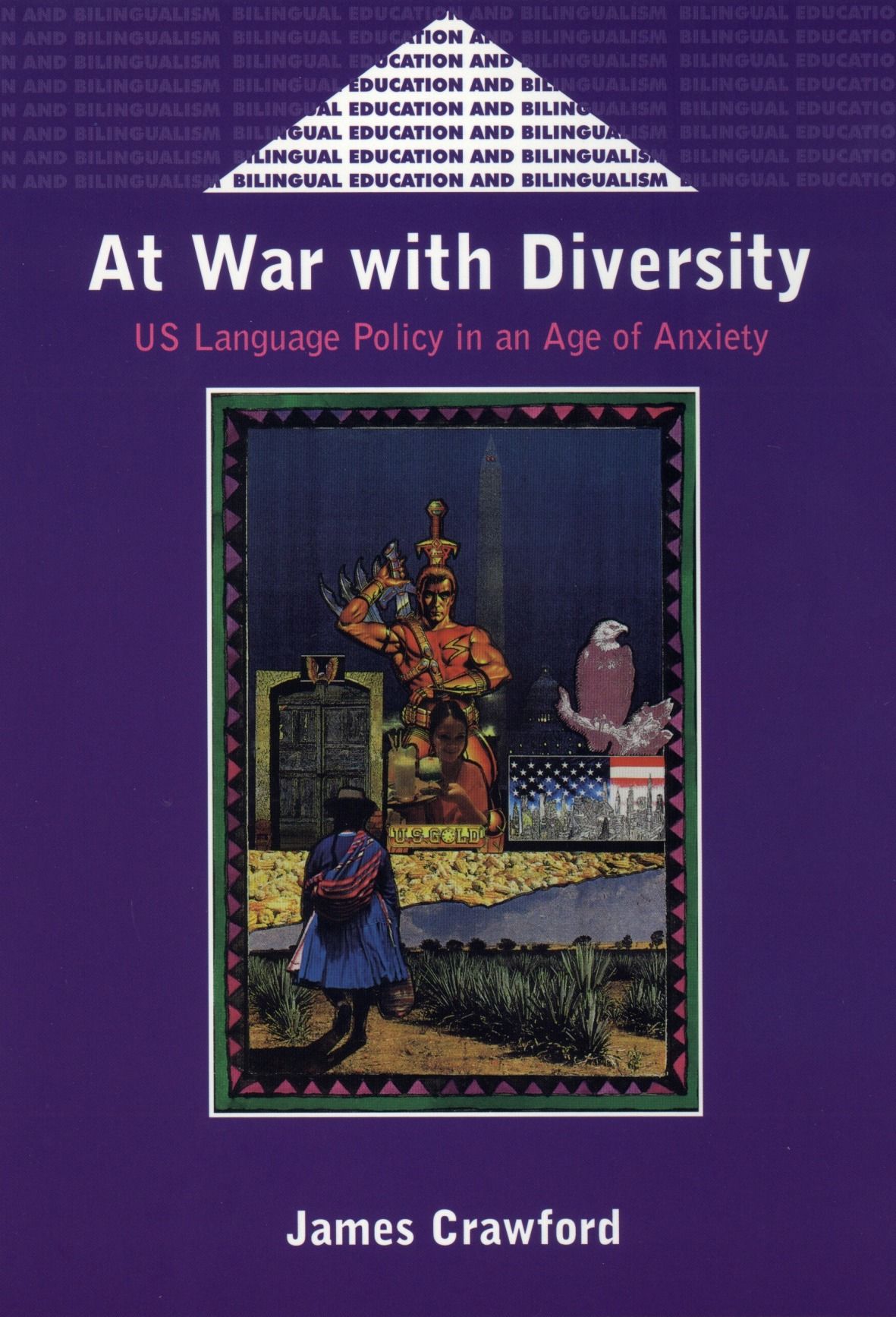
At War with Diversity
Bilingualism is a reality that many Americans still find difficult to accept; hence the prominence of English-only activism in U.S. politics. This collection of essays analyzes the sources of the anti-bilingual movement, its changing directions, and its impact on education policy. The book also explores efforts to resist the English-only trend, including projects to revitalize Native American languages.
eBook


Going North Thinking West
A long-time writing program administrator and well-respected iconoclast, Irvin Peckham is strongly identified with progressive ideologies in education. However, inGoing North Thinking West, Peckham mounts a serious critique of what is called critical pedagogy-primarily a project of the academic left-in spite of his own sympathies there.
College composition is fundamentally a middle-class enterprise, and is conducted by middle-class professionals, while student demographics show increasing presence of the working class. In spite of best intentions to ameliorate inequitable social class relationships, says Peckham, critical pedagogies can actually contribute to reproducing those relationships in traditional forms-not only perpetuating social inequities, but pushing working class students toward self-alienation, as well.
Peckham argues for more clarity on the history of critical thinking, social class structures and teacher identity (especially as these are theorized by Pierre Bourdieu), while he undertakes a critical inquiry of the teaching practices with which even he identifies.
Going North Thinking Westfocuses especially on writing teachers who claim a necessary linkage between critical thinking and writing skills; these would include both teachers who promote the fairly a-political position that argumentation is the obvious and necessary form of academic discourse, and more controversial teachers who advocate turning a classroom into a productive site of social transformation.
Ultimately, Peckham argues for a rereading of Freire (an icon of transformational pedagogy), and for a collaborative investigation of students' worlds as the first step in a successful writing pedagogy. It is an argument for a pedagogy based on service to students rather than on transforming them.
eBook