
Catalogue Search | MBRL


Are you sure you want to remove the book from the shelf?

{{itemTitle}}
407
result(s) for
"English language -- Word formation"
Sort by:

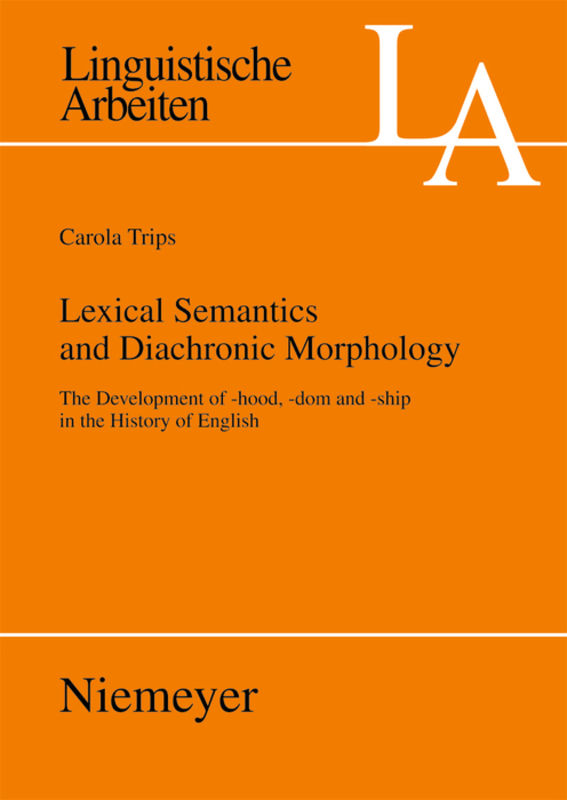
Lexical Semantics and Diachronic Morphology
This book is the most comprehensive study to date of the development of the three suffixes -hood, -dom and -ship in the history of English. Based on data from annotated corpora it provides an in depth investigation from Old English to Modern English and shows that structurally the three suffixes developed from syntactic heads (nouns) via morphological heads in compounds to morphological heads in derivations. Being an instance of morphologisation the rise of suffixes clearly shows that word formation is not part of the syntactic module. This development is triggered by semantic change, more precisely, by the semantics of the elements which keep their salient meanings and develop further meanings through metonymic shifts, finally leading to underspecified meanings. The findings are analysed in a revised version of Lieber's (2004) framework to account for the diachronic facts and have far-reaching consequences for morphological theory since they show that derivational suffixes bear meaning and hence contribute to processes of lexicalisation which is clear evidence for sign-based models and against, for example, Separationist assumptions.
eBook

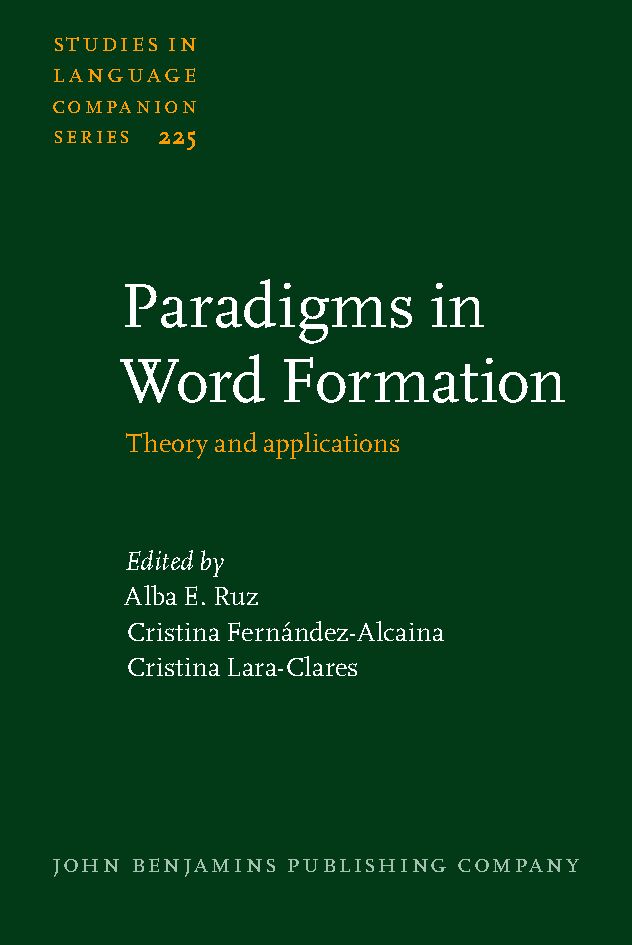
Paradigms in word formation : theory and applications
The focus of Paradigms in Word Formation: Theory and applications is on the relevance of paradigms for linguistic description. Paradigmatic organization has traditionally been considered an inherent feature of inflectional morphology, but research in the last decades clearly shows the existence of paradigms in word formation, especially in affixal derivation, often at the expense of other word-formation processes. This volume seeks to address the role that paradigms may play in the description of compounding, conversion and participles. This volume should be of interest to anyone specialized in the field of English morphology and word formation.
eBook
Analogy in word-formation : a study of English neologisms and occasionalisms
The series publishes state-of-the-art work on core areas of linguistics across theoretical frameworks as well as studies that provide new insights by building bridges to neighbouring fields such as neuroscience and cognitive science. The series considers itself a forum for cutting-edge research based on solid empirical data on language in its various manifestations, including sign languages. It regards linguistic variation in its synchronic and diachronic dimensions as well as in its social contexts as important sources of insight for a better understanding of the design of linguistic systems.
Book

Constructional Change in English
Martin Hilpert combines construction grammar and advanced corpus-based methodology into a new way of studying language change. Constructions are generalizations over remembered exemplars of language use. These exemplars are stored with all their formal and functional properties, yielding constructional generalizations that contain many parameters of variation. Over time, as patterns of language use are changing, the generalizations are changing with them. This book illustrates the workings of constructional change with three corpus-based studies that reveal patterns of change at several levels of linguistic structure, ranging from allomorphy to word formation and to syntax. Taken together, the results strongly motivate the use of construction grammar in research on diachronic language change. This new perspective has wide-ranging consequences for the way historical linguists think about language change. It will be of particular interest to linguists working on morpho-syntax, sociolinguistics and corpus linguistics.
eBook

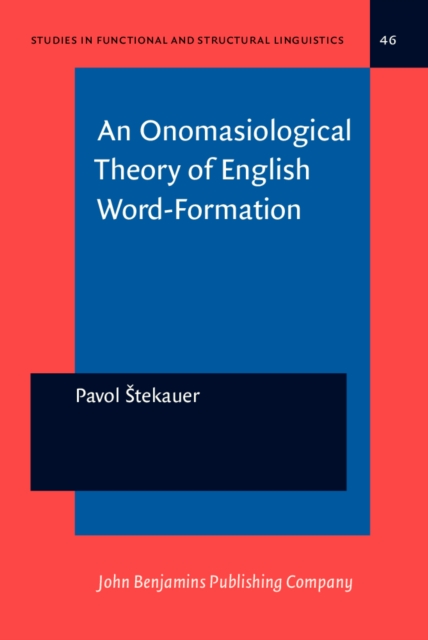
An Onomasiological Theory of English Word-Formation
Pavol Štekauer presents an original approach to the intricate problems of English word-formation. The emphasis is on the process of coining new naming units (words). This is described by an onomasiological model, which takes as its point of departure the naming needs of a speech community, and proceeds through conceptual reflection of extra-linguistic reality and semantic analysis to the form of a new naming unit. As a result, it is the form which implements options given by semantics by means of the so-called Form-to-Meaning Assignment Principle.Word-formation is conceived of as an independent component, interrelated with the lexical component by supplying it with new naming units, and by making use of the word-formation bases of naming units stored in the Lexicon. The relation to the Syntactic component is only mediated through the Lexical component.In addition, the book presents a new approach to productivity. It is maintained that word-formation processes are as productive as syntactic processes. This radically new approach provides simple answers to a number of traditional problems of word-formation.
eBook

The word and its ways in English : essays on the parts of speech and person
\"Words are the foundation, the building blocks of language. In this book, Walter Hirtle presents the word as the smallest element of meaning in the brain. He also explores how thoughts in the mind of a speaker become a succession of spoken words that get translated back into meaning in the mind of a listener. Inspired by the work of the French linguist Gustave Guillaume and last of a series, The Word and its Ways in English is a study of the way the word is configured in English, an attempt to discern its nature. His exploration covers different categories of words and how grammatical components such as person, case and gender, contribute to the word's overall meaning and are intimately linked to the mind. The Word and its Ways in English is thought provoking for anybody seeking a deeper understanding of the link between language, meaning and words.\"-- Provided by publisher.
Book

Extra-grammatical Morphology in English
Extra-grammatical morphology is a hitherto neglected area of research, highly marginalised because of its irregularity and unpredictability. Yet many neologisms in English are formed by means of extra-grammatical mechanisms, such as abbreviation, blending and reduplication, which therefore deserve both greater attention and more systematic study. This book analyses such phenomena.
eBook