
Catalogue Search | MBRL


Are you sure you want to remove the book from the shelf?

{{itemTitle}}
9,541
result(s) for
"English language Aspect."
Sort by:


Culture and Identity through English as a Lingua Franca
The use of English as a global lingua franca has given rise to new challenges and approaches in our understanding of language and communication. One area where ELF (English as a lingua franca) studies, both from an empirical and theoretical orientation, have the potential for significant developments is in our understanding of the relationships between language, culture and identity. ELF challenges traditional assumptions concerning the purposed 'inexorable' link between a language and a culture. Due to the multitude of users and contexts of ELF communication the supposed language, culture and identity correlation, often conceived at the national level, appears simplistic and naïve. However, it is equally naïve to assume that ELF is a culturally and identity neutral form of communication. All communication involves participants, purposes, contexts and histories, none of which are 'neutral'. Thus, we need new approaches to understanding the relationship between language, culture and identity which are able to account for the multifarious and dynamic nature of ELF communication.
eBook

English Linguistic Imperialism from Below
This book offers a sociolinguistic analysis of 'low-fee private schooling'. It demonstrates that political economic transitions experienced as radical social mobility have led to intense parental desire for (low-fee) private English schooling. Rather than English schooling leading to social mobility, social mobility necessitates English schooling.
eBook

World Englishes in Asian Contexts
This book is the first comprehensive treatment of the spread, acculturation, functions and evolution of English in Asia. It discusses all major issues resulting from the introduction of English in culturally different contexts and the two-way interaction
eBook

Irish English Volume 2: The Republic of Ireland
This volume continues the Dialects of English series, and complements Irish English volume 1: Northern Ireland, by Karen Corrigan. Focusing on Irish English in the Republic of Ireland, the book starts by exploring the often oppositional roles of national language development and globalisation in shaping Irish English from the earliest known times to the present. Three chapters on the lexicon and discourse, syntax, and phonology focus on traditional dialect but also refer to colloquial and vernacular Irish English, the use of dialect in literature, and the modern \"standard\" language, especially as found in the International Corpus of English (ICE-Ireland). A separate chapter examines the internal history of Irish English, from Irish Middle English to contemporary change in progress. The book includes an extended bibliographical essay and a set of sample literary texts and texts from ICE-Ireland. Continuing themes include the impact on Irish English of contact with the Irish language, the position of Irish English in world Englishes, and features which help to distinguish between Irish English in the Republic and in Northern Ireland.
eBook

The English-Vernacular Divide
This book offers a critical exploration of the role of English in postcolonial communities such as India. Specifically, it focuses on some local ways in which the language falls along the lines of a class-based divide (with ancillary ones of gender and caste as well). The book argues that issues of inequality, subordination and unequal value seem to revolve directly around the general positioning of English in relation to vernacular languages. The author was raised and schooled in the Indian educational system.
eBook

The Future Conditional
In The Future
Conditional , Eric S. Henry brings
twelve-years of expertise and research to offer a nuanced
discussion of the globalization of the English language and the
widespread effects it has had on Shenyang, the capital and largest
city of China's northeast Liaoning Province. Adopting an
ethnographic and linguistic perspective, Henry considers the
personal connotations that English, has for Chinese people, beyond
its role in the education system. Through research on how English
is spoken, taught, and studied in China, Henry considers what the
language itself means to Chinese speakers. How and why, he asks,
has English become so deeply fascinating in contemporary China,
simultaneously existing as a source of desire and anxiety? The
answer, he suggests, is that English-speaking Chinese consider
themselves distinctly separate from those who do not speak the
language, the result of a cultural assumption that speaking English
makes a person modern.
Seeing language as a study that goes beyond the classroom,
The Future Conditional assesses the emerging viewpoint
that, for many citizens, speaking English in China has become a
cultural need-and, more immediately, a realization of one's
future.
eBook

The Emergence of the English Native Speaker
The native speaker is one of the central but at the same time most controversial concepts of modern linguistics. With regard to English, it became especially controversial with the rise of the so-called \"New Englishes,\" where reality is much more complex than the neat distinction into native and non-native speakers would make us believe. This volume reconstructs the coming-into-being of the English native speaker in the second half of the nineteenth century in order to probe into the origins of the problems surrounding the concept today. A corpus of texts which includes not only the classics of the nineteenth-century linguistic literature but also numerous lesser-known articles from periodical journals of the time is investigated by means of historical discourse analysis in order to retrace the production and reproduction of this particularly important linguistic ideology.
eBook
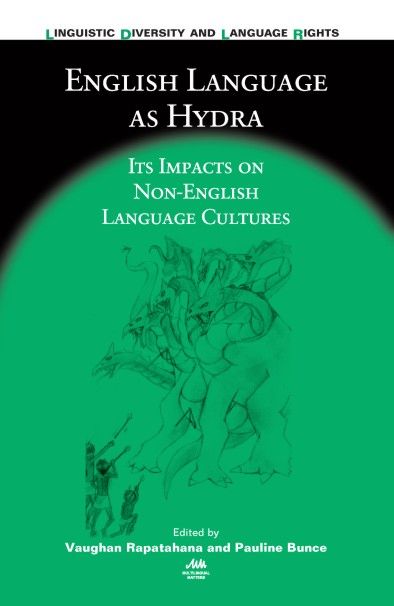
English Language as Hydra
This book argues that the English language industry has become a swirling, beguiling monster, unashamedly intent on challenging local lingua-diversity and threatening individual identities. It brings together linguists, literary figures and teaching professionals in a wide-ranging expose of this enormous Hydra in action on four continents.
eBook

Corpus-Based Contrastive Studies of English and Chinese
This book is concerned with cross-linguistic contrast of major grammatical categories in English and Chinese, two most important yet genetically different world languages. This genetic difference has resulted in many subsidiary differences that are, among other things, related to grammar. Compared with typologically related languages, cross-linguistic contrast of English and Chinese is more challenging yet promising. The main theme of this book lies in its focus on cross-linguistic contrast of aspect-related grammatical categories, or, grammatical categories that contribute to aspectual meaning – both situation aspect at the semantic level and viewpoint aspect at the grammatical level – in English and Chinese.
The unique strength of this volume lies in that it is first corpus-based book contrasting English and Chinese. Given that the state of the art in language studies is to use corpora, the significance of the marriage between contrastive studies and the corpus methodology in this book is not to be underestimated.
1. Introduction 2. Aspect Marking in English and Chinese 3. Temporal Adverbials and Telicity in English and Chinese 4. Quantifying Constructions in English and Chinese 5. Passives in English and Chinese 6. Negation in English and Chinese: Variants and Variations 7. Negation in English and Chinese: Special Usages 8. Challenge and Promise, and the Way Forward
Richard Xiao is Senior Lecturer in English and Chinese Studies at Edge Hill University, UK. He has published extensively in corpus linguistics as well as contrastive and translation studies. Richard’s recent books include Aspect in Mandarin Chinese (2004), Corpus-Based Language Studies (2006), and A Frequency Dictionary of Mandarin Chinese (2009).
Tony McEnery is Professor of English Linguistics and Dean of the Faculty of Arts and Social Sciences at Lancaster University, UK. As a world renowned corpus linguist, he has published numerous books including Corpus Linguistics (1996/2001), Aspect in Mandarin Chinese (2004), Corpus-Based Language Studies (2006), and Corpora in Linguistics (2010).
\"This book is no doubt a fascinating contribution to corpus linguistics, linguistic theory, and a cross-linguistic analysis of aspect-related grammatical categories of the two typologically dissimilar languages.\" - Chinese Language and Dialogue, Vol 1:2 (2010)
eBook