
Catalogue Search | MBRL


Are you sure you want to remove the book from the shelf?

{{itemTitle}}
761
result(s) for
"English language Lexicography."
Sort by:
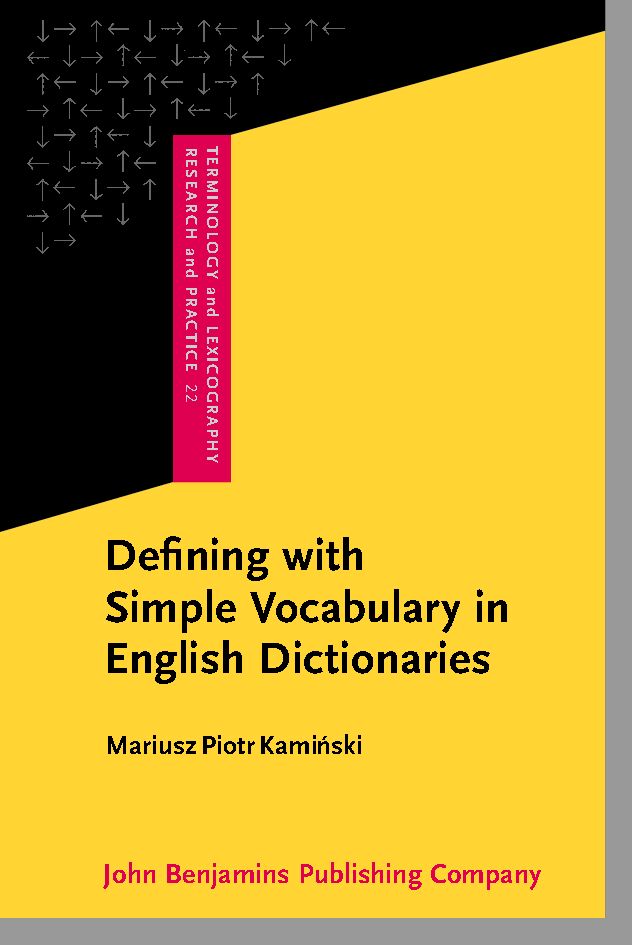
Defining with Simple Vocabulary in English Dictionaries
This book investigates an important but under-researched aspect of dictionary making: the use of a controlled vocabulary in definitions. The main concern of the author is the role of a definition vocabulary in how foreign learners understand and perceive dictionary definitions. The author takes the reader through a detailed historical account of controlled vocabularies and examines definitions in a range of English dictionaries with respect to their vocabulary loads. He performs a series of experiments with university students to reveal merits and shortcomings of restricted vocabularies. This monograph has been written with the aim to fill a gap in the literature on defining vocabulary. It is intended for lexicographers, dictionary editors, course designers, teachers, and students, as well as anyone who wishes to explain words in an intelligible way.
eBook
Historical dictionaries in their paratextual context
Both dictionary and paratext research have emerged recently as widely-recognised research areas of intrinsic interest. This collection represents an attempt to place dictionaries within the paratextual context for the first time. This volume covers paratextual concerns, including dictionary production and use, questions concerning compilers, publishers, patrons and subscribers, and their cultural embedding generally. This book raises questions such as who compiled dictionaries and what cultural, linguistic and scientific notions drove this process. What influence did the professional interests, life experience, and social connexions of the lexicographer have? Who published dictionaries and why, and what do the forematter, backmatter, and supplements tell us? Lexicographers edited, adapted and improved earlier works, leaving copies with marginalia which illuminate working methods. Individual copies offer a history of ownership through marginalia, signatures, dates, places, and library stamps. Further questions concern how dictionaries were sold, who patronised them, subscribed to them, and how they came to various libraries.
Book

Dictionary Poetics
Dictionary Poetics analyses book-length poems from a number of writers who have used particular editions of specific dictionaries to structure their work. Authors include Louis Zukofsky , George Oppen, Clark Coolidge, Bernadette Mayer, Tina Darragh, and Harryette Mullen.
eBook

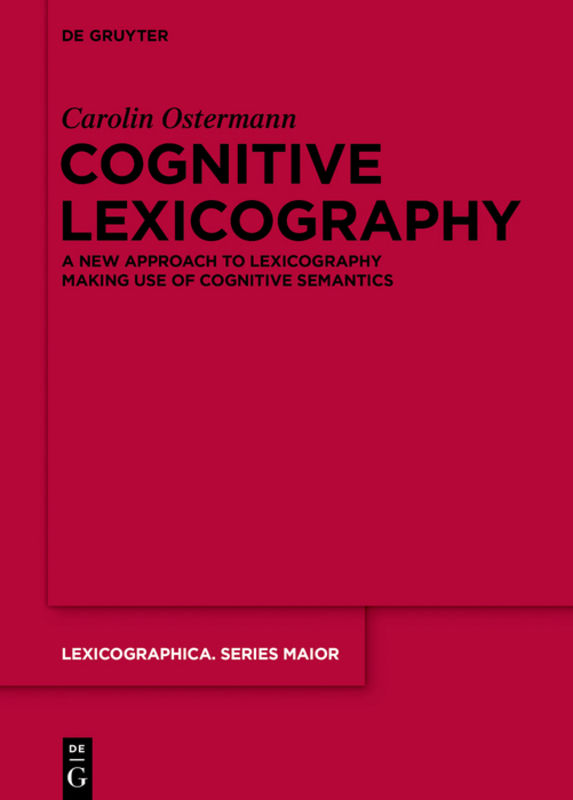
Cognitive Lexicography
English lexicography and linguistics have always shared close ties, yet the potential of cognitive linguistics for lexicography has only been hesitantly acknowledged in the literature. This is what cognitive lexicography attempts to change by using insights gained in cognitive semantic research for the development of new dictionary features. After a short survey of the history and practice of English monolingual learner lexicography, as well as an outline of the relationship between linguistics and lexicography, three new dictionary features are developed. They cover three different cognitive semantic theories as well as three different parts of the monolingual dictionary entry, each time for a new set of lexemes. Frame semantics, conceptual metaphor theory, as well as cognitive conceptions of polysemy, are used to create a new example section for agentive nouns, a new defining structure for emotion terms and a new microstructural arrangement for particle entries. Dictionary analyses on all, as well as user studies on two of the features, complement these suggestions. The monograph thus presents a new approach to lexicography that incorporates into its description of lexical items how humans perceive and conceptualise language.
eBook


Words of the World
Most people think of the Oxford English Dictionary (OED) as a distinctly British product. Begun in England 150 years ago, it took more than 60 years to complete and, when it was finally finished in 1928, the British prime minister heralded it as a 'national treasure'. It maintained this image throughout the twentieth century, and in 2006 the English public voted it an 'Icon of England', alongside Marmite, Buckingham Palace and the bowler hat. However, this book shows that the dictionary is not as 'British' as we all thought. The linguist and lexicographer, Sarah Ogilvie, combines her insider knowledge and experience with impeccable research to show that the OED is in fact an international product in both its content and its making. She examines the policies and practices of the various editors, applies qualitative and quantitative analysis, and finds new OED archival materials in the form of letters, reports and proofs. She demonstrates that the OED, in its use of readers from all over the world and its coverage of World English, is in fact a global text.
eBook


English dictionaries, 800-1700 : the topical tradition
A fascinating study which explores the so-called topical , i.e. non-alphabetical, word-lists which appeared between the beginnings of written culture and 1700. A form of early dictionary, these lists followed the influential paradigms of theology, philosophy, and natural history of the time, providing us with evidence on cultural history and li.
eBook