
Catalogue Search | MBRL


Are you sure you want to remove the book from the shelf?

{{itemTitle}}
28
result(s) for
"English language Locative constructions."
Sort by:

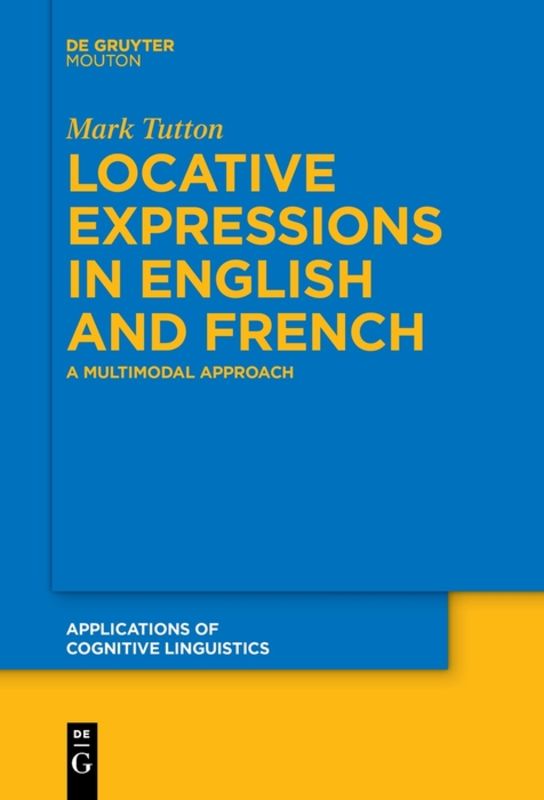
Locative Expressions in English and French
Expressing location is one of the most common linguistic tasks that we perform in our daily lives. This book provides the first comprehensive analysis into how speakers of English and French use gesture as well as speech when describing where objects are located. It shows that spoken locative expressions are made up of both speech and gesture components, and that the two modalities contribute in a complementary fashion to convey locative meaning.
eBook
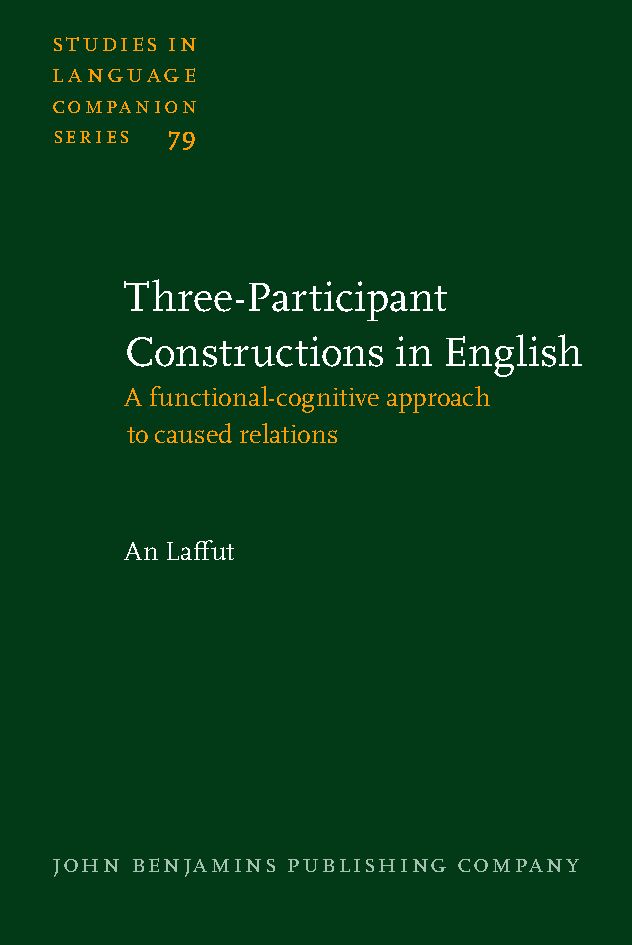
Three-participant constructions in English : a functional-cognitive approach to caused relations
This study aims to give a systematic and comprehensive description of the constructions involved in three important types of alternation: the locative alternation, which is by far the most researched of the three, the image impression alternation and the material/product alternation. The author looks at the constructions as part of alternation, but also looks beyond the alternations, and analyzes and describes the constructions in their own right. They are analyzed as three-participant constructions with relational complements, construing causation of the three main subtypes of relations, namely intensive, circumstantial and possessive relations. Particular attention is paid to the concept of holicity, to the status of the prepositional phrase, and to collocational properties, which play a key role in the decision as to which alternate should be regarded as the unmarked one within its construction paradigm. The approach taken is inspired by systemic functional grammar and can broadly be characterized as cognitive-functional.
eBook

Construction Learning as a Function of Frequency, Frequency Distribution, and Function
The article considers effects of construction frequency, form, function, and prototypicality on second language acquisition (SLA). It investigates these relationships by focusing on naturalistic SLA in the European Science Foundation corpus (Perdue, 1993) of the English verb-argument constructions (VACs): verb locative (VL), verb object locative (VOL), and ditransitive (VOO). Goldberg (2006) argued that Zipfian type/token frequency distributions (Zipf, 1935) in natural language constructions might optimize learning by providing one very high-frequency exemplar that is also prototypical in meaning. The article tests and confirms this proposal for naturalistic English as a second language. The authors show that VAC type/token distribution in the input is Zipfian and that learners first use the most frequent, prototypical, and generic exemplar (e.g., put in the VOL VAC, give in the VOO ditransitive, etc.). Learning is driven by the frequency and frequency distribution of exemplars within constructions and by the match of their meaning to the construction prototype. (Verlag, adapt.).
Journal Article

Locative Inversion in Old English Embedded Clauses
A grammatical construction resembling Present-Day English locative inversion has already been found in Old English, with a fronted prepositional phrase prompting V2 word order, both in main and subordinate clauses. It has been demonstrated that several discourse-related factors influence the positioning of objects, fronted locatives, finite verbs and subjects in subordinate clauses. One of the main aims of the present paper is to provide a quantitative and qualitative analysis of the locative inversion construction in Old English subordinate clauses. The Old English data for this study were obtained from the York–Toronto–Helsinki Parsed Corpus of Old English Prose, and they were analysed using Corpus Studio. The results were compared with those for main clauses, and discourse-related factors such as PP anaphoricity or subject type were analysed in order to find the motivation for the existence of this alternation of word orders. PP anaphoricity proved not to be a determining factor in triggering finite verb inversion, while other factors such as subject weight and subject type do seem to motivate finite verb inversion, thus yielding an embedded PP-V-S word order.
Journal Article

ON THE NOTION OF SUBJECT FOR SUBJECT-ORIENTED ADVERBS
This article investigates the nature of predication of so-called subject-oriented adverbs in English. It is noted that there are both conceptual and empirical issues to be addressed. On the conceptual side, there is no consensus in previous studies on what exactly the notion of subject is for these adverbs and why these adverbs have an orientation to the subject. On the empirical side, there are circumstances in which some of the adverbs seem to be construed with the object argument of the verb. This article focuses on these problems through an examination of the adverbs occurring in locative, passive, unaccusative, and resultative constructions. It is argued that when these adverbs seem to be associated with the object, they are predicated of a phonetically empty pronoun that occurs as the subject of a small clause, controlled by the object. Moreover, it is indicated that subject-oriented adverbs occurring in different positions across different constructions are all parasitically predicated of DPs that are introduced by a functional head in primary predication. Given the proposal made in recent studies that predication relationships between lexical categories and their external arguments in general are mediated by a functional head, it is claimed that subject-oriented adverbs also need to be supported by such a head to be associated with DPs. Thus, it is concluded that the notion of subject for these adverbs and their orientation are derived from the general theory of predication.
Journal Article

Appearance and Existence in Mandarin Chinese
In Mandarin Chinese, the string of three overt elements in a row, a locative, a verb, and a nominal, asserts the existence of the entity denoted by the nominal in the location. This paper argues that the verb is contained in an adjunct, whereas the locative in its base position and the nominal establish a matrix predication relation. Thus, instead of the overt verb, the head of the matrix predicate of the construction is null. Moreover, a new analysis is provided to explain the obligatory argument sharing between the verb and the matrix predication of the construction. Furthermore, the paper argues that the agent of a transitive verb in certain types of embedded clauses needs to be Case-licensed by either the v of the selecting verb, as in an ECM construction, or a local c-commanding functional element, such as a complementizer, as in the English infinitive for construction. This Case-licensing explains why the transitive verb in the string has no agent. The research shows that the syntactic strategies to license abstract Cases in Chinese are similar to the ones found in other languages. Finally, the paper argues that the post-verbal - zhe is an adessive marker when it occurs in a non-progressive context.
Journal Article

Locatives and existentials in L2 Spanish: The acquisition of the semantic contrasts among \ser, estar\ and \haber\
This study analyses the expression of locative and existential predicates elicited through an oral production task in the speech of two groups of learners of Spanish as a second language (L2) (first language English, n = 18; first language Moroccan Arabic, n = 14), and a native control group (n = 18). A total of 25,000 words were analysed, with over 1,000 locative and existential predicates. These predicates were coded according to the lexical verb used as well as the semantics of the THEME; special attention was given to the use of copular verbs. Results indicated a delayed development of estar to express location, some overextension of haber with definite themes, and a small incorrect use of ser to locate objects in the English group. Overall, it is argued that given the case of complex semantics but simple syntax, the phenomenon is relatively unproblematic for L2 learners even at intermediate proficiency, probably due to the fact that these semantic concepts are already present in the first languages (LIs) of the learners, and particularly because these are mapped onto lexical pieces and not onto functional morphology, the bottleneck for L2 acquisition.
Journal Article

Deconstructing possession
The paper argues that clausal possession is to be decomposed into three distinct, independently attested, syntactic configurations, each associated with its own meaning. These include Location, represented as an ordinary small clause, the Part-Whole relation, which always has a complement structure within DP as its source, and an applicative structure ApplP, the source of (in) alienable possession, where humans are treated as special. The analysis we propose focuses on Palestinian Arabic and extends to English clausal possession and its realizations across HAVE and BE. Palestinian Arabic overtly distinguishes a number of ingredients which in other languages enter into possession less transparently: It marks Location and Part-Whole relations by distinct prepositions, it features a full-agreement/no-agreement distinction associated with scope, and, lacking HAVE, it keeps separate P ° and BE, the ingredients often assumed to enter into its composition. The picture which emerges is partly familiar and partly new. We argue that the notion possession is never linguistically encoded as such, since none of the underlying representations proposed is associated exclusively with possession. We also argue that the subject in possessive clauses is a derived subject with both HAVE and BE. We attribute the differences between Palestinian Arabic and English to a difference in their agreement systems, which in conjunction with Economy, forces P ° to extract from its PP, and leads to the formation of HAVE. If we are correct, the cross-linguistic distribution of HAVE and BE may further reduce to parametric differences in agreement systems.
Journal Article

On coming the pub in the North West of England: accusative unaccusatives, dependent case, and preposition incorporation
Some English dialects in the North West of England allow the complements of certain motion verbs to surface with no visible preposition to, producing strings like John came the pub with me, which are ungrammatical in other dialects of English. This paper offers a detailed description of this understudied construction, showing that the Goal argument has a mixture of direct object properties and PP object properties. To explain this mixture of properties, it is proposed that the Goal argument in this construction is introduced in a PP headed by a silent preposition TO, but subsequently moves into spec-vP, the final position of direct objects, receiving accusative case there. Since some of the verbs that enter into this construction are unaccusative, this analysis reinforces a conclusion regarding accusative case already reached in the dependent case literature: assignment of accusative must be decoupled from the assignment of an external argument theta-role, contra classical formulations of Burzio's Generalization.
Journal Article