
Catalogue Search | MBRL


Are you sure you want to remove the book from the shelf?

{{itemTitle}}
5,004
result(s) for
"English language Verb."
Sort by:


The Verb Phrase in English
The chapters in this volume feature new and groundbreaking research carried out by leading scholars and promising young researchers from around the world on recent changes in the English verb phrase. Drawing on authentic corpus data, the papers consider both spoken and written English in several genres. Each contribution pays particular attention to the methodologies used for investigating short-term patterns of change in English, with detailed discussions of controversies in this area. This cutting-edge collection is essential reading for historians of the English language, syntacticians and corpus linguists.
eBook

What is it doing? : a book about verbs
\"Ping uses verbs to explain to William what the bear outside Bernard's cabin is doing. Readers learn the different jobs of verbs in a sentence\"-- Provided by publisher.
Book
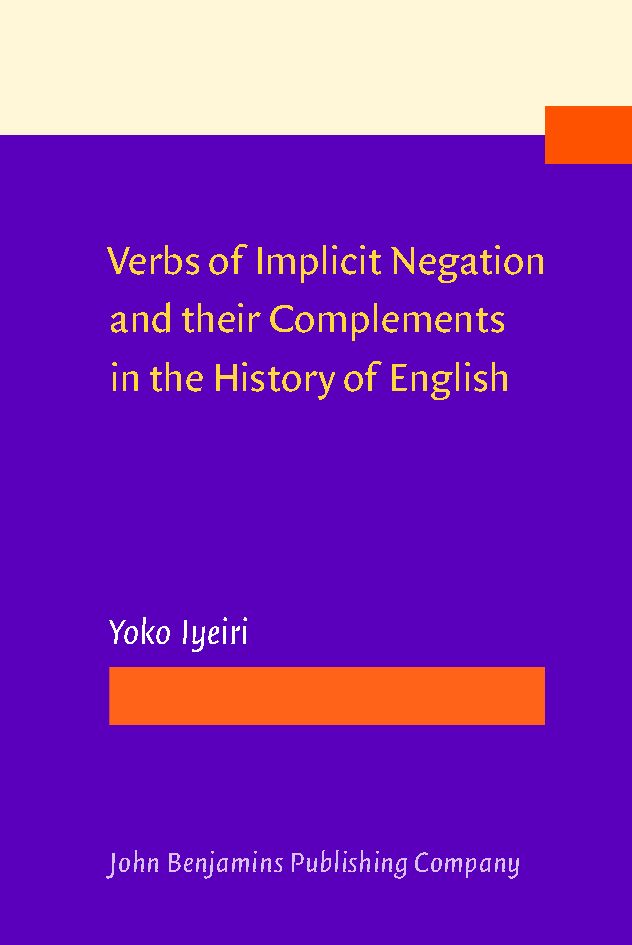
Verbs of Implicit Negation and their Complements in the History of English
For sale in all countries except Japan. For customers in Japan: please contact Yushodo Co. The principal focus of this book concerns various shifts of complements which verbs of implicit negation (e.g. forbid, forbear, avoid, prohibit, and prevent) have experienced in the history of English. Forbid, for example, was once followed by that-clauses, while in contemporary English it is in usual cases followed by to-infinitives except in the fixed form God forbid that ... Although a number of English verbs have undergone similar syntactic changes, the paths they have selected in their historical development are not always the same. Unlike forbid, the verb prevent is now followed by gerunds often with the preposition from. This book describes some of the most representative paths followed by different verbs of implicit negation and reveals the major complement shifts that have occurred throughout the history of English. It will be of particular interest to researchers and students specializing in English linguistics, historical linguistics, and corpus linguistics.
eBook


Frame-constructional verb classes : change and theft verbs in English and German
While verb classes are a mainstay of linguistic research, the field lacks consensus on precisely what constitutes a verb class. This book presents a novel approach to verb classes, employing a bottom-up, corpus-based methodology and combining key insights from Frame Semantics, Construction Grammar, and Valency Grammar. On this approach, verb classes are formulated at varying granularity levels to adequately capture both the shared semantic and syntactic properties unifying verbs of a class and the idiosyncratic properties unique to individual verbs. In-depth analyses based on this approach shed light on the interrelations between verbs, frame-semantics, and constructions, and on the semantic richness and network organization of grammatical constructions.This approach is extended to a comparison of Change and Theft verbs, revealing unexpected lexical and syntactic differences across semantically distinct classes. Finally, a range of contrastive (German-English) analyses demonstrate how verb classes can inform the cross-linguistic comparison of verbs and constructions.
eBook

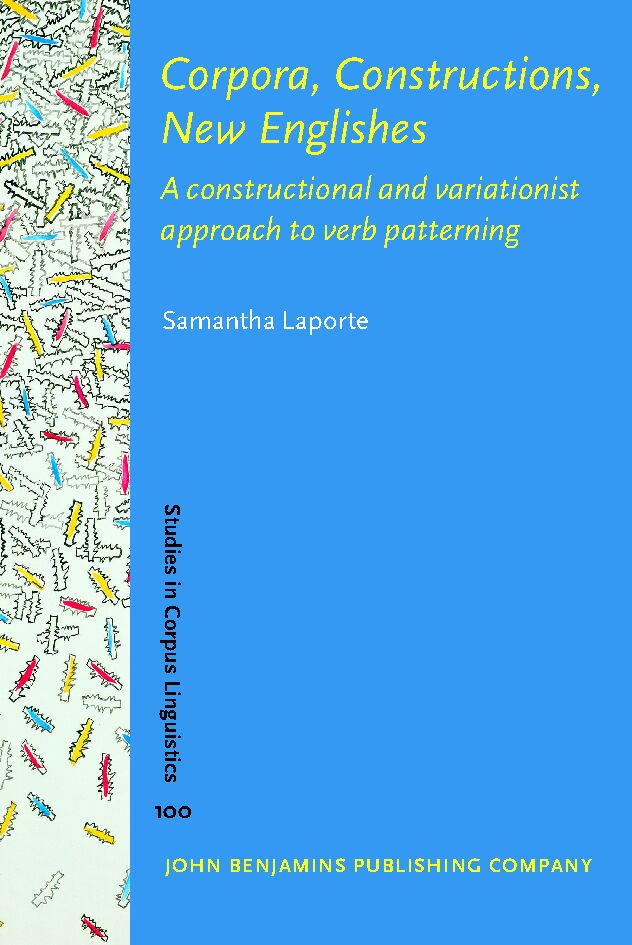
Corpora, constructions, new Englishes : a constructional and variationist approach to verb patterning
This book takes an integrated approach to the fields of Corpus Linguistics, Construction Grammar and World Englishes through a thorough constructional and corpus-based examination of the patterning of the versatile high-frequency verb make in British English and New Englishes.
eBook
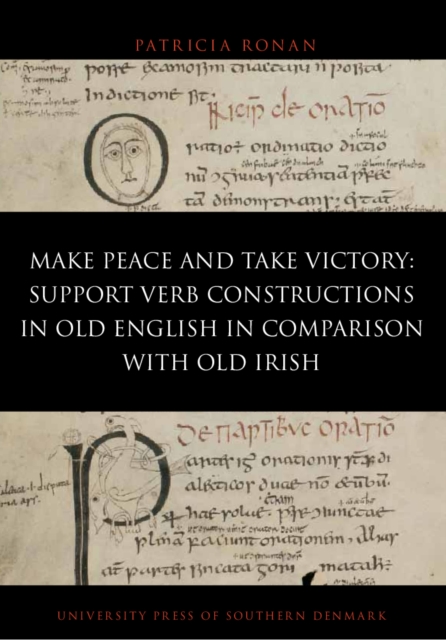
Make peace and take victory : support verb constructions in old English in comparison with old Irish
This corpus-based study examines the use of support verb constructions in Old English and Old Irish. It determines in how far these constructions can be seen as a means to offer semantic specification of existing verbal expressions. The study further investigates whether support verb constructions may be employed to create periphrastic verbal expressions to denote concepts for which no simple verb exists in the language at that stage. This latter situation may particularly arise as a consequence of contact with new cultural concepts. The approach of the study is both qualitative and quantitative. It compares the use of the Old English constructions to corresponding Old Irish structures as well as to other language varieties, especially Present Day English, which has a considerably more analytic morphological structure than either of the two medieval languages.
eBook