
Catalogue Search | MBRL


Are you sure you want to remove the book from the shelf?

{{itemTitle}}
136
result(s) for
"English poetry Illustrations."
Sort by:

Photopoetry, 1845-2015 : a critical history
From amateur experiments in scrapbooks and stereographs to contemporary photobook collaborations between leading practitioners, poets and photographers have created an art form that continues to evolve and deserves critical exploration. 'Photopoetry 1845-2015, a Critical History' represents the first account of this challenging and diverse body of work.0Nott traces the development of photopoetic collaboration from its roots in 19th-century illustrative practices to the present day. Focusing on work from the UK and US, he examines how and why poets and photographers collaborate, and explores the currents of exchange and engagement between poems and photographs on the page. The book not only considers canonical figures, but brings to light forgotten practitioners whose work questioned and shaped the relationship between word and image.0'Photopoetry 1845-2015, a Critical History' provides a new lens through which to explore poetry, photography, and the spaces between them.
Book

Poetry, pictures, and popular publishing : the illustrated gift book and Victorian visual culture, 1855-1875
In Poetry, Pictures, and Popular Publishing eminent Rossetti scholar Lorraine Janzen Kooistra demonstrates the cultural centrality of a neglected artifact: the Victorian illustrated gift book. Turning a critical lens on \"drawing-room books\" as both material objects and historical events, Kooistra reveals how the gift book's visual/verbal form mediated \"high\" and popular art as well as book and periodical publication.
A composite text produced by many makers, the poetic gift book was designed for domestic space and a female audience; its mode of publication marks a significant moment in the history of authorship, reading, and publishing. With rigorous attention to the gift book's aesthetic and ideological features, Kooistra analyzes the contributions of poets, artists, engravers, publishers, and readers and shows how its material form moved poetry into popular culture. Drawing on archival and periodical research, she offers new readings of Eliza Cook, Adelaide Procter, and Jean Ingelow and shows the transatlantic reach of their verses. Boldly resituating Tennyson's works within the gift-book economy he dominated, Kooistra demonstrates how the conditions of corporate authorship shaped the production and receptionof the laureate's verses at the peak of his popularity.
Poetry, Pictures, and Popular Publishing changes the map of poetry's place—in all its senses—in Victorian everyday life and consumer culture.
eBook

Poetry, pictures, and popular publishing : the illustrated gift book and Victorian visual culture, 1855-1875
\"In Poetry, Pictures, and Popular Publishing eminent Rossetti scholar Lorraine Janzen Kooistra demonstrates the cultural centrality of a neglected artifact: the Victorian illustrated gift book. Turning a critical lens on \"drawing-room books\" as both material objects and historical events, Kooistra reveals how the gift book's visual/verbal form mediated \"high\" and popular art as well as book and periodical publication. A composite text produced by many makers, the poetic gift book was designed for domestic space and a female audience; its mode of publication marks a significant moment in the history of authorship, reading, and publishing. With rigorous attention to the gift book's aesthetic and ideological features, Kooistra analyzes the contributions of poets, artists, engravers, publishers, and readers and shows how its material form moved poetry into popular culture. Drawing on archival and periodical research, she offers new readings of Eliza Cook, Adelaide Procter, and Jean Ingelow and shows the transatlantic reach of their verses. Boldly re-situating Tennyson's works within the gift-book economy he dominated, Kooistra demonstrates how the conditions of corporate authorship shaped the production and reception of the laureate's verses at the peak of his popularity. Poetry, Pictures, and Popular Publishing changes the map of poetry's place--in all its senses--in Victorian everyday life and consumer culture\"-- Provided by publisher.
Book

Dickinson's Misery
How do we know that Emily Dickinson wrote poems? How do we recognize a poem when we see one? InDickinson's Misery, Virginia Jackson poses fundamental questions about reading habits we have come to take for granted. Because Dickinson's writing remained largely unpublished when she died in 1886, decisions about what it was that Dickinson wrote have been left to the editors, publishers, and critics who have brought Dickinson's work into public view. The familiar letters, notes on advertising fliers, verses on split-open envelopes, and collections of verses on personal stationery tied together with string have become the Dickinson poems celebrated since her death as exemplary lyrics.
Jackson makes the larger argument that the century and a half spanning the circulation of Dickinson's work tells the story of a shift in the publication, consumption, and interpretation of lyric poetry. This shift took the form of what this book calls the \"lyricization of poetry,\" a set of print and pedagogical practices that collapsed the variety of poetic genres into lyric as a synonym for poetry.
Featuring many new illustrations from Dickinson's manuscripts, this book makes a major contribution to the study of Dickinson and of nineteenth-century American poetry. It maps out the future for new work in historical poetics and lyric theory.
eBook

Heart Beats
Many people in Great Britain and the United States can recall elderly relatives who remembered long stretches of verse learned at school decades earlier, yet most of us were never required to recite in class.Heart Beatsis the first book to examine how poetry recitation came to assume a central place in past curricular programs, and to investigate when and why the once-mandatory exercise declined. Telling the story of a lost pedagogical practice and its wide-ranging effects on two sides of the Atlantic, Catherine Robson explores how recitation altered the ordinary people who committed poems to heart, and changed the worlds in which they lived.
Heart Beatsbegins by investigating recitation's progress within British and American public educational systems over the course of the nineteenth and twentieth centuries, and weighs the factors that influenced which poems were most frequently assigned. Robson then scrutinizes the recitational fortunes of three short works that were once classroom classics: Felicia Hemans's \"Casabianca,\" Thomas Gray's \"Elegy Written in a Country Churchyard,\" and Charles Wolfe's \"Burial of Sir John Moore after Corunna.\" To conclude, the book considers W. E. Henley's \"Invictus\" and Rudyard Kipling's \"If--,\" asking why the idea of the memorized poem arouses such different responses in the United States and Great Britain today.
Focusing on vital connections between poems, individuals, and their communities,Heart Beatsis an important study of the history and power of memorized poetry.
eBook

The politics of Middle English parables
The politics of Middle English parables examines the
dynamic intersection of fiction, theology and social practice in
late-medieval England. Parables occupy a prominent place in Middle
English literature, appearing in dream visions and story
collections as well as in lives of Christ and devotional treatises.
While most scholarship approaches the translated stories as stable
vehicles of Christian teaching, this book highlights the many
variations and points of conflict across Middle English renditions
of the same story. In parables related to labour, social
inequality, charity and penance, the book locates a creative
theological discourse through which writers attempted to
re-construct Christian belief and practice. Analysis of these
diverse retellings reveals not what a given parable meant in a
definitive sense but rather how Middle English parables inscribe
the ideologies, power structures and cultural debates of
late-medieval Christianity.
eBook

Fearful symmetry
This brilliant outline of Blake's thought and commentary on his poetry comes on the crest of the current interest in Blake, and carries us further towards an understanding of his work than any previous study. Here is a dear and complete solution to the riddles of the longer poems, the so-called \"Prophecies,\" and a demonstration of Blake's insight that will amaze the modern reader. The first section of the book shows how Blake arrived at a theory of knowledge that was also, for him, a theory of religion, of human life and of art, and how this rigorously defined system of ideas found expression in the complicated but consistent symbolism of his poetry. The second and third parts, after indicating the relation of Blake to English literature and the intellectual atmosphere of his own time, explain the meaning of Blake's poems and the significance of their characters.
eBook
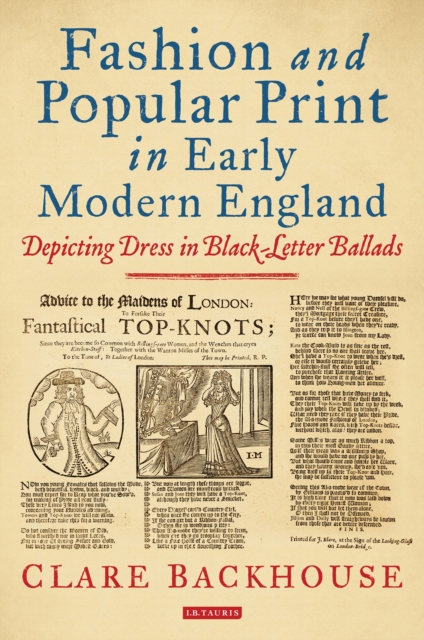
Fashion and Popular Print in Early Modern England
Fashion featured in black-letter broadside ballads over a hundred years before fashion magazines appeared in England. In the seventeenth century, these single-sheet prints contained rhyming song texts and woodcut pictures, accessible to almost everyone in the country. Dress was a popular subject for ballads, as well as being a commodity with close material and cultural connections to them.This book analyses how the distinctive words and images of these ballads made meaning, both in relation to each other on the ballad sheet and in response to contemporary national events, sumptuary legislation, religious practice, economic theory, the visual arts and literature. In this context, Clare Backhouse argues, seventeenth-century ballads increasingly celebrated the proliferation of print and fashionable dress, envisioning new roles for men and women in terms of fashion consumption and its importance to national prosperity. The book demonstrates how the hitherto overlooked but extensive source material that these ballads offer can enrich the histories of dress, art and culture in early modern England.
eBook

'A larger vision': William Blake, Phoebe Anna Traquair, and the Visual Imagination in EBB's Sonnets from the Portuguese
Four years later, when the Edinburgh-based artist Phoebe Anna Traquair (1852-1936) embarked on an ambitious and intricate project to illustrate EBB's Sonnets from the Portuguese (1850), which she would eventually complete in January 1897, she focuses precisely on this visual excess of EBB's poetic imagination.4 Born Phoebe Anna Moss in Dublin, Traquair was inspired by childhood visits to the medieval manuscripts housed at Trinity College, particularly to see the Book of Kells, to pursue a career in art. Traquair's long artistic career saw her move to work on large-scale murals, embroidery, and enamel jewelry as well as book illustration, and she became one of the first women elected to the Royal Scottish Academy in 1920. Like Rossetti, she valued William Blake's poetry and art as inspirational, using his illustrations repeatedly as sources for her illuminations and murals (Cumming, p. 34).6 Blake appears alongside John the Baptist, Tennyson, Lord Lister, and Louis Pasteur in her final mural scheme, commissioned for the Manners Chapel, All Saints Church, Thorney Hill in 1920; as Traquair wrote to her sister Amelia, the portraits she included were of those who \"sing the Te Deum, tho' they don't often know it.\" Focusing on Blake's proverb from plate 10 of \"The Marriage of Heaven and Hell,\" \"Enough! Or Too much,\" Lucy Kellett notes, \"As a 'Proverb' itself, Blake's phrase more widely speculates on the desirability of 'Enough' and 'Too much' as the theoretical and practical states of being and doing in art\" and, further, that \"'too muchness' in Romantic literature manifested in its expansive and complex forms\" (pp. 1-2).
Journal Article

The Complete Fables of Jean de La Fontaine
Charming and elegant, Jean de La Fontaine's (1621-1695) animal fables depict sly foxes and scheming cats, vain birds and greedy wolves, all of which subtly express his penetrating insights into French society and the beasts found in all of us. Norman R. Shapiro has been translating La Fontaine's fables for over twenty years, capturing the original works' lively mix of plain and archaic language. This newly complete collection is destined to set the English standard for the oeuvre of one of the world's greatest fabulists.
eBook