
Catalogue Search | MBRL


Are you sure you want to remove the book from the shelf?

{{itemTitle}}
322
result(s) for
"Enlightenment Germany"
Sort by:

Before Boas
The history of anthropology has been written from multiple viewpoints, often from perspectives of gender, nationality, theory, or politics.Before Boasdelves deeper into issues concerning anthropology's academic origins to present a groundbreaking study that reveals how ethnology and ethnography originated during the eighteenth rather than the nineteenth century, developing parallel to anthropology, or the \"natural history of man.\"
Han F. Vermeulen explores primary and secondary sources from Russia, Germany, Austria, the United States, the Netherlands, Hungary, the Czech Republic, Slovakia, France, and Great Britain in tracing how \"ethnography\" was begun as field research by German-speaking historians and naturalists in Siberia (Russia) during the 1730s and 1740s, was generalized as \"ethnology\" by scholars in Göttingen (Germany) and Vienna (Austria) during the 1770s and 1780s, and was subsequently adopted by researchers in other countries.
Before Boasargues that anthropology and ethnology were separate sciences during the Age of Reason, studying racial and ethnic diversity, respectively. Ethnography and ethnology focused not on \"other\" cultures but on all peoples of all eras. Following G. W. Leibniz, researchers in these fields categorized peoples primarily according to their languages. Franz Boas professionalized the holistic study of anthropology from the 1880s into the twentieth century.
eBook


Organizing Enlightenment : information overload and the invention of the modern research university
The Enlightenment-era concerns that gave rise to the modern research university can illuminate contemporary debates about knowledge in the digital age.
Since its inception, the research university has been the central institution of knowledge in the West. Today its intellectual authority is being challenged on many fronts, above all by radical technological change. Organizing Enlightenment tells the story of how the university emerged in the early nineteenth century at a similarly fraught moment of cultural anxiety about revolutionary technologies and their disruptive effects on established institutions of knowledge.
Drawing on the histories of science, the university, and print, as well as media theory and philosophy, Chad Wellmon explains how the research university and the ethic of disciplinarity it created emerged as the final and most lasting technology of the Enlightenment. Organizing Enlightenment reveals higher education's story as one not only of the production of knowledge but also of the formation of a particular type of person: the disciplinary self. In order to survive, the university would have to institutionalize a new order of knowledge, one that was self-organizing, internally coherent, and embodied in the very character of the modern, critical scholar.
eBook

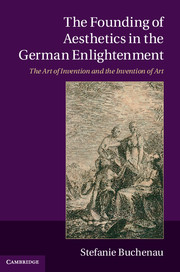
The Founding of Aesthetics in the German Enlightenment
When, in 1735, Alexander Gottlieb Baumgarten added a new discipline to the philosophical system, he not only founded modern aesthetics but also contributed to shaping the modern concept of art or 'fine art'. In The Founding of Aesthetics in the German Enlightenment, Stefanie Buchenau offers a rich analysis and reconstruction of the origins of this new discipline in its wider context of German Enlightenment philosophy. Present-day scholars commonly regard Baumgarten's views as an imperfect prefiguration of Kantian and post-Kantian aesthetics, but Buchenau argues that Baumgarten defended a consistent and original project which must be viewed in the context of the modern debate on the art of invention. Her book offers new perspectives on Kantian aesthetics and beauty in art and science.
eBook

China in the German Enlightenment
\"Over the course of the eighteenth century, European intellectuals shifted from admiring China as a utopian place of wonder to despising it as a backwards and despotic state. That transformation had little to do with changes in China itself, and everything to do with Enlightenment conceptions of political identity and Europe's own burgeoning global power. China in the German Enlightenment considers the place of German philosophy, particularly the work of Leibniz, Goethe, Herder, and Hegel, in this development. Beginning with the first English translation of Walter Demel's classic essay \"How the Chinese Became Yellow,\" the collection's essays examine the connections between eighteenth-century philosophy, German Orientalism, and the origins of modern race theory.\"-- Provided by publisher.
Book

Exorcism and Enlightenment
In the late eighteenth century, Catholic priest Johann Joseph Gassner (1727-1779) discovered that he had extraordinary powers of exorcism. Deciding that demons were responsible for most human ailments, he healed thousands, rich and poor, Protestant and Catholic. In this book H. C. Erik Midelfort delves deeply into records of the time to explore Gassner's remarkable exorcising campaign, chronicle the official efforts to curb him, and reconstruct the sufferings of the afflicted.
Gassner's activities triggered a Catholic religious revival as well as a noisy skeptical reaction. In response to those who doubted that he was really casting out demons, Gassner marshaled hundreds of eyewitness reports that seemed to prove his exorcisms really worked. Midelfort describes the enormous public controversy that resulted, and he demonstrates that the Gassner episode yields important insights into the German Enlightenment and Counter-Enlightenment, the limitations of eighteenth-century debate, and the ongoing role of magic and belief in an age of scientific enlightenment.
eBook


The Radical Enlightenment in Germany
This volume investigates the impact of Radical Enlightenment thought on German culture during the eighteenth century. It takes recent work by Jonathan Israel as its point of departure and debates the precise nature of Enlightenment.
eBook