
Catalogue Search | MBRL


Are you sure you want to remove the book from the shelf?

{{itemTitle}}
487
result(s) for
"Entrepreneurship fast"
Sort by:

Sustainable Entrepreneurship: How Entrepreneurs Create Value from Sustainable Opportunities
Sustainable Entrepreneurship: How entrepreneurs create value from sustainable opportunities offers unique new insights, represents a step towards the development of a more comprehensive analysis of sustainable entrepreneurship.
eBook
Innovation engines
In an uncertain economy where business risk is significant, the company tends to rely more on its environment than to invest, for example, in all steps of technological creation; This can be explained by the fact that investments in the acquisition (ownership) of production resources are less expensive than those implied in the formation of these resources; which also explains the attractiveness (in an open economy) of regions with abundant scientific and technical resources. To understand and analyze the innovation process in order to better design and launch new goods, services and technologies, one has to consider the creative dimension of the individual, the business and the organization in general. In new approaches to innovation, the entrepreneur and the company are analyzed through their skills, and their function of resource generation; Innovation thus becomes endogenous, gradual or radical, integrated in a complex process with many feedbacks and interactions. The innovative organization (small or large) is presented in this book as a dynamic system composed of specific and diverse skills (including those of the contractor, engineers or managers). By acquiring, combining and mobilizing these skills, the innovative agent (entrepreneur or company) can create technological resources and develop relations with its environment. Hence the importance of management in design, implementation, protection of intellectual property as well as of the development of new goods, services and technology, commercial and organizational models.
eBook

Jewish and Greek Communities in Egypt
In the years following Nasser's rise to power, the demographic landscape and the economy of Egypt underwent a profound change. Related to the migration of diverse communities, that had a distinguished role in Egyptian economy, from Egypt, these shifts have mostly been discussed in the light of postcolonial studies and the nationalisation policies in the wider region. Najat Abdulhaq focuses instead on the role that these minorities had in the economy of pre-Nasser Egypt and, by giving special attention to the Jewish and Greek communities residing in Egypt, investigates the dynamics of minorities involved in entrepreneurship and business. With rigorous analysis of the types of companies that were set up, Abdulhaq draws out the changes which were occurring in the political and social sphere at the time. This book, whilst primarily focused on the economic activities of these two minority communities, has implications for an understanding analysis of the political, the juridical, the intellectual and the cultural trends at the time. It thus offers vital analysis for those examining the economic history of Egypt, as well as the political and cultural transformations of the twentieth century in the region.
eBook

Biotechnology entrepreneurship : leading, managing and commercializing innovative technologies
This second edition of Biotechnology Entrepreneurship: Leading, Managing, and Commercializing Innovative Technologies is an authoritative, easy-to-read guide covering biotechnology entrepreneurship and the process of commercializing innovative biotechnology products.
eBook
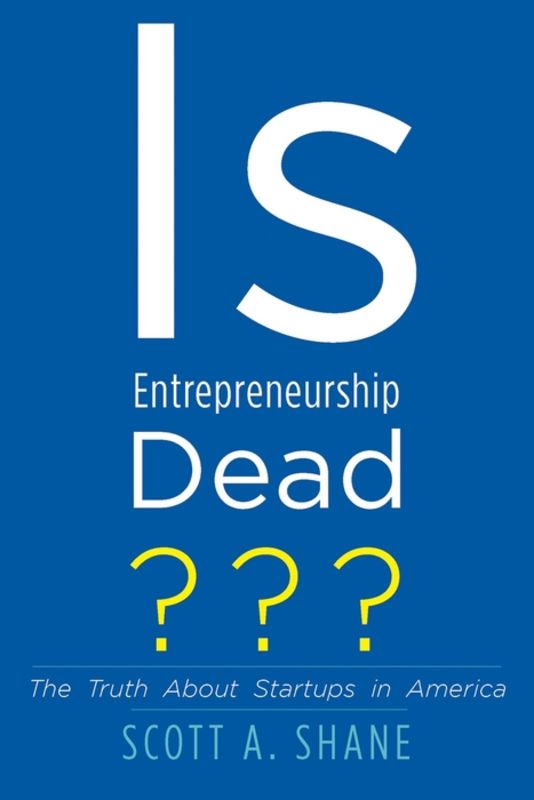
Is entrepreneurship dead? : the truth about startups in America
It's become an article of faith that American entrepreneurship is in trouble. The problems are many: lack of capital, too few entrepreneurial immigrants, excessive regulation, an aging population, slowing population growth, and rising student debt. But while experts across the country debate the causes and propose solutions, Scott Shane explains that the data just do not fit. Dismantling each of the most widely accepted theories in turn, he persuasively demonstrates that-while an evolving market is changing the nature of most startups-entrepreneurship is actually alive and well. Shane reveals how the number of incorporated startups is rising, fewer startups are failing, and the number of businesses backed by investors is increasing. The overall picture is positive. Exhaustively researched and compellingly told, this book will be read and discussed for years to come.
eBook

Embracing the “fail fast and learn fast” mindset: conceptualizing learning from failure in knowledge-intensive SMEs
“Fail fast and learn fast” is a principle commonly advanced to quickly grow and scale startups and SMEs. However, the literature lacks detailed insights into how such learning is organized. The paper aims to investigate how knowledge-intensive SMEs learn from failures through organizational learning processes. To answer this question, we present in-depth case studies of three SMEs that operate in a dynamic context where quick adaption to changes, failures, and learning are natural modes of practice. Our findings present the learning from the failure process, which includes three phases: (1) failure recognition, (2) interactive sensemaking, and (3) organizational adaptation. We condense our insights into a framework disentangling how SMEs succeed and fail and how they can learn from failures through their underlying learning processes. We contribute to prior literature on organizational learning in SMEs by focusing on knowledge-intensive SMEs and practices that enable effective learning from failures.
Plain English Summary
The “fail fast and learn fast” mindset provides an opportunity for an organization not only to experiment, make mistakes, and fail but also to learn from this experience and use it for future success. However, research has not yet managed to provide detailed insights into how such learning can best be organized and facilitated. In this article, we investigate how knowledge-intensive SMEs learn from failures through organizational learning processes. We show that SMEs should strive to learn from failure and that this learning can be organized over three phases: failure recognition, interactive sensemaking, and organizational adaptation; each with underlying sub-activities and principles. We contribute to prior literature on organizational learning by focusing on knowledge-intensive SMEs and describing practices that enable effective learning from failure. We also provide insights for managers on how to facilitate rapid learning from failure in their knowledge-intensive SMEs.
Journal Article

Conforming to the host country versus being distinct to our home countries
PurposeThe purpose of this paper is to examine how ethnic migrant entrepreneurs (EMEs) utilise identity work to build legitimacy in a host country. According to optimal distinctiveness theory (ODT), legitimacy is achieved by balancing conformance and distinctiveness. This paper draws on ODT in the context of ethnic migrant entrepreneurship to examine how EMEs both fit in (conformance) and maintain their uniqueness (distinctiveness) in cross-cultural settings.Design/methodology/approachThis study adopts a qualitative approach utilising semi-structured interviews to examine the identity work of EMEs from three distinct countries (Indonesia, Pakistan and South Korea (henceforth Korea)) in one host country (Malaysia).FindingsThe results show that EMEs’ identity work incorporates both the blurring and strengthening of host-home country boundaries. Building on this study’s results, the authors develop a model of identity work and three propositions regarding legitimacy building through identity in the context of ethnic migrant entrepreneurship.Originality/valueThrough the model and propositions, this research contributes to the identity, international entrepreneurship and ethnic migrant entrepreneurship discourse by identifying the mechanisms, focus and key features of identity work for entrepreneurs operating in cross-cultural settings. In so doing, this research also offers an alternative interpretation on the apparent divergent views around identity work in the fields of organisation (advocate isomorphism) and entrepreneurship (advocate uniqueness).
Journal Article
Global dynamics of immigrant entrepreneurship
PurposeThe purpose of this paper is to review the existing literature on immigrant entrepreneurship since the mid-2000s to examine the changing trends, variations and theoretical advances in immigrant entrepreneurship in Western societies.Design/methodology/approachUsing the SocIndex and Proquest Business Premium databases, the authors conducted a literature review of about 100 peer-reviewed articles published since the mid-2000s. The authors critically assess the main research findings, identify key concepts and models that have been developed over the past decade, and offer new theoretical insight into the ever-changing global dynamics of immigrant entrepreneurship. Although the focus is on the USA, the authors also include some seminal research based in other Western countries of immigrant reception.FindingsBased on a critical review of existing research that has been published between 2004 and the present, the authors highlight main trends and variations of the entrepreneurial endeavors among diasporic migrants, address the emerging forces shaping immigrant entrepreneurship, highlight theoretical advances in the field of entrepreneurship studies, and suggest new directions for future research. The authors note that the changing trends and ethnonational variations are caused not only by unequal access to human capital, social capital, financial capital, and cross-border venture capital on the part of individual entrepreneurs, but also by differences in broader structural circumstances in the home country and/or host country and interaction between national/local and transnational/global forces. The authors discuss new theoretical advances, identify gaps and raise questions for future research.Originality/valueThe review offers important insight into the ever-changing local and global dynamics of immigrant entrepreneurship and broadens the established conceptual and theoretical models in the sociology of immigrant/ethnic entrepreneurship.
Journal Article
Fast Fashion, Charities, and the Circular Economy: Challenges for Operations Management
Textile waste is one of the most pollutant items globally, being strongly affected by fast fashion (FF) products. Public pressure has made many FF firms voluntarily collect a small fraction of their preowned items and export them to developing countries for reuse. However, some developing countries are launching import bans on second-hand clothes. In addition, FF firms may soon be forced by extended producer responsibility legislation to collect more preowned items for reuse and recycling. To date, they do not have sufficient capacity to deal with this. Charities have been the key collectors and recyclers of unwanted clothes. Therefore, charities could help FF firms increase their capacity in this reverse supply chain (SC). However, we hardly witness such a collaboration for two main reasons: (i) charities prefer to sell high-quality preowned items in the primary market to generate the highest possible revenue and FF firms may fear cannibalization, (ii) many charities believe that FF firms generate quantities of low-quality items that require collection and sorting while being difficult to sell in the primary market. Charities also face competition from many small for-profit organizations selling FF preowned items. While charities have the support of volunteers, they tend to be less efficient. This work urges Operations Management (OM) researchers to suggest innovative business models to help (i) FF firms and charities collaborate to solve the abovementioned issues, and (ii) charities to improve their traditional practices for competitiveness. This study is primarily a position paper highlighting some challenges and introducing interesting research problems. Although the paper is not a research paper, it follows a qualitative research method to collect and analyze the required supporting documents to justify arguments and statements. We collected primary and secondary data from the textile reverse SC members to familiarize the OM community with this context. The cur
Paper

What are the fundamental knowledge-sharing drivers of small family businesses in the restaurant and fast-food industry?
PurposeDespite the undoubted role of knowledge in the small family business (FB) in the restaurant and fast-food industry, there are some main challenges in the knowledge-sharing (KS) orientation for promoting their business. This study tries to recognise and explore the drivers influencing these enterprises' KS processes.Design/methodology/approachThe authors applied combined exploratory and confirmatory analysis in two studies. In the first study, by the Delphi method, the 22 experts consisting of managers, FB owners and academic professors explore and forecast significant items and drivers. The second study is a confirmatory factor analysis (CFA) for validating the first study's indicators using the survey collected amongst 218 restaurants and fast foods employees.FindingsThe findings indicate 23 indicators in three main drivers of individual, organisational and technological, are critical for KS in small FBs in the investigated industry.Originality/valueThis research supports the understanding of knowledge management and the FB and contributes to recognising the influential factors for KS amongst small and medium-sized family businesses in the food-related industry. Also, by identifying and ranking the most significant factors, this research will help entrepreneurs facilitate FB entrepreneurship. Finally, the results provide practical implications for current and future KM and FB decision-makers.
Journal Article