
Catalogue Search | MBRL


Are you sure you want to remove the book from the shelf?

{{itemTitle}}
25,900
result(s) for
"Environmental Anthropology"
Sort by:
Shifting Livelihoods
Honorable Mention for the Society for the Anthropology of Work (SAW) Book PrizeThe many dimensions of gold in a shadow economyPeople employ various methods to extract gold in the rainforests of the Chocó, in northwest Colombia: Rural Afro-Colombian artisanal miners work hillsides with hand tools or dredge mud from river bottoms. Migrant miners level the landscape with excavators, then trap gold with mercury. Canadian mining companies prospect for open-pit mega-mines. Drug traffickers launder cocaine profits by smuggling gold into Colombia and claiming it came from fictitious small-scale mines.Through an ethnography of gold that examines the movement of people, commodities, and capital, Shifting Livelihoods investigates how resource extraction reshapes a place. In the Chocó, gold enables forms of \"shift\" (rebusque)-a metaphor for the fluid livelihood strategy adopted by forest dwellers and migrant gold miners alike as they seek informal work amid a drug war. Mining's effects on rural people, corporations, and politics are on view in this fine-grained account of daily life in a regional economy dominated by gold and cocaine.
eBook

Sustainability in the global city : myth and practice
\"Cities play a pivotal but paradoxical role in the future of our planet. As world leaders and citizens grapple with the consequences of growth, pollution, climate change, and waste, urban sustainability has become a ubiquitous catchphrase and a beacon of hope. Yet, we know little about how the concept is implemented in daily life - particularly with regard to questions of social justice and equity. This volume provides a unique and vital contribution to ongoing conversations about urban sustainability by looking beyond the promises, propaganda, and policies associated with the concept in order to explore both its mythic meanings and the practical implications in a variety of everyday contexts. The authors present ethnographic studies from cities in eleven countries and six continents. Each chapter highlights the universalized assumptions underlying interpretations of sustainability while elucidating the diverse and contradictory ways in which people understand, incorporate, advocate for, and reject sustainability in the course of their daily lives\"-- Provided by publisher.
Book

Thinking Like a River
The Kemi River is the major watercourse in the Finnish province of Lapland and the »stream of life« for the inhabitants of its banks. Franz Krause examines fishing, transport and hydropower on the Kemi River and analyses the profoundly rhythmic patterns in the river dwellers' activities and the river's dynamics. The course of the seasons and weekly and daily rhythms of discharge, temperature, work and other patterns make the river dwellers' world an ever-transforming phenomenon. The flows of life and the frictions of everyday encounters continually remake the river and its inhabitants, negotiating national strategies, economic power, people's ingenuity, and the currents of the Kemi River.
eBook

Environmental winds : making the global in Southwest China
\"The book challenges the notion that globalized social formations emerged solely in the Global North prior to impacting the Global South. Instead, such formations have been constituted, transformed, and propelled through diverse, site-specific social interactions that complicate and defy divisions between 'global' and 'local.' The book brings the reader into the lives of Chinese scientists, officials, villagers, and expatriate conservationists who were caught up in environmental trends over the past 25 years. Hathaway reveals how global environmentalism has been enacted and altered in China, often with unanticipated effects, such as the rise of indigenous rights, or the reconfiguration of human/animal relationships, fostering what rural villagers refer to as \"the revenge of wild elephants.\"\"-- Provided by publisher.
Book

Environmental Sustainability Generated by the Views of the Skolt Sami and Gregory Bateson
This article contributes to the debate about environmental sustainability, using the Skolt Sami conceptions of nature obligations as guides to this theme. The author’s recent research material is analysed in relation to other relevant publications and sources of environmental anthropology. Three key factors emerge: reasonableness in the use of natural resources, protection of nature, and respect for nature. Gregory Bateson’s models help to arrange these elements in relation to each other. It is argued here that respect for nature sets a scale for the conceptions of reasonableness and nature protection as the basis of environmental sustainability. The article produces questions and principles that may help put environmental sustainability into practice.
Journal Article


Human–Hyena (Crocuta crocuta) Conflict in the Tarangire Ecosystem, Tanzania
Interactions between people and large carnivores on shared landscapes can have harmful social and ecological consequences. Human–carnivore coexistence depends on an assemblage of sociological factors including effective management institutions that address the social costs of carnivore conservation and promote tolerance toward wildlife. In East Africa, large carnivores are particularly troublesome for herders who depend on livestock for subsistence and wellbeing. This paper provides an overview of human–hyena conflict in the Tarangire ecosystem of northern Tanzania. It presents descriptive results from a questionnaire survey (n = 1076) administered as part of an anthropological study (2019–2020; 2022; 2023) of human–wildlife interactions across twelve villages inhabited by Maasai agropastoralists. The survey instrument was designed through community-based participatory research methods to convey herder concerns about the impacts of spotted hyenas (Crocuta crocuta) on the livestock economy. Based on the perceptions and local ecological knowledge of Maasai interlocutors, the paper provides an overview of the spatial and temporal patterns of human–hyena interactions. Perceived frequencies of hyena attacks on kraaled livestock were unevenly distributed geographically, with those homesteads surrounding Manyara Ranch most heavily affected. Based on herder-reported livestock losses, the costs of depredation by spotted hyenas across the study area were estimated at approximately USD 904.84 per household per year. Most homesteads lacked fortified bomas and would benefit from the provision of lights and fencing materials to improve kraal structures. The paper’s central finding is that spotted hyenas represent a pressing, everyday concern for local pastoralists. Unsurprisingly, herders despise hyenas and are intolerant of sharing landscapes with them. For carnivore conservation outside protected areas to thrive in Tanzania, conservationists and policy makers must engage more meaningfully with the lived experiences of local herders who bear the brunt of conservation costs on their livelihoods.
Journal Article

On trails : an exploration
\"In 2009, while thru-hiking the Appalachian Trail, Robert Moor began to wonder about the paths that lie beneath our feet: How do they form? Why do some improve over time while others fade? What makes us follow or strike off on our own? Over the course of the next seven years, Moor traveled the globe, exploring trails of all kinds, from the miniscule to the massive. He learned the tricks of master trail-builders, hunted down long-lost Cherokee trails, and traced the origins of our road networks and the Internet. In each chapter, Moor interweaves his adventures with findings from science, history, philosophy, and nature writing--combining the nomadic joys of Peter Matthiessen with the eclectic wisdom of Lewis Hyde's The Gift. Throughout, Moor reveals how this single topic--the oft-overlooked trail--sheds new light on a wealth of age-old questions: How does order emerge out of chaos? How did animals first crawl forth from the seas and spread across continents? How has humanity's relationship with nature and technology shaped the world around us? And, ultimately, how does each of us pick a path through life? With a breathtaking arc that spans from the dawn of animal life to the digital era, On Trails is a book that makes us see our world, our history, our species, and our ways of life anew\"--Book jacket flap.
Book
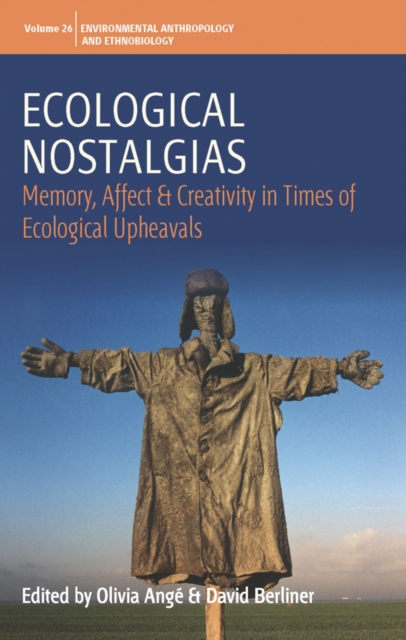
Ecological Nostalgias
Introducing the study of econostalgias through a variety of rich
ethnographic cases, this volume argues that a strictly human
centered approach does not account for contemporary longings
triggered by ecosystem upheavals. In this time of climate change,
this book explores how nostalgia for fading ecologies unfolds into
the interstitial spaces between the biological, the political and
the social, regret and hope, the past, the present and the
future.
eBook