
Catalogue Search | MBRL


Are you sure you want to remove the book from the shelf?

{{itemTitle}}
7,047
result(s) for
"Environmental engineering History."
Sort by:

The environmental imagination : technics and poetics of the architectural environment
\"The Environmental Imagination explores the relationship between tectonics and poetics in environmental design in architecture. Working thematically and chronologically from the eighteenth century to the present day, this book redefines the historiography of environmental design by looking beyond conventional histories to argue that the environments within buildings are a collaboration between poetic intentions and technical means. In a sequence of essays, the book traces a line through works by leading architects of the nineteenth and twentieth centuries that illustrate the impact of new technologies on the conception and realisation of environments in buildings. In this, a consideration of the qualitative dimension of environment is added to the primarily technological narratives of other accounts. In this second edition, the book has been substantially rewritten and restructured to include further research conducted in the decade since the first edition. A number of important buildings have been revisited, in order to extend the descriptions of their environments, and studies have been made of a number of newly studied, significant buildings. A completely new essay offers an environmental interpretation of Luis Barrâagan's magical own house in Mexico City and the earlier studies of buildings by Peter Zumthor have been gathered into a single, extended essay that includes a body of new research. On the fiftieth anniversary of the publication of Reyner Banham's, The Architecture of the Well-tempered Environment, the book concludes with a critical tribute to that seminal text. The Environmental Imagination will appeal to academics and practitioners with interests in the history, theory and technology of architecture\"-- Provided by publisher.
Book

Mercury, Mining, and Empire
On the basis of an examination of the colonial mercury and
silver production processes and related labor systems, Mercury,
Mining, and Empire explores the effects of mercury pollution in
colonial Huancavelica, Peru, and Potosí, in present-day Bolivia.
The book presents a multifaceted and interwoven tale of what
colonial exploitation of indigenous peoples and resources left in
its wake. It is a socio-ecological history that explores the toxic
interrelationships between mercury and silver production, urban
environments, and the people who lived and worked in them. Nicholas
A. Robins tells the story of how native peoples in the region were
conscripted into the noxious ranks of foot soldiers of
proto-globalism, and how their fate, and that of their communities,
was-and still is-chained to it.
eBook

Engineering the environment : phytotrons and the quest for climate control in the Cold War
\"This is the first history of phytotrons: huge climate-controlled laboratories that enabled plant scientists to experiment on the environmental causes of growth and development of living organisms. Made possible by computers and other modern technologies of the early Cold War, such as air conditioning and humidity control, phytotrons promised an end to global hunger and political instability, spreading around the world to thirty countries after World War II. The United States built nearly a dozen, including the first at Caltech in 1949. By the mid-1960s, as support and funding for basic science dwindled, phytotrons declined and ultimately disappeared--until, nearly thirty years later, the British built the Ecotron to study the impact of climate change on biological communities. By recalling the forgotten history of phytotrons, David P.D. Munns reminds us of the important role they can play in helping researchers unravel the complexities of natural ecosystems in the Anthropocene\"--Provided by publisher.
Book

Tainted Earth
Smelting is an industrial process involving the extraction of metal from ore. During this process, impurities in ore-including arsenic, lead, and cadmium-may be released from smoke stacks, contaminating air, water, and soil with toxic-heavy metals.
The problem of public health harm from smelter emissions received little official attention for much for the twentieth century. Though people living near smelters periodically complained that their health was impaired by both sulfur dioxide and heavy metals, for much of the century there was strong deference to industry claims that smelter operations were a nuisance and not a serious threat to health. It was only when the majority of children living near the El Paso, Texas, smelter were discovered to be lead-exposed in the early 1970s that systematic, independent investigation of exposure to heavy metals in smelting communities began. Following El Paso, an even more serious led poisoning epidemic was discovered around the Bunker Hill smelter in northern Idaho. In Tacoma, Washington, a copper smelter exposed children to arsenic-a carcinogenic threat.
Thoroughly grounded in extensive archival research,Tainted Earthtraces the rise of public health concerns about nonferrous smelting in the western United States, focusing on three major facilities: Tacoma, Washington; El Paso, Texas; and Bunker Hill, Idaho. Marianne Sullivan documents the response from community residents, public health scientists, the industry, and the government to pollution from smelters as well as the long road to protecting public health and the environment. Placing the environmental and public health aspects of smelting in historical context, the book connects local incidents to national stories on the regulation of airborne toxic metals.
The nonferrous smelting industry has left a toxic legacy in the United States and around the world. Unless these toxic metals are cleaned up, they will persist in the environment and may sicken people-children in particular-for generations to come. The twentieth-century struggle to control smelter pollution shares many similarities with public health battles with such industries as tobacco and asbestos where industry supported science created doubt about harm, and reluctant government regulators did not take decisive action to protect the public's health.
eBook

Epidemics, empire, and environments : cholera in Madras and Quebec City, 1818-1910
\"Throughout the nineteenth century, cholera was a global scourge against human populations. Practitioners had little success in mitigating the symptoms of the disease, and its causes were bitterly disputed. What experts did agree on was that the environment played a crucial role in the sites where outbreaks occurred. In this book, Michael Zeheter offers a probing case study of the environmental changes made to fight cholera in two markedly different British colonies: Madras in India and Quebec City in Canada. The colonial state in Quebec aimed to emulate British precedent and develop similar institutions that allowed authorities to prevent cholera by imposing quarantines and controlling the disease through comprehensive change to the urban environment and sanitary improvements. In Madras, however, the provincial government sought to exploit the colony for profit and was reluctant to commit its resources to measures against cholera that would alienate the city's inhabitants. It was only in 1857, after concern rose in Britain over the health of its troops in India, that a civilizing mission of sanitary improvement was begun. As Zeheter shows, complex political and economic factors came to bear on the reshaping of each colony's environment and the urgency placed on disease control\"-- Provided by publisher.
Book

A Companion to Global Environmental History
The Companion to Global Environmental History offers multiple points of entry into the history and historiography of this dynamic and fast-growing field, to provide an essential road map to past developments, current controversies, and future developments for specialists and newcomers alike. * Combines temporal, geographic, thematic and contextual approaches from prehistory to the present day * Explores environmental thought and action around the world, to give readers a cultural, intellectual and political context for engagement with the environment in modern times * Brings together environmental historians from around the world, including scholars from South Africa, Brazil, Germany, and China
eBook

Energy capitals : local impact, global influence
\"Fossil fuels propelled industries and nations into the modern age and continue to powerfully influence economies and politics today. As Energy Capitals demonstrates, the discovery and exploitation of fossil fuels has proven to be a mixed blessing in many of the cities and regions where it has occurred. With case studies from the United States, Canada, Mexico, Norway, Africa, and Australia, this volume views a range of older and more recent energy capitals, contrasts their evolutions, and explores why some capitals were able to influence global trends in energy production and distribution while others failed to control even their own destinies. Chapters show how local and national politics, social structures, technological advantages, education systems, capital, infrastructure, labor force, supply and demand, and other factors have affected the ability of a region to develop and control its own fossil fuel reserves. The contributors also view the environmental impact of energy industries and demonstrate how, in the depletion of reserves or a shift to new energy sources, regions have or have not been able to recover economically. The cities of Tampico, Mexico, and Port Gentil, Gabon, have seen their oil deposits exploited by international companies with little or nothing to show in return and at a high cost environmentally. At the opposite extreme, Houston, Texas, has witnessed great economic gain from its oil, natural gas, and petrochemical industries. Its growth, however, has been tempered by the immense strain on infrastructure and the human transformation of the natural environment. In another scenario, Perth, Australia, Calgary, Alberta, and Stavanger, Norway have benefitted as the closest established cities with administrative and financial assets for energy production that was developed hundreds of miles away. Whether coal, oil, or natural gas, the essays offer important lessons learned over time and future considerations for the best ways to capture the benefits of energy development while limiting the cost to local populations and environments. \"-- Provided by publisher.
Book

Historical baselines in marine bioinvasions: Implications for policy and management
The human-mediated introduction of marine non-indigenous species is a centuries- if not millennia-old phenomenon, but was only recently acknowledged as a potent driver of change in the sea. We provide a synopsis of key historical milestones for marine bioinvasions, including timelines of (a) discovery and understanding of the invasion process, focusing on transfer mechanisms and outcomes, (b) methodologies used for detection and monitoring, (c) approaches to ecological impacts research, and (d) management and policy responses. Early (until the mid-1900s) marine bioinvasions were given little attention, and in a number of cases actively and routinely facilitated. Beginning in the second half of the 20th century, several conspicuous non-indigenous species outbreaks with strong environmental, economic, and public health impacts raised widespread concerns and initiated shifts in public and scientific perceptions. These high-profile invasions led to policy documents and strategies to reduce the introduction and spread of non-indigenous species, although with significant time lags and limited success and focused on only a subset of transfer mechanisms. Integrated, multi-vector management within an ecosystem-based marine management context is urgently needed to address the complex interactions of natural and human pressures that drive invasions in marine ecosystems.
Journal Article
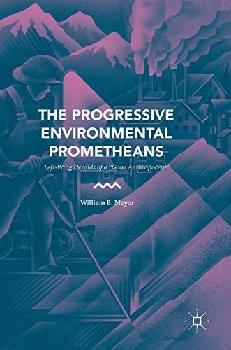
The progressive environmental Prometheans : left-wing heralds of a \good anthropocene\
This book is devoted to the exploration of environmental Prometheanism, the belief that human beings can and should master nature and remake it for the better. Meyer considers, among others, the question of why Prometheanism today is usually found on the political right while environmentalism is on the left. Chapters examine the works of leading Promethean thinkers of nineteenth and early and mid-twentieth century Britain, France, America, and Russia and how they tied their beliefs about the earth to a progressive, left-wing politics. Meyer reconstructs the logic of this \"progressive Prometheanism\" and the reasons it has vanished from the intellectual scene today. The Progressive Environmental Prometheans broadens the reader's understanding of the history of the ideas behind Prometheanism. This book appeals to anyone with an interest in environmental politics, environmental history, global history, geography and Anthropocene studies. William B. Meyer is Associate Professor of Geography at Colgate University. He is the author of Human Impact on the Earth (1996), Americans and Their Weather: A History (2000; updated edition, 2014), and The Environmental Advantages of Cities (2013), as well as numerous journal articles and book chapters.
Book

Fault Lines
Earth's fractured geology is visible in its fault lines. It is along these lines that earthquakes occur, sometimes with disastrous effects. These disturbances can significantly influence urban development, as seen in the aftermath of two earthquakes in Messina, Italy, in 1908 and in the Belice Valley, Sicily, in 1968. Following the history of these places before and after their destruction, this book explores plans and developments that preceded the disasters and the urbanism that emerged from the ruins. These stories explore fault lines between \"rural\" and \"urban,\" \"backwardness\" and \"development,\" and \"before\" and \"after,\" shedding light on the role of environmental forces in the history of human habitats.
eBook