
Catalogue Search | MBRL


Are you sure you want to remove the book from the shelf?

{{itemTitle}}
46,835
result(s) for
"Environmental ethics"
Sort by:


The Influence of Corporate Environmental Ethics on Competitive Advantage: The Mediation Role of Green Innovation
This study utilizes structural equation modeling (SEM) to explore the positive effect of corporate environmental ethics on competitive advantage in the Taiwanese manufacturing industry via the mediator: green innovation performance. This study divides green innovation into green product innovation and green process innovation. The empirical results show that corporate environmental ethics positively affects green product innovation and green process innovation. In addition, this study verifies that green product innovation mediates the positive relationship between corporate environmental ethics and competitive advantage, but green process innovation does not. Therefore, corporate environmental ethics can not only affect competitive advantage directly, but also influence it indirectly via green product innovation in the Taiwanese manufacturing industry. Taiwanese manufacturing companies can increase their corporate environmental ethics and green product innovation to enhance their competitive advantages.
Journal Article

Moral ground : ethical action for a planet in peril
Bringing together the testimony of over 80 visionaries--from religious leaders to scientists to elected officials--this book encourages a newly discovered, or rediscovered, commitment to consensus about our ethical obligation to the future and why it's wrong to wreck the world.
Book

Environmental Health Ethics
Environmental Health Ethics illuminates the conflicts between protecting the environment and promoting human health. In this study, David B. Resnik develops a method for making ethical decisions on environmental health issues. He applies this method to various issues, including pesticide use, antibiotic resistance, nutrition policy, vegetarianism, urban development, occupational safety, disaster preparedness and global climate change. Resnik provides readers with the scientific and technical background necessary to understand these issues. He explains that environmental health controversies cannot simply be reduced to humanity versus environment and explores the ways in which human values and concerns - health, economic development, rights and justice - interact with environmental protection.
eBook
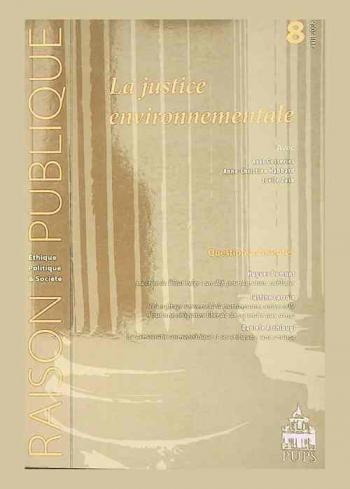
La justice environnementale
Le point sur la definition et les enjeux contemporains de la justice environnementale. Avec au sommaire : Les theories de la justice intergenerationnelle. Synopsis a l'usage des durabilistes presses (A. Gosseries) ; L'ethique environnementale : la defaite du politique ? (A. C. Habbard) ; Questions environnementales et participations democratiques (J. Zask)
Book

Exploring corporate environmental ethics and green creativity as antecedents of green competitive advantage, sustainable production and financial performance: empirical evidence from manufacturing firms
PurposeEnvironmental degradation in emerging economies has induced stakeholder pressures on diverse firms to ensure sustainable business performance. Consequently, firms are adopting environmentally ethical cultures and reinforcing green creativity to satisfy stakeholders' environmental needs while attaining green competitive advantage, sustainable production and higher financial performance. The purpose of this study is to investigate whether corporate environmental ethics and green creativity serve as antecedents to higher competitiveness, sustainable production and financial performance, and also examine if green competitive advantage and sustainable production mediate the relationships between corporate environmental ethics, green creativity and financial performance in the context of an emerging economy.Design/methodology/approachThis study using a survey approach examined data from 290 manufacturing small and medium-sized enterprises. Data were analyzed and interpreted using SmartPLS 3.0 software, a variance-based structural equation modelling technique. This modelling technique was adopted due to its suitability for predictive research models.FindingsThe findings show that corporate environmental ethics and green creativity are critical antecedents to green competitive advantage, sustainable production and financial performance. The results connote that while corporate environmental ethics and green creativity directly and robustly influence green competitive advantage, sustainable production and financial performance, their effect on financial performance is strengthened via the indirect effects of green competitive advantage and sustainable production. Contrasting past findings, corporate environmental ethics negatively related to financial performance in this study context. The findings indicate that the integration of environmental ethics and green creativity can be a unique strategy for mitigating environmental negative risks while improving green competitive advantage, sustainable production and financial performance.Originality/valueThe study is among the few that draws insights from organizational ethics and the natural resource-based view (NRBV) to examine the interactions between corporate environmental ethics, green creativity, green competitive advantage, sustainable production and financial performance. Drawing insights from the findings, the study provides suggestions for managers, academicians, policymakers and governments as well as highlights implications and directions for future research.
Journal Article


Fostering environmental preservation: exploring the synergy of green human resource management and corporate environmental ethics
Purpose
This study aims to explore the unique and synergistic effects of green human resource management (GHRM) and corporate environmental ethics (CEE) on the environmental performance (EP) of manufacturing small and medium-sized enterprises (SMEs) in Yemen, a less developed country (LDC).
Design/methodology/approach
Through a cross-sectional survey design, data were collected from 262 manufacturing SMEs in Yemen and analyzed using “hierarchical regression analysis” via PROCESS Macro.
Findings
The empirical results showed that GHRM and CEE positively affect EP and, more importantly, that CEE and GHRM have a synergistic effect on EP.
Research limitations/implications
This study makes a theoretical contribution by integrating GHRM, CEE and EP into a single framework, taking into account the perspectives of the resource-based view and the ethical theory of organizing. The results corroborate the unique and synergistic effects of GHRM and CEE on EP of SMEs in the manufacturing sector.
Practical implications
The results of this study offer valuable insights for SME managers/decision-makers, who are anticipated to become more interested in integrating environmental ethics into their companies. This has implications that with the consideration of CEE, SMEs can benefit from GHRM practices to improve their EP.
Social implications
The study highlights the positive economic and social impact of SMEs adopting eco-friendly practices like GRHM. In today’s economy, it is not sufficient to simply strive for economic growth. It is possible for SMEs to achieve well-rounded performance by implementing the recommended framework that emphasizes the importance of social and environmental well-being.
Originality/value
This study advances the existing work on the impact of GHRM on EP by demonstrating the crucial role of CEE in predicting EP of manufacturing SMEs in LDCs like Yemen. Previous research on GHRM has mainly been conducted on SMEs in developed nations, which may not be entirely applicable to LDCs. It is crucial to understand this aspect in the context of LDCs so that SMEs can adopt environmental practices effectively in the future: how SMEs conserve the environment through their environmental practices.
Journal Article


Greening the cubicle: unraveling the impact of corporate environmental ethics on employees’ green innovative behavior through the affective events theory
Previous research has acknowledged that employees’ Green Innovative Behavior (GIB) is a pivotal driver for organizations striving towards sustainable development. However, the comprehensive understanding of its antecedents and underlying mechanisms remains insufficient. In response, drawing upon the Affective Events Theory (AET), our investigation establishes a moderated sequential mediation model to delve into the psychological processes by which Corporate Environmental Ethics (CEE) stimulate employees’ GIB. Derived from a cohort of 358 employees in the manufacturing sector, our findings indicate a positive influence of CEE on employees’ GIB, with environmental passion and environmental commitment serving as sequential mediators in the relationship. Particularly noteworthy is that personal innovativeness weakens the positive impact of CEE on environmental passion, suggesting a certain degree of substitution between personal innovativeness and CEE regarding environmental passion. Furthermore, this moderating effect extends to the sequential stages of environmental passion and environmental commitment, exerting indirect influences on employees’ GIB. Our study provides valuable insights into the relationship between CEE and employees’ GIB from affective perspectives, while also offering empirical evidence to support organizations in driving employees’ GIB.
Journal Article