
Catalogue Search | MBRL


Are you sure you want to remove the book from the shelf?

{{itemTitle}}
529
result(s) for
"Environmental policy -- Germany -- History"
Sort by:

The Age of Smoke
In 1880, coal was the primary energy source for everything from home heating to industry. Regions where coal was readily available, such as the Ruhr Valley in Germany and western Pennsylvania in the United States, witnessed exponential growth-yet also suffered the greatest damage from coal pollution.These conditions prompted civic activism in the form of \"anti-smoke\" campaigns to attack the unsightly physical manifestations of coal burning. This early period witnessed significant cooperation between industrialists, government, and citizens to combat the smoke problem. It was not until the 1960s, when attention shifted from dust and grime to hazardous invisible gases, that cooperation dissipated, and protests took an antagonistic turn.The Age of Smokepresents an original, comparative history of environmental policy and protest in the United States and Germany. Dividing this history into distinct eras (1880 to World War I, interwar, post-World War II to 1970), Frank Uekoetter compares and contrasts the influence of political, class, and social structures, scientific communities, engineers, industrial lobbies, and environmental groups in each nation. He concludes with a discussion of the environmental revolution, arguing that there were indeed two environmental revolutions in both countries: one societal, where changing values gave urgency to air pollution control, the other institutional, where changes in policies tried to catch up with shifting sentiments.Focusing on a critical period in environmental history,The Age of Smokeprovides a valuable study of policy development in two modern industrial nations, and the rise of civic activism to combat air pollution. As Uekoetter's work reveals, the cooperative approaches developed in an earlier era offer valuable lessons and perhaps the best hope for future progress.
eBook


How green were the Nazis?
Annotation, The first book to examine the Third Reich's environmental policies and to offer an in-depth exploration of the intersections between brown ideologies and green practices
eBook
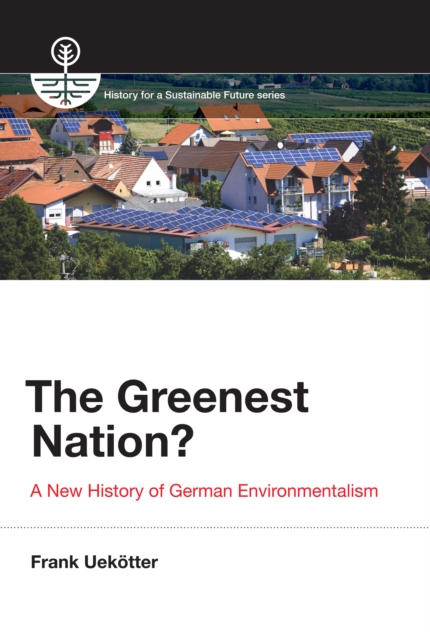
The Greenest Nation?
Germany enjoys an enviably green reputation. Environmentalists in other countries applaud its strict environmental laws, its world-class green technology firms, its phase-out of nuclear power, and its influential Green Party. Germans are proud of these achievements, and environmentalism has become part of the German national identity. InThe Greenest Nation?Frank Uekötter offers an overview of the evolution of German environmentalism since the late nineteenth century. He discusses, among other things, early efforts at nature protection and urban sanitation, the Nazi experience, and civic mobilization in the postwar years. He shows that much of Germany's green reputation rests on accomplishments of the 1980s, and emphasizes the mutually supportive roles of environmental nongovernmental organizations, corporations, and the state. Uekötter looks at environmentalism in terms of civic activism, government policy, and culture and life, eschewing the usual focus on politics, prophets, and NGOs. He also views German environmentalism in an international context, tracing transnational networks of environmental issues and actions and discussing German achievements in relation to global trends. Bringing his discussion up to the present, he shows the influence of the past on today's environmental decisions. As environmentalism is wrestling with the challenges of the twenty-first century, Germany could provide a laboratory for the rest of the world.
eBook

THE ECONOMICS OF DENSITY: EVIDENCE FROM THE BERLIN WALL
This paper develops a quantitative model of internal city structure that features agglomeration and dispersion forces and an arbitrary number of heterogeneous city blocks. The model remains tractable and amenable to empirical analysis because of stochastic shocks to commuting decisions, which yield a gravity equation for commuting flows. To structurally estimate agglomeration and dispersion forces, we use data on thousands of city blocks in Berlin for 1936, 1986, and 2006 and exogenous variation from the city's division and reunification. We estimate substantial and highly localized production and residential externalities. We show that the model with the estimated agglomeration parameters can account both qualitatively and quantitatively for the observed changes in city structure. We show how our quantitative framework can be used to undertake counterfactuals for changes in the organization of economic activity within cities in response, for example, to changes in the transport network.
Journal Article

Environmental organizations in modern Germany
German environmental organizations have doggedly pursued environmental protection through difficult times: hyperinflation and war, National Socialist rule, postwar devastation, state socialism in the GDR, and confrontation with the authorities during the 1970s and 1980s. The author recounts the fascinating and sometimes dramatic story of these organizations from their origins at the end of the nineteenth century to the present, not only describing how they reacted to powerful social movements, including the homeland protection and socialist movements in the early years of the twentieth century, the Nazi movement, and the anti-nuclear and new social movements of the 1970s and 1980s, but also examining strategies for survival in periods like the current one, when environmental concerns are not at the top of the national agenda. Previous analyses of environmental organizations have almost invariably viewed them as parts of larger social structures, that is, as components of social movements, as interest groups within a political system, or as contributors to civil society. This book, by contrast, starts from the premise that through the use of theories developed specifically to analyze the behavior of organizations and NGOs we can gain additional insight into why environmental organizations behave as they do.
eBook

Socio-technical Change and the Politics of Urban Infrastructure
This paper reconstructs the trajectory of energy efficiency policies in Berlin from the 1920s to today in order to illustrate how the shifting political and socioeconomic conditions of a city can shape urban energy provision and consumption. Taking a long-term perspective on the relationship between urban transitions and energy policy, it investigates how the geo-political turbulence, regime diversity and socioeconomic volatility experienced by 20th-century Berlin influenced strategies of electricity generation and use in the city. Drawing on different ways of conceptualising change to socio-technical systems in the literature, the paper's findings present a more differentiated picture of urban energy transitions than notions of path dependency and transition pathways imply, highlighting the importance of non-linear trends, political contestation and crisis discourses in and beyond the city and their relevance for reconfiguring urban energy systems today.
Journal Article

Pigou in the 21st Century: a tribute on the occasion of the 100th anniversary of the publication of The Economics of Welfare
The year 2020 marks the centennial of the publication of Arthur Cecil Pigou’s magnum opus The Economics of Welfare. Pigou’s pricing principles have had an enduring influence on the academic debate, with a widespread consensus having emerged among economists that Pigouvian taxes or subsidies are theoretically desirable, but politically infeasible. In this article, we revisit Pigou’s contribution and argue that this consensus is somewhat spurious, particularly in two ways: (1) Economists are too quick to ignore the theoretical problems and subtleties that Pigouvian pricing still faces; (2) The wholesale skepticism concerning the political viability of Pigouvian pricing is at odds with its recent practical achievements. These two points are made by, first, outlining the theoretical and political challenges that include uncertainty about the social cost of carbon, the unclear relationship between the cost–benefit and cost-effectiveness approaches, distributional concerns, fragmented ministerial responsibilities, an unstable tax base, commitment problems, lack of acceptance and trust between government and citizens as well as incomplete international cooperation. Secondly, we discuss the recent political success of Pigouvian pricing, as evidenced by the German government’s 2019 climate policy reform and the EU’s Green Deal. We conclude by presenting a research agenda for addressing the remaining barriers that need to be overcome to make Pigouvian pricing a common political practice.
Journal Article
Bicycle Use in Germany: Explaining Differences between Municipalities with Social Network Effects
This paper aims to account for important factors influencing bicycle use and focuses in particular on differences between 20 selected German municipalities with considerable variation in their bicycle mode share. Using data from the nation-wide survey Mobility in Germany 2002, a mode choice model for bicycling is developed. In an extension to previous research, social network or spillover effects as a measure of the city's bicycling culture are also taken into account. These effects are modelled using an instrumental variable approach. It is shown that social network effects increase the probability of cycling for shopping and recreational trip purposes, but not for school, work or errands. Furthermore, it is found that cycling infrastructure matters only for shopping and errand trips. Finally, commuting trips by bicycle seem to be largely independent of any policy variables.
Journal Article