
Catalogue Search | MBRL


Are you sure you want to remove the book from the shelf?

{{itemTitle}}
34,266
result(s) for
"Environmental policy -- United States"
Sort by:

Critical government documents on the environment
\"Although the earth has been around for millions of years, humans have only been seriously interested in protecting and preserving the environment for less than 200 years; the terms \"conservationism\" and \"environmentalism\" are little more than 100 years old. The Industrial Revolution brought with it many benefits such as the production of coal, steel, cement, and mass-produced chemicals and fertilizers; it also brought pollution and, shortly thereafter, a serious concern for the environment. This book presents the most up-to-date government information on various environmental topics. Critical Government Documents on the Environment presents official governmental positions on many of the leading environmental issues facing us today. All the material in this book is from published sources, including: Environmental Protection Agency, Department of the Interior, Department of Energy, Department of Agriculture, Department of Health and Human Services, the White House, National Aeronautics and Space Administration, National Oceanic and Atmospheric Administration, National Weather Service, U.S. Global Change Research Program, U.S. Geological Survey. This book does not offer any new science but attempts to present important government information on various issues facing our environment. Areas covered include global warming and greenhouse gases, water, air and marine pollution, and renewable energy. It includes a timeline of important environmental events over the last 200 years and has an extensive glossary of environmental terms.\"--Page 4 of cover.
Book

Environmental Politics in Japan, Germany, and the United States
A decade of climate change negotiations almost ended in failure because of the different policy approaches of the industrialized states. Japan, Germany, and the United States exemplify the deep divisions that exist among states in their approaches to environmental protection. Germany is following what could be called the green social welfare state approach to environmental protection, which is increasingly guided by what is known as the precautionary principle. In contrast, the US is increasingly leaning away from the use of environmental regulations, towards the use of market-based mechanisms to control pollution and cost-benefit analysis to determine when environmental protection should take precedence over economic activities. Internal political divisions mean that Japan sits uneasily between these two approaches. Miranda A. Schreurs uses a variety of case studies to explore why these different policy approaches emerged and what their implications are, examining the differing ideas, actors, and institutions in each state.
eBook


The Promise of Wilderness
From Denali's majestic slopes to the Great Swamp of central New Jersey, protected wilderness areas make up nearly twenty percent of the parks, forests, wildlife refuges, and other public lands that cover a full fourth of the nation's territory. But wilderness is not only a place. It is also one of the most powerful and troublesome ideas in American environmental thought, representing everything from sublime beauty and patriotic inspiration to a countercultural ideal and an overextension of government authority.
The Promise of Wilderness examines how the idea of wilderness has shaped the management of public lands since the passage of the Wilderness Act in 1964. Wilderness preservation has engaged diverse groups of citizens, from hunters and ranchers to wildlife enthusiasts and hikers, as political advocates who have leveraged the resources of local and national groups toward a common goal. Turner demonstrates how these efforts have contributed to major shifts in modern American environmental politics, which have emerged not just in reaction to a new generation of environmental concerns, such as environmental justice and climate change, but also in response to changed debates over old conservation issues, such as public lands management. He also shows how battles over wilderness protection have influenced American politics more broadly, fueling disputes over the proper role of government, individual rights, and the interests of rural communities; giving rise to radical environmentalism; and playing an important role in the resurgence of the conservative movement, especially in the American West.
Watch the book trailer: https://www.youtube.com/watch?v=Jsq-6LAeYKk
eBook

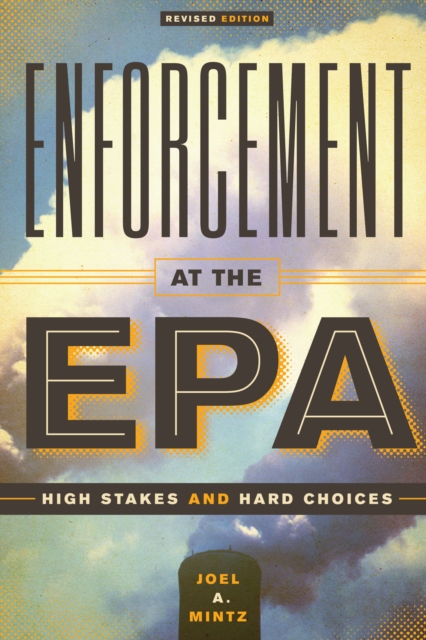
Enforcement at the EPA : high stakes and hard choices
The only published work that treats the historical evolution of EPA enforcement, this book provides a candid inside glimpse of a crucial aspect of the work of an important federal agency. Based on 190 personal interviews with present and former enforcement officials at EPA, the U.S. Department of Justice, and key congressional staff members-along with extensive research among EPA documents and secondary sources-the book vividly recounts the often tumultuous history of EPA's enforcement program. It also analyzes some important questions regarding EPA's institutional relationships and the Agency's working environment. This revised and updated edition adds substantial new chapters examining EPA enforcement during the Clinton and George W. Bush administrations. Its treatment of issues of civil service decline and the applicability of captive agency theory is also new and original.
eBook


Public participation in environmental assessment and decision making
Federal agencies have taken steps to include the public in a wide range of environmental decisions. Although some form of public participation is often required by law, agencies usually have broad discretion about the extent of that involvement. Approaches vary widely, from holding public information-gathering meetings to forming advisory groups to actively including citizens in making and implementing decisions.
Proponents of public participation argue that those who must live with the outcome of an environmental decision should have some influence on it. Critics maintain that public participation slows decision making and can lower its quality by including people unfamiliar with the science involved.
This book concludes that, when done correctly, public participation improves the quality of federal agencies' decisions about the environment. Well-managed public involvement also increases the legitimacy of decisions in the eyes of those affected by them, which makes it more likely that the decisions will be implemented effectively. This book recommends that agencies recognize public participation as valuable to their objectives, not just as a formality required by the law. It details principles and approaches agencies can use to successfully involve the public.
eBook

Breakpoint : reckoning with America's environmental crises
\"An insightful look at the American environmental crisis and emerging solutions from the heartland to the coasts in the era of global climate change. Eminent ecologist Jeremy B. C. Jackson and award-winning journalist Steve Chapple traveled the length of the Mississippi River interviewing farmers, fishermen, scientists, and policymakers to better understand the mounting environmental problems ravaging the United States. Along their journey, which quickly expanded to California, Florida, and New York, the pair uncovered surprising and profound connections between ecological systems and environmental crises across the country. Artfully weaving together independent research and engaging storytelling, Jackson and Chapple examine the looming threats from recent hurricanes and fires, industrial agriculture, river mismanagement, extreme weather events, drought, and rising sea levels that are pushing the country toward the breaking point of ecological and economic collapse. Yet, despite these challenges, the authors provide optimistic and practical solutions for addressing these multidimensional issues to achieve greater environmental stability, human well-being, and future economic prosperity. With a passionate call to action, they look hopefully toward emerging and achievable solutions to preserve the country's future\"--Jacket.
Book

The Greening of the U.S. Military
By the Cold War's end, U.S. military bases harbored nearly 20,000 toxic waste sites. All told, cleaning the approximately 27 million acres is projected to cost hundreds of billions of dollars. And yet while progress has been made, efforts to integrate environmental and national security concerns into the military's operations have proven a daunting and intrigue-filled task that has fallen short of professed goals in the post-Cold War era. InThe Greening of the U.S. Military, Robert F. Durant delves into this too-little understood world of defense environmental policy to uncover the epic and ongoing struggle to build an environmentally sensitive culture within the post-Cold War military. Through over 100 interviews and thousands of pages of documents, reports, and trade newsletter accounts, he offers a telling tale of political, bureaucratic, and intergovernmental combat over the pace, scope, and methods of applying environmental and natural resource laws while ensuring military readiness. He then discerns from these clashes over principle, competing values, and narrow self-interest a theoretical framework for studying and understanding organizational change in public organizations. From Dick Cheney's days as Defense Secretary under President George H. W. Bush to William Cohen's Clinton-era-tenure and on to Donald Rumsfeld's Pentagon, the battle over \"greening\" the military has been one with high-stakes consequences for both national defense and public health, safety, and the environment. Durant's polity-centered perspective and arguments will evoke needed scrutiny, debate, and dialogue over these issues in environmental, military, policymaking, and academic circles.
eBook