
Catalogue Search | MBRL


Are you sure you want to remove the book from the shelf?

{{itemTitle}}
47,654
result(s) for
"Environmental responsibility."
Sort by:


Impact of Corporate Environmental Responsibility on Operating Income: Moderating Role of Regional Disparities in China
Although the same environmental regulations apply to all regions in China, legal enforcement can be different due to local economic development priorities. There is still a lack of knowledge about how regional disparities affect the operating performance results of the implementation of corporate environmental management practices, thus providing little information for foreign companies when they invest and develop their production base in China. To fill this research gap, this paper collects data from the Fortune 500 Chinese firms to investigate the moderating role of regional disparities in affecting the performance results of corporate environmental management efforts based on the institutional theory. The disclosed corporate environmental responsibility (CER) practices serve as proxy to represent corporate environmental management practices. Content analysis approach was applied to collect and analyze CER practices published in the corporate reports of Chinese manufacturers. The results show that CER has a positive impact on operating income, while regional disparities influence the relationship between CER and corporate operating income. Specifically, CER and operating income are positively related in Eastern China; on the contrary, they are negatively related in Western China. This paper adds to the body of knowledge about environmental discrepancies in the same emerging economy, and provides insights for systematic consideration in terms of the issues of government environmental regulations and corporate environmental strategies.
Journal Article

Moral ground : ethical action for a planet in peril
Bringing together the testimony of over 80 visionaries--from religious leaders to scientists to elected officials--this book encourages a newly discovered, or rediscovered, commitment to consensus about our ethical obligation to the future and why it's wrong to wreck the world.
Book

Refining Expertise
Winner of the 2015 Rachel Carson Prize presented by the
Society for Social Studies of Science Residents of a small
Louisiana town were sure that the oil refinery next door was making
them sick. As part of a campaign demanding relocation away from the
refinery, they collected scientific data to prove it. Their
campaign ended with a settlement agreement that addressed many of
their grievances-but not concerns about their health. Yet, instead
of continuing to collect data, residents began to let refinery
scientists' assertions that their operations did not harm them
stand without challenge. What makes a community move so suddenly
from actively challenging to apparently accepting experts'
authority? Refining Expertise argues that the answer lies
in the way that refinery scientists and engineers defined
themselves as experts. Rather than claiming to be infallible, they
began to portray themselves as responsible-committed to operating
safely and to contributing to the well-being of the community. The
volume shows that by grounding their claims to responsibility in
influential ideas from the larger culture about what makes good
citizens, nice communities, and moral companies, refinery
scientists made it much harder for residents to challenge their
expertise and thus re-established their authority over scientific
questions related to the refinery's health and environmental
effects. Gwen Ottinger here shows how industrial facilities'
current approaches to dealing with concerned communities-approaches
which leave much room for negotiation while shielding industry's
environmental and health claims from critique-effectively undermine
not only individual grassroots campaigns but also environmental
justice activism and far-reaching efforts to democratize science.
This work drives home the need for both activists and politically
engaged scholars to reconfigure their own activities in response,
in order to advance community health and robust scientific
knowledge about it.
eBook


Ecological Moral Character
An ecological model through which we can imagine
Aquinas' vision of moral character
The images we use to think about moral character are powerful.
They inform our understanding of the moral virtues and the ways in
which moral character develops. However, this aspect of virtue
ethics is rarely discussed.
In Ecological Moral Character, Nancy M. Rourke creates
an ecological model through which we can form images of moral
character. She integrates concepts of ecology with Aquinas' vision
and describes the dynamics of a moral character in terms of the
processes and functions that take place in an ecosystem. The
virtues, the passions, the will, and the intellect, are also
described in terms of this model.
Ecological Moral Character asks readers to choose
deliberately the models we use to imagine moral character and
offers this ecological virtue model as a vital framework for a
period of environmental crisis.
eBook


The anthropology of corporate social responsibility
The first and only edited volume on the anthropology of corporate social responsibility. Offers a critical, comprehensive overview charting the anthropological contribution to the analysis of corporate social responsibility. Draws together work of key thinkers/anthropologists working on corporate social responsibility. Brings together ethnographic case studies of CSR in practice from diverse localities across the global and across various sectors and industries from mining, oil and gas, to cosmetics and apparel.
eBook

Loving this planet : leading thinkers talk about how to make a better world
Caldicott interviews various environmentalists on the subjects of their interest.
Book
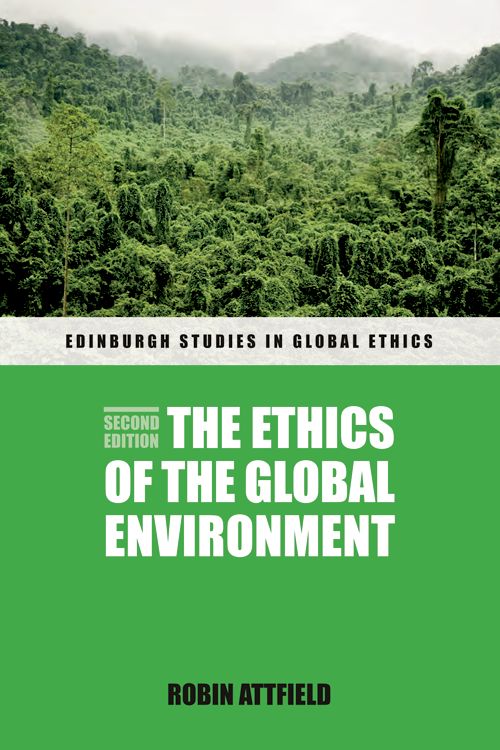
The Ethics of the Global Environment
This fully updated and expanded textbook looks at issues including climate change, sustainable development and biodiversity preservation, and sensitively addresses global developments such as the Summits at Durban on climate and at Nagoya on biodiversity.
eBook