
Catalogue Search | MBRL


Are you sure you want to remove the book from the shelf?

{{itemTitle}}
16
result(s) for
"Environmentalism -- Great Britain -- History"
Sort by:


Romantic Ecologies and Colonial Cultures in the British Atlantic World, 1770-1850
By addressing these and other intriguing questions, Kevin Hutchings highlights significant intersections between Green Romanticism and colonial politics, demonstrating how contemporary understandings of animality, climate, and habitat informed literary and cross-cultural debates about race, slavery, colonialism, and nature in the British Atlantic world. Revealing an innovative dialogue between British, African, and Native American writers of the Romantic period, this book will be of interest to anyone wishing to consider the interconnected histories of transatlantic colonial relations and environmental thought.
eBook

The East India Company and the natural world
\"The East India Company and the Natural World is the first work to explore the deep and lasting impacts of the largest colonial trading company, the British East India Company on the natural environment. The EIC both contributed to and recorded environmental change during the first era of globalization. From the small island of St Helena in the South Atlantic, to peninsula India and outposts in South and Southeast Asia, the Company presence profoundly altered the environment by introducing plants and animals, felling forests, and redirecting rivers. The threats of famine and disease encouraged experiments with agriculture and the recording of the virtues of medicinal plants. The EIC records of the weather, the soils, and the flora provide modern climate scientists with invaluable data. The contributors - drawn from a wide range of academic disciplines - use the lens of the Company to illuminate the relationship between colonial capital and the changing environment between 1600 and 1857.\" -- Provided by publisher.
Book

Making Another World Possible
Making Another World Possible identifies the British contribution to the genealogy of modern green and anti-capitalist thinking by examining left libertarian ideologies in the late 19th and early 20th century Britain and highlighting their influence on present day radical thought. As capitalism heralded the triumph of technology, greater production, and a new urban industrial society, some imagined alternatives to this notion of progress based on endless economic growth. The book examines the development of ideas from these dissidents who included communists, class warriors, free thinkers, secularists, and Christian communitarians. All shared the same beliefs that the benefits of industrialism could only be realized through equality and that urban culture depended on a healthy agriculture and harmony with the natural world - concerns that are still of great importance today. This distinctive history of anarchist ideas reappraises the work of thinkers and revises the historical picture of the radical milieu in 19th and 20th century Britain. It will be an essential resource to anyone researching the history of ideas and studying anarchism.
eBook

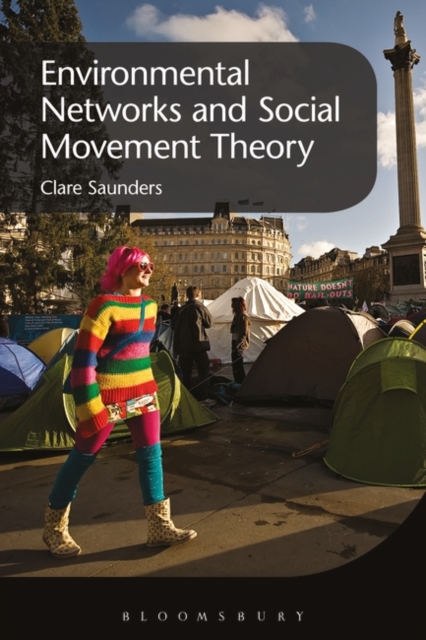
Environmental Networks and Social Movement Theory
This book is available as open access through the Bloomsbury Open Access programme and is available on www.bloomsburycollections.com. Clare Saunders' book is an important contribution to the literature on social movements and environmentalism. Using the concept of 'environmental networks', it explores the extent to which social movement theory helps us understand how a broad range of environmental organizations interact. It considers the practicalities of social movement theories and it goes on to relate them to the practices of environmental networks. Theoretically and empirically rich, the book draws on extensive survey material with 144 UK environmental organizations, as diverse as not-in-my-backyard (NIMBY) groups, reformists, conservationists and radicals; interviews with more than 40 key campaigners and extensive participant-observation, particularly in London. Focussing particularly on the crucial question of networking dynamics, the book reveals that there are broad ranging network links across the movements' spatial and ideological dimensions. Combined with inevitable ideological clashes and a degree of sectarian rivalry, these links helps produce vibrant environmental networks that together work to protect and/or preserve the environment. This book is an invaluable resource for anyone concerned with environmental issues, politics and movements.
eBook

Romantic ecocriticism : origins and legacies
\"Romantic Ecocriticism: Origins and Legacies is unique due to its rare assemblage of essays, which has not appeared within an edited collection before. Romantic Ecocriticism is distinct because the essays in the collection develop transnational and transhistorical approaches to the proto-ecological early environmental aspects in British and American Romanticism. First, the edition's transnational approach is evident through transatlantic connections such as, but are not limited to, comparisons among the following writers: William Wordsworth, William Howitt, and Henry D. Thoreau; John Clare and Aldo Leopold; Charles Darwin and Ralph W. Emerson. Second, the transhistorical approach of Romantic Ecocriticism is evident in connections among the following writers: William Wordsworth and Emily Bronte; Thomas Malthus and George Gordon Byron; James Hutton and Percy Shelley; Erasmus Darwin and Charlotte Smith; Gilbert White and Dorothy Wordsworth among others. Thus, Romantic Ecocriticism offers a dynamic collection of essays dedicated to links between scientists and literary figures interested in natural history.\" -- Publisher's description
Book
The Environmental Tradition in English Literature
Drawing upon the English literary tradition for new perspectives and paradigms, this collection presents a broad range of theoretical and historical approaches to ecocriticism. The first section of the volume offers different theoretical frameworks for ecocritical work, encompassing a range of socio-political, post-modern and multi-disciplinary approaches. In the second section, contributors explore the ways in which ecocriticism allows us to re-think literary history.
Contents: Introduction, Louise Westling; Part 1: Theoretical approaches: After ’Organic Community’: ecocriticism, nature and human nature, Martin Ryle; Beyond 2000: Raymond Williams and the Ecocritic’s Task, Dominic Head; Ecofeminism in literary studies, Naomi Guttman; Towards a post-pastoral view of British poetry, Terry Gifford; Post-modern ecocriticism in the science fiction novel: J.G. Ballard and Ken Kesey, Bennett Huffman; Cosmos as metaphor: Eco-spiritual poetics, Paul Davies; Narratives of Resignation: Environmentalism in recent fiction, Richard Kerridge; Ecotopian fiction and the sustainable society, Lisa Garforth; Part 2: Historical approaches: Making the rocks disappear: refocusing Chaucer’s Knight’s and Franklin’s Tales, Gillian Rudd; The Commodious Ark: Nature’s voice in early modern poetry, Diane McColley; ’Founded on the affections’: a romantic ecology, Ralph Pite; Was there a Victorian ecology?, John Parham; Letting in the Sky: An Ecofeminist reading of Virginia Woolf’s short fiction, Charlotte Zoë Walker; Reversing the fall: the sense of place in D.H. Lawrence, Gavin Murray; Twentieth-century rural poets of Britain and Ireland: ecological voices from the geographical and cultural margins, Andy Jurgis; Ecocriticism: An annotated bibliography, Jo Rawlinson. Index.
eBook


The Colonial Emergence of a Statistical Imaginary
Intellectual networks linking humanitarians in Britain, Western Australia, and New Zealand in the 1850s and 1860s operationalized the concept of native “protection” by arguing contra demographic pessimists that native peoples could survive if their adaptation was thoughtfully managed. While the population-measurement capacities of the colonial governments of Western Australia and New Zealand were still weak, missionaries pioneered the gathering of the data that enabled humanitarians to objectify natives as populations. This paper focuses on Francis Dart Fenton (in New Zealand), Florence Nightingale (in Britain), and Rosendo Salvado (in Western Australia) in the 1850s and 1860s. Their belief in the necessity of population statistics manifests the practical convergence of colonial humanitarianism with public health perspectives and with “the statistical movement” that had become influential in Britain in the 1830s. We draw attention to the materialism and environmentalism of these three quantifiers of natives, and to how native peoples were represented as governable through knowledge of their physical needs and vulnerabilities.
Journal Article