
Catalogue Search | MBRL


Are you sure you want to remove the book from the shelf?

{{itemTitle}}
231
result(s) for
"Ephesians"
Sort by:

Being At Home or Taking Up Habitation? A Verbal Aspectual Analysis of Christ’s Habitation in Ephesians 3:17
The prayer in Ephesians 3:16–19 is filled with syntactical oddities and the portrayal of Christ’s habitation in the readers’ hearts (3:17) is also quite enigmatic. Does it describe the inception of Christ’s habitation or his durative habitation? The grammar seems to imply it is a request for Christ to take up habitation (inceptive), while the context (e.g., 2:22) suggests they are already indwelt by Christ (durative). Many commentators favour the latter, though a minority favours the former. This article contributes to the literature on Ephesians 3:17 by employing verbal aspect theory to evaluate the cogency of the inceptive interpretation so as to shed some light on the enigma of Christ’s habitation in this verse.
We begin with a study of the structural and theological background to the problem. After that, we show the significance of verbal aspect for the Greek verbal system and demonstrate its operation with the tense-mood combinations found in this pericope. Through this, we show that the inceptive interpretation cannot be avoided. Last, we do a theological synthesis to establish the author’s communicative purpose and in so doing shed light on the apparent contradiction between the context and grammar of Ephesians 3:17.
Journal Article

“More than We Can Ask or Imagine” (Eph 3: 20–21): The Resurrection of Christ in Ephesians and Its Ongoing Multidimensional Cosmic Consequences
While most Christians might imagine the resurrection of Jesus Christ from the dead as a single event, for the author of Ephesians, the resurrection is a continuing event of cosmic proportions. In a very real way, the Epistle to the Ephesians is an extended reflection on the ongoing multidimensional cosmic consequences and transformations that result from the death of Jesus and his resurrection, whose impact not only affects the macrocosm in which Christ sits triumphantly at the right hand of God, “far above every principality, authority, power, and dominion” (Eph 1: 20–22), but also the microcosm of the Church, “his body, the fullness of the one who fills the universe in every way” (1: 23), transforming those who compose the smallest microcosm, the baptized who form a Christian household and who, gathered at table to share Eucharist (5: 17–6: 9), are “seated with Christ in the heavenly places” (2: 6), already participating in the eternal Messianic banquet. This is to say that, for this author, the resurrection of Jesus of Nazareth is the catalyst for an ongoing and ever more evolving “new creation” of humanity and, indeed, the entire cosmos, with “Christification”—the full maturation into the divine “Christ nature” (Eph 4: 13, 15–16) as the telos or goal for the whole universe (Eph 1: 10).
Journal Article

Of child’s obedience, parent’s honour and parental restraint: A contextual and ethical analysis of Ephesians 6:1–4
This article examines Ephesians 6:1–4 through a contextual and ethical lens, exploring its enduring applicability and implications for parent–child relationships within contemporary Christian households. The text’s dual injunction – child’s obedience and honour to parents and father’s disciplinary limits – forms the cornerstone of many theological conceptions of family life. However, its application has often veered into coercive territory, particularly within conservative religious communities where parental authority is sacralised and unquestioned. Utilising insights from theological exegesis, Greco-Roman household code analysis, and contemporary child development psychology, this study critiques both permissive and authoritarian models of parenting that claim biblical legitimacy. It also challenges children’s disobedience to godly parental instructions (in the Lord). Contribution: The article contends that Paul’s exhortations must be reinterpreted within their original socio-cultural matrix and in alignment with Christocentric ethics. Consequently, it offers a theologically responsible and child-sensitive framework that upholds mutual dignity, relational accountability and the spiritual formation of children without resorting to control or abuse. Ultimately, the study reclaims Ephesians 6:1–4 as a text that fosters ethical parental restraint and meaningful, voluntary obedience rooted in love and discipleship.
Journal Article
“Sleeper Awake, Rise from the Dead”: Future Resurrection and Present Ethics in Ephesians
Within Ephesians, resurrection is the defining evidence of God’s divine power. A scholarly consensus contends that the letter is characterized by a realized eschatology in which the two references to individuals’ resurrection in Eph 2:5–6 and Eph 5:14 refer to an already accomplished salvation. This article, however, argues that interpreting the reference to believers’ resurrection in overly realized terms breaks the logic by which the letter roots Christian ethical action in future expectation. It reevaluates both references to resurrection within its epistolary context, demonstrating how the already accomplished resurrection of Christ is the surety of believers’ future resurrection and the basis for life in the present. This analysis challenges the overly realized interpretation of Ephesians’ eschatology and suggests that, rather than an already accomplished event or a spiritualized metaphor, Ephesians’ references to resurrection refer to the future hope that Christian believers will be bodily resurrected—a hope that is patterned on Christ’s resurrection in history. It is this vision of future hope, then, that acts as the foundation for ethical action within the letter. Christ’s resurrection light—the light that will fully be realized in the eschatological resurrection—becomes the evaluative measure of ethical action in the present.
Journal Article

Ephesians
This commentary, written from a distinctively Pentecostal perspective, is primarily for pastors, lay persons and Bible students. It is based upon the best scholarship, written in popular language, and communicates the meaning of the text with minimal technical distractions. This author offers a running exposition on the text and extended comments on matters of special significance for Pentecostals. He acknowledges and interacts with alternative interpretations of individual passages, and his commentary also provides periodic opportunities for reflection upon and personal response to the biblical text.
eBook

Begeleiding en toerusting tot goeie werke as noodsaaklike deel van gemeentebediening
Leading and equipping people for good deeds as a crucial part of parish ministry. The article examines the role that equipment for good works, as an integral part of church ministry, can play in revitalising and help congregations to grow. The investigation is conducted through an exegetical analysis of Ephesians 2, focusing on verse 10. The results of the study of Ephesians are then compared with other Scriptures where good works are mentioned. From this research, it becomes clear that good works do not play a role in the justification and salvation of believers, because it is solely the work of God’s undeserved grace. However, good works are an integral part of God’s purpose in his redemption of humanity. Humanity is not saved by good works but rather unto good works. According to Ephesians, good works serve to proclaim the greatness of God’s grace towards believers. God prepares the good works for believers. Believers are enabled to do good works through the gifts that Christ and the Spirit give them, and the equipment they receive through the special services. From the Gospels, it is evident that good works were a characteristic of Jesus’ mission, and therefore also the calling of his disciples. In the pastoral letters, good works are described as part of Christ’s purpose for which He acquired a people for Himself. The ultimate goal of equipping from the Word, is the ability to do good works. Therefore, good works testify to maturity in faith, reliability, and dedication. A lack of good works puts a question mark on someone’s faith. The conclusion from the research is that deliberate equipping of members to actively do good works, should be an integral part of church ministry. Each member of the congregation should be held responsible for using the opportunities that God creates for them, to do good works. The lack of a structured ministry of equipping members for distributing God’s grace by good works, can be a leading cause of stagnation and decline in congregations.ContributionThe article contributes to practical theological reflection on ministry in the church through in-depth exegetical analysis and comparison of Scripture with Scripture. The place of equipping for good works, which is often overlooked in reformed circles, is highlighted here.
Journal Article
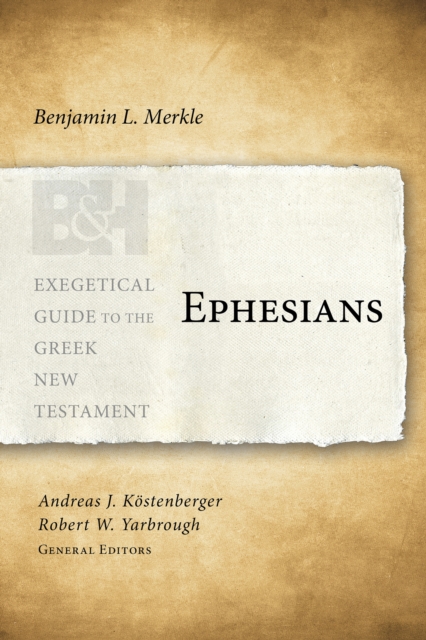
Ephesians
The Exegetical Guide to the Greek New Testament (EGGNT) closes the gap between the Greek text and the available lexical and grammatical tools, providing all the necessary information for greater understanding of the text.
eBook


The use of οἰκονομία for missions in Ephesians
The concern which prompted the letter and the author s digression in Ephesians 3:2 12 represents a lacuna in Ephesians scholarship. Its function within the wider discourse remains uncertain. The term οἰκονομία is prominent in the discourse and has been interpreted as an administrative office or activity in the Pauline corpus. This article shows that the term has a missional nuance in Ephesians. It is used for the role of Christ in the execution of the plan of God (Eph 1:10) and the role of Paul in the implementation of the plan (Eph 3:2). The author of Ephesians acknowledges the role Paul played in the mission s movement of the gospel itself, I Paul the prisoner of Jesus Christ (Eph 3:1, 7). He is identified as the person to whom the stewardship of the grace of God has been given (Eph 3:2). The οἰκονομία of the gospel is committed by Paul to the church, marking a new phase in the development of the mission of the church.Intradisciplinary and/or interdisciplinary implications: The article suggests that in Ephesians 3:10, which is a crux interpretum, that the missional nuance of the term οἰκονομία indicates in Ephesians 3:10 the role of the Church in the execution of the plan of God and the missio Dei is implied.Keywords: oikonomia; missions; Ephesians
Journal Article
Participating in the New Creation in Ephesians
This article explores Ephesians, asking how the theme of the new creation is developed in Ephesians. Rather than specifying matters like authorship, date, and recipients, it takes a broad view of the situation of the letter so that the focus can be on exploring the theme. It argues that the new creation idea is developed in three main ways. First, while Ephesians has a decidedly realized eschatology, there are hints throughout the letter of the consummation when the whole Earth is freed from corruption and reconciled under one head, Jesus Christ. Second, particularly in chapters 1–3, the writer of Ephesians focuses on realized aspects of eschatology to strengthen the readers’ understanding of their identity in Christ and their status as people of the new creation. The writer does this to strengthen the readers to assume the posture of the new creation while living in a fallen world beset with sin and under spiritual powers. In Ephesians 4–6, the writer describes this new creation virtues the readers are to embody as they contend for God in the world. Finally, the article explores the missional appeal of the letter. The writer challenges the readers to embody the new creation ethic and join God’s mission that calls all humankind to believe in the gospel and become people of the new creation.
Journal Article