
Catalogue Search | MBRL


Are you sure you want to remove the book from the shelf?

{{itemTitle}}
7,055
result(s) for
"Epidemics History"
Sort by:


The Great Manchurian Plague of 1910-1911
When plague broke out in Manchuria in 1910 as a result of transmission from marmots to humans, it struck a region struggling with the introduction of Western medicine, as well as with the interactions of three different national powers: Chinese, Japanese, and Russian. In this fascinating case history, William Summers relates how this plague killed as many as 60,000 people in less than a year, and uses the analysis to examine the actions and interactions of the multinational doctors, politicians, and ordinary residents who responded to it.
Summers covers the complex political and economic background of early twentieth-century Manchuria and then moves on to the plague itself, addressing the various contested stories of the plague's origins, development, and ecological ties. Ultimately, Summers shows how, because of Manchuria's importance to the world powers of its day, the plague brought together resources, knowledge, and people in ways that enacted in miniature the triumphs and challenges of transnational medical projects such as the World Health Organization.
eBook

Ending epidemics : a history of escape from contagion
\"From the discovery of microorganisms to the end of smallpox, the story of how we came to understand the infectious diseases that once killed us & how we might escape such diseases in the future\"-- Provided by publisher.
Book

Pandemics, Publics, and Narrative
Pandemics, Publics, and Narrative explores how members of the general public experienced the 2009 swine flu pandemic. It examines the stories related to us by individuals about what happened to them in 2009, their reflections on news and expert advice given to them, and how they considered vaccination, social isolation, and other infection control measures. The book charts also the storytelling of public life, including the “be alert, not alarmed” messages from the beginning of the outbreak through to the “boy who cried wolf” problem that emerged later in the outbreak when the virus turned out to be less serious than first thought for most people. Key themes of the book are the significance of personal immunity for people as they reflected on how to respond to the threat of an influenza virus and the ways in which universal public health advice was interpreted quite differently by people according to their medical and biographical situation. The book provides unprecedented insight into the lives of ordinary people during 2009, some affected profoundly and others hardly affected at all. By drawing on currents in sociocultural scholarship of narrative, illness narrative, and narrative medicine, it develops a novel “narrative public health” approach that bridges health communications and narrative. The book provides therefore important new insights for health communicators and researchers across the social and health sciences.
eBook

Pandemics : a very short introduction
\"The 2014 Ebola epidemic demonstrated the power of pandemics and their ability not only to destroy lives locally but also to capture imaginations worldwide. Pandemics: A Very Short Introduction provides a concise yet comprehensive account of pandemics throughout human history, illustrating the ways in which pandemic disease-including plague, tuberculosis, malaria, smallpox, cholera, influenza, HIV/AIDS, and Covid 19-has shaped history and how human history has shaped pandemic disease. By considering the explosion of medical research and the varying state responses, such as quarantine and travel restrictions, this Very Short Introduction shows why pandemics are both interesting from a medical standpoint and provide insight into the culture and politics of their time\"-- Provided by publisher.
BOOK
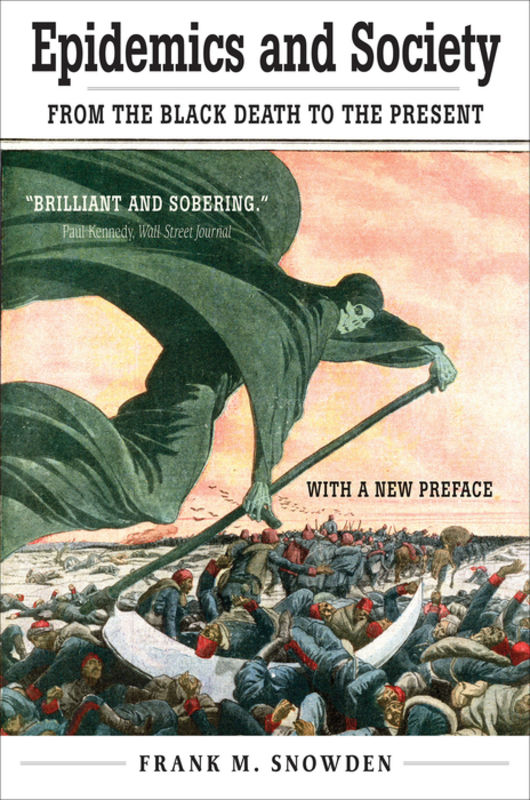
Epidemics and Society
A wide-ranging study that illuminates the connection between epidemic diseases and societal change, from the Black Death to Ebola This sweeping exploration of the impact of epidemic diseases looks at how mass infectious outbreaks have shaped society, from the Black Death to today. In a clear and accessible style, Frank M. Snowden reveals the ways that diseases have not only influenced medical science and public health, but also transformed the arts, religion, intellectual history, and warfare. A multidisciplinary and comparative investigation of the medical and social history of the major epidemics, this volume touches on themes such as the evolution of medical therapy, plague literature, poverty, the environment, and mass hysteria. In addition to providing historical perspective on diseases such as smallpox, cholera, and tuberculosis, Snowden examines the fallout from recent epidemics such as HIV/AIDS, SARS, and Ebola and the question of the world's preparedness for the next generation of diseases.
eBook

Preexisting conditions : recounting the plague
\"Plagues and pandemics confront societies with something they often seek to deny, namely that mortality and vulnerability is not just an individual concern. The narratives examined in this book both confirm the desire to avoid this recognition as well as the different ways it asserts itself nevertheless\"-- Provided by publisher.
BOOK

The Black Death and Later Plague Epidemics in the Scandinavian Countries
This monograph represents an expansion and deepening of previous works by Ole J. Benedictow - the author of highly esteemed monographs and articles on the history of plague epidemics and historical demography. In the form of a collection of articles, the author presents an in-depth monographic study on the history of plague epidemics in Scandinavian countries and on controversies of the microbiological and epidemiological fundamentals of plague epidemics.
eBook

The pandemic century : one hundred years of panic, hysteria and hubris
Ever since the 1918 Spanish influenza pandemic, scientists have dreamed of preventing catastrophic outbreaks of infectious disease. Yet, despite a century of medical progress, viral and bacterial disasters continue to take us by surprise, inciting panic and dominating news cycles. From pneumonic plague in LA and `parrot fever' in Argentina to the more recent AIDS, SARS and Ebola epidemics, the last 100 years have been marked by a succession of unanticipated outbreaks and scares. Like man-eating sharks, predatory pathogens are always present in nature, waiting to strike; when one is seemingly vanquished, others appear in its place. The Pandemic Century exposes the limits of science against nature, and how these crises are shaped by humans as much as microbes.
Book

More than hot : a short history of fever
A conceptual and cultural history of fever, a universally experienced and sometimes feared symptom.
Winner of the CHOICE Outstanding Academic Title of the Choice ACRL
Christopher Hamlin's magisterial work engages a common experience—fever—in all its varieties and meanings. Reviewing the representations of that condition from ancient times to the present, More Than Hot is a history of the world through the lens of fever. The book deals with the expression of fever, with the efforts of medical scientists to classify it, and with fever's changing social, cultural, and political significance.
Long before there were thermometers to measure it, people recognized fever as a dangerous, if transitory, state of being. It was the most familiar form of alienation from the normal self, a concern to communities and states as well as to patients, families, and healers.
The earliest medical writers struggled for a conceptual vocabulary to explain fever. During the Enlightenment, the idea of fever became a means to acknowledge the biological experiences that united humans. A century later, in the age of imperialism, it would become a key element of conquest, both an important way of differentiating places and races, and of imposing global expectations of health. Ultimately the concept would split: \"fevers\" were dangerous and often exotic epidemic diseases, while \"fever\" remained a curious physiological state, certainly distressing but usually benign. By the end of the twentieth century, that divergence divided the world between a global South profoundly affected by fevers—chiefly malaria—and a North where fever, now merely a symptom, was so medically trivial as to be transformed into a familiar motif of popular culture.
A senior historian of science and medicine, Hamlin shares stories from individuals—some eminent, many forgotten—who exemplify aspects of fever: reflections of the fevered, for whom fevers, and especially the vivid hallucinations of delirium, were sometimes transformative; of those who cared for them (nurses and, often, mothers); and of those who sought to explain deadly epidemic outbreaks. Significant also are the arguments of the reformers, for whom fever stood as a proxy for manifold forms of injustice.
Broad in scope and sweep, Hamlin's study is a reflection of how the meanings of diseases continue to shift, affecting not only the identities we create but often also our ability to survive.
eBook