
Catalogue Search | MBRL


Are you sure you want to remove the book from the shelf?

{{itemTitle}}
19
result(s) for
"Epidemics Popular works."
Sort by:

The outbreak atlas
\"Provides an overview of outbreak activities alongside compelling case studies and visualizations to guide readers through the complexity involved in outbreak preparedness, response, and recovery\"-- Provided by publisher.
BOOK
Seven Modern Plagues
Epidemiologists are braced for the big one: the strain of flu that rivals the pandemic of 1918-1919, which killed at least 20 million people worldwide. In recent years, we have experienced scares with a host of new influenza viruses: bird flu, swine flu, Spanish flu, Hong Kong flu, H5N1, and most recently, H5N7. While these diseases appear to emerge from thin air, in fact, human activity is driving them. And the problem is not just flu, but a series of rapidly evolving and dangerous modern plagues.
According to veterinarian and journalist Mark Walters, we are contributing to-if not overtly causing-some of the scariest epidemics of our time. Through human stories and cutting-edge science, Walters explores the origins of seven diseases: mad cow disease, HIV/AIDS, Salmonella DT104, Lyme disease, hantavirus, West Nile, and new strains of flu. He shows that they originate from manipulation of the environment, from emitting carbon and clear-cutting forests to feeding naturally herbivorous cows \"recycled animal protein.\"
Since Walters first drew attention to these \"ecodemics\" in 2003 with the publication of Six Modern Plagues, much has been learned about how they developed. In this new, fully updated edition, the author presents research that precisely pinpoints the origins of HIV, confirms the link between forest fragmentation and increased risk of Lyme disease, and expands knowledge of the ecology of West Nile virus.
He also explores developments in emerging diseases, including a new chapter on flu, examining the first influenza pandemic since the Hong Kong flu of 1968; a new tick-borne infection in the Mid-West; a second novel bird flu in China; and yet a new SARS-like virus in the Middle East.
Readers will not only learn how these diseases emerged but the conditions that make future pandemics more likely. This knowledge is critical in order to prevent the next modern plague.
eBook

Epidemics and pandemics : your questions answered
\"In the wake of COVID, it's more important than ever to understand epidemics-how they emerge and what we can do to fight back\"-- Provided by publisher.
BOOK

Living with polio
Polio was the most dreaded childhood disease of twentieth-century America. Every summer during the 1940s and 1950s, parents were terrorized by the thought that polio might cripple their children. They warned their children not to drink from public fountains, to avoid swimming pools, and to stay away from movie theaters and other crowded places. Whenever and wherever polio struck, hospitals filled with victims of the virus. Many experienced only temporary paralysis, but others faced a lifetime of disability. Living with Polio is the first book to focus primarily on the personal stories of the men and women who had acute polio and lived with its crippling consequences. Writing from personal experience, polio survivor Daniel J. Wilson shapes this impassioned book with the testimonials of more than one hundred polio victims, focusing on the years between 1930 and 1960. He traces the entire life experience of the survivors—from the alarming diagnosis all the way to the recent development of post-polio syndrome, a condition in which the symptoms of the disease may return two or three decades after they originally surfaced. Living with Polio follows every physical and emotional stage of the disease: the loneliness of long separations from family and friends suffered by hospitalized victims; the rehabilitation facilitieswhere survivors spent a full year or more painfully trying to regain the use of their paralyzed muscles; and then the return home, where they were faced with readjusting to school or work with the aid of braces, crutches, or wheelchairs while their families faced the difficult responsibilities of caring for and supporting a child or spouse with a disability. Poignant and gripping, Living with Polio is a compelling history of the enduring physical and psychological experience of polio straight from the rarely heard voices of its survivors.
eBook

Pandemics
Pandemics inflict significant harm on societies, often exacerbated by human activities that alter the natural environment. As cities expand, encroaching on areas once inhabited by wildlife, the risk of disease transmission increases. Bacteria have existed for 3.5 billion years and viruses for 1.5 billion years, while humans have only been around for 130,000 years. Coronaviruses have a long evolutionary history of over fifty million years, with some recent strains dating back to around 8000 BCE, indicating a prolonged coevolution with bats and birds. Advancements in technology during the 20th century have facilitated rapid global travel, allowing microbes to spread more quickly than ever before.
BOOK

COVID Chronicles
In 2020, the COVID-19 pandemic brought the world to its knees.
When we weren't sheltering in place, we were advised to wear masks,
wash our hands, and practice social distancing. We watched in
horror as medical personnel worked around the clock to care for the
sick and dying. Businesses were shuttered, travel stopped, workers
were furloughed, and markets dropped. And people continued to
die.
Amid all this uncertainty, writers and artists from around the
world continued to create comics, commenting directly on how
individuals, societies, governments, and markets reacted to the
worldwide crisis. COVID Chronicles: A Comics Anthology
collects more than sixty such short comics from a diverse set of
creators, including indie powerhouses, mainstream artists, Ignatz
and Eisner Award winners, and media cartoonists. In narrative
styles ranging from realistic to fantastic, they tell stories about
adjusting to working from home, homeschooling their kids, missing
birthdays and weddings, and being afraid just to leave the house.
They probe the failures of government leaders and the social safety
net. They dig into the racial bias and systemic inequities that
this pandemic helped bring to light. We see what it's like to get
the virus and live to tell about it, or to stand by helplessly as a
loved one passes.
At times heartbreaking and at others hopeful and humorous, these
comics express the anger, anxiety, fear, and bewilderment we feel
in the era of COVID-19. Above all, they highlight the power of art
and community to help us make sense of a world in crisis, reminding
us that we are truly all in this together.
The comics in this collection have been generously donated by
their creators. A portion of the proceeds from the sale of this
volume are being donated by the publisher to the Book Industry
Charitable Foundation (Binc) in support of comics shops,
bookstores, and their employees who have been adversely affected by
the pandemic.
eBook
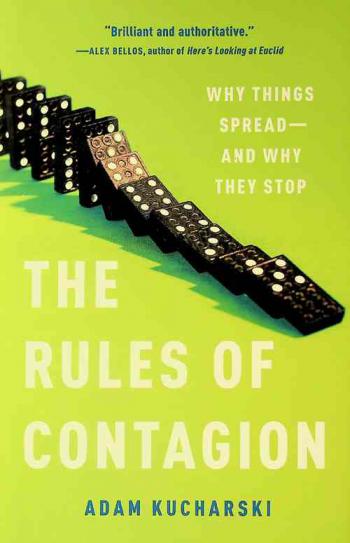
The rules of contagion : why things spread-and why they stop
A deadly virus suddenly explodes into the population. A political movement gathers pace, and then quickly vanishes. An idea takes off like wildfire, changing our world forever. We live in a world that's more interconnected than ever before. Our lives are shaped by outbreaks--of disease, of misinformation, even of violence--that appear, spread and fade away with bewildering speed. To understand them, we need to learn the hidden laws that govern them. From 'superspreaders' who might spark a pandemic or bring down a financial system to the social dynamics that make loneliness catch on, The Rules of Contagion offers compelling insights into human behaviour and explains how we can get better at predicting what happens next. Along the way, Adam Kucharski explores how innovations spread through friendship networks, what links computer viruses with folk stories--and why the most useful predictions aren't necessarily the ones that come true.

Beasts of the Earth
Humans have lived in close proximity to other animals for thousands of years. Recent scientific studies have even shown that the presence of animals has a positive effect on our physical and mental health. People with pets typically have lower blood pressure, show fewer symptoms of depression, and tend to get more exercise.But there is a darker side to the relationship between animals and humans. Animals are carriers of harmful infectious agents and the source of a myriad of human diseases. In recent years, the emergence of high-profile illnesses such as AIDS, SARS, West Nile virus, and bird flu has drawn much public attention, but as E. Fuller Torrey and Robert H. Yolken reveal, the transfer of deadly microbes from animals to humans is neither a new nor an easily avoided problem.Beginning with the domestication of farm animals nearly 10,000 years ago, Beasts of the Earth traces the ways that human-animal contact has evolved over time. Today, shared living quarters, overlapping ecosystems, and experimental surgical practices where organs or tissues are transplanted from non-humans into humans continue to open new avenues for the transmission of infectious agents. Other changes in human behavior like increased air travel, automated food processing, and threats of bioterrorism are increasing the contagion factor by transporting microbes further distances and to larger populations in virtually no time at all.While the authors urge that a better understanding of past diseases may help us lessen the severity of some illnesses, they also warn that, given our increasingly crowded planet, it is not a question of if but when and how often animal-transmitted diseases will pose serious challenges to human health in the future.
eBook

The rules of contagion : why things spread - and why they stop
A deadly virus suddenly explodes into the population. A political movement gathers pace, and then quickly vanishes. An idea takes off like wildfire, changing our world forever. We live in a world that's more interconnected than ever before. Our lives are shaped by outbreaks - of disease, of misinformation, even of violence - that appear, spread and fade away with bewildering speed. To understand them, we need to learn the hidden laws that govern them. From 'superspreaders' who might spark a pandemic or bring down a financial system to the social dynamics that make loneliness catch on, The Rules of Contagion offers compelling insights into human behaviour and explains how we can get better at predicting what happens next. Along the way, Adam Kucharski explores how innovations spread through friendship networks, what links computer viruses with folk stories - and why the most useful predictions aren't necessarily the ones that come true.
Book

Mor 1480–1730
Mor, který přišel ve 40. letech 14. století, předznamenal dlouhé období periodicky se vracejících smrtících epidemií. Nebezpečí se nevyhýbalo nikomu, „černá smrt“ pravidelně postihovala bohatá obchodní centra v Itálii stejně jako spoře zalidněné regiony Skandinávie. Teprve na počátku 18. století nemoc z Evropy zmizela stejně záhadně, jako se o čtyři století dříve objevila.
Morová nákaza byla nejen zdrojem paniky, drastických sanitárních opatření či morálního sebezpytování, ale představovala i složitý lékařský problém. Od vrcholného středověku do období osvícenství vzniklo na toto téma nesčetně traktátů.
Tato publikace se zabývá postupnými proměnami názorů na mor mezi lékaři raného novověku v několika oblastech. Předně se věnuje vývoji dobové lékařské literatury, zkoumá vliv modernity či naopak tradice a způsob, jímž spolu různí autoři vedli učené spory. V následující části na základě výběru pramenů z řady oblastí Evropy sleduje hlavní teorie o původu moru včetně představ o zkažení vzduchu, názorů na nakažlivost nemoci či nauky o moru přenášeném lidskými smysly. Dále popisuje, co doporučovali renesanční a barokní lékaři svým klientům, kteří se chtěli chránit před nákazou. Šlo o široké spektrum preventivních opatření počínaje karanténou či útěkem z nakažené oblasti přes dodržování vhodné diety až po užívání různých druhů amuletů. Poslední část knihy popisuje raně novověkou léčbu morem nakažených pacientů, a to jak podáváním léků či tzv. „chirurgickými“ metodami (pouštěním krve či otvíráním morových bubonů).
eBook