
Catalogue Search | MBRL


Are you sure you want to remove the book from the shelf?

{{itemTitle}}
2,851
result(s) for
"Epigram"
Sort by:
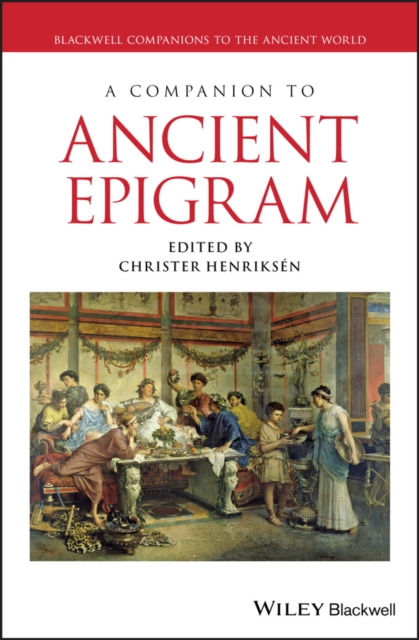
A companion to ancient epigram
A delightful look at the epic literary history of the short, poetic genre of the epigram
From Nestor's inscribed cup to tombstones, bathroom walls, and Twitter tweets, the ability to express oneself concisely and elegantly, continues to be an important part of literary history unlike any other. This book examines the entire history of the epigram, from its beginnings as a purely epigraphic phenomenon in the Greek world, where it moved from being just a note attached to physical objects to an actual literary form of expression, to its zenith in late 1 st century Rome, and further through a period of stagnation up to its last blooming, just before the beginning of the Dark Ages.
A Companion to Ancient Epigram offers the first ever full-scale treatment of the genre from a broad international perspective. The book is divided into six parts, the first of which covers certain typical characteristics of the genre, examines aspects that are central to our understanding of epigram, and discusses its relation to other literary genres. The subsequent four parts present a diachronic history of epigram, from archaic Greece, Hellenistic Greece, and Latin and Greek epigrams at Rome, all the way up to late antiquity, with a concluding section looking at the heritage of ancient epigram from the Middle Ages up to modern times.
* Provides a comprehensive overview of the history of the epigram
* The first single-volume book to examine the entire history of the genre
* Scholarly interest in Greek and Roman epigram has steadily increased over the past fifty years
* Looks at not only the origins of the epigram but at the later literary tradition
A Companion to Ancient Epigram will be of great interest to scholars and students of literature, world literature, and ancient and general history. It will also be an excellent addition to the shelf of any public and university library.
eBook

Ausonius
Decimus Magnus Ausonius of Bordeaux, whose life spanned the greater part of the fourth century AD, was one of the most significant literary and political figures of his age.After an academic career in his native Gaul he was appointed tutor to the future emperor Gratian, a position through which he achieved great power for himself and his family.
eBook

Epigrams of Martial Englished by Divers Hands
This title is part of UC Press's Voices Revived program, which commemorates University of California Press's mission to seek out and cultivate the brightest minds and give them voice, reach, and impact. Drawing on a backlist dating to 1893, Voices Revived makes high-quality, peer-reviewed scholarship accessible once again using print-on-demand technology. This title was originally published in 1987.
eBook

Callimachus, Conon and Ptolemy: an Alexandrian epigram between geography and astronomy
A neglected, anonymous and undated epigram on the world map of Ptolemy’s Geography, here critically edited for the first time on the basis of all existing manuscripts, proves a rare case of reception of Callimachus’ Lock of Berenice, with an emphasis on the bonds between geography and astronomy, and with so-called ‘geographical astrology’. It may stem from Late Antique Alexandria.
Journal Article

THE POTIDAEA EPIGRAM AND EURIPIDES’ SUPPLIANT WOMEN: AN INTERTEXTUAL READING
CEG 1.10 shows striking parallels in language and thought with Euripides’ Suppliant Women 531–6 (c. 423), with both passages describing the departure of the soul into the upper air (aithêr) after death. This article argues that rather than being a commonplace in fifth-century Athens, the mention of this eschatology in Suppliant Women is a deliberate reference to CEG 1.10; and that the significance of this reference is the recontextualization of the lines from CEG 1.10 to describe the battle of Delium (423), thus expressing the war-weariness and disillusion of Athens.
Journal Article
PLAYING IN THE LION'S JAWS: METATEXTUALITY IN MARTIAL'S ‘LION AND HARE’ CYCLE
This paper aims to provide an analysis of the metatextual function of one of the most well-known elements of Martial's Epigrams, the ‘lion and hare’ cycle from Book 1. This cycle, in which a hare is held precariously but safely in the jaws of a lion, has historically been read as representing the relationship between Domitian and poet. This paper aims to expand on this reading of the cycle while considering a largely unexplored point of view: the metatexual function of this cycle within Martial's larger epigrammatic project. I identify three major ways in which the cycle supports Martial's larger interests in exploring poetic anxieties and defending the genre of epigrammatic poetry. First of all, by figuring the lion and the hare as, respectively, the emperor and the poet, Martial presents and performs an exemplum modelling clemency in the reception of lascivious poetry. Second, as a sexual metaphor that points to the anxiety and insecurity of both predator and prey, the cycle anticipates a broader concern of the Epigrams: the instability of Roman hierarchical relations and the difficulty of maintaining balance within such relationships. Third, Martial's continued use of hare imagery in the later books of the Epigrams, both in culinary and in hunting contexts, suggests the continued consumption and enjoyment of the genre of epigram, particularly outside of the imperial city.
Journal Article


Fearful symmetry
This brilliant outline of Blake's thought and commentary on his poetry comes on the crest of the current interest in Blake, and carries us further towards an understanding of his work than any previous study. Here is a dear and complete solution to the riddles of the longer poems, the so-called \"Prophecies,\" and a demonstration of Blake's insight that will amaze the modern reader. The first section of the book shows how Blake arrived at a theory of knowledge that was also, for him, a theory of religion, of human life and of art, and how this rigorously defined system of ideas found expression in the complicated but consistent symbolism of his poetry. The second and third parts, after indicating the relation of Blake to English literature and the intellectual atmosphere of his own time, explain the meaning of Blake's poems and the significance of their characters.
eBook

Lament in Verse Epitaphs from Hellenistic Itanos
Itanos on Crete produced a striking dossier of inscribed Hellenistic elegiac epitaphs. The three longest echo the motifs and dialogic or antiphonal structure of sung lament or literary representations of it, and they recall the circumstances of lament performance. Readers thus created a simulacrum of lament. Each section of Exákon’s epitaph (I. Cret. III.iv.37) exhibits a lament motif, the last spoken by the deceased; the text is thus dialogic, but themes echoing across sections generate antiphony. Léon’s companion epitaphs on two surfaces (I. Cret. III.iv.39) reinforce the dialogue between an anonymous mourner in A and the deceased in B, and the echoing of A’s lament motifs in B creates antiphony. Those epitaphs allude to lament contexts, but the three brothers’ epitaph (I. Cret. III.iv.38) focuses on their hero cult. These epigrams’ separation from actual lament and verbal evocation of it can be compared to literary epigram’s evocation of absent material reality (Peter Bing’s Ergänzungsspiel).
Journal Article