
Catalogue Search | MBRL


Are you sure you want to remove the book from the shelf?

{{itemTitle}}
15,375
result(s) for
"Equality Research."
Sort by:


Scientific Evidence and Equal Protection of the Law
Scientific Evidence and Equal Protection of the Lawprovides unique insights into the judicial process and scientific inquiry by examining major decisions of the U.S. Supreme Court, civil rights advocacy, and the nature of science itself.
eBook

Measuring poverty around the world
\"In this, his final book, economist Anthony Atkinson, one of the world's great social scientists and a pioneer in the study of poverty and inequality, offers an inspiring analysis of a central question: What is poverty and how much of it is there around the globe? The persistence of poverty--in rich and poor countries alike--is one of the most serious problems facing humanity. Better measurement of poverty is essential for raising awareness, motivating action, designing good policy, gauging progress, and holding political leaders accountable for meeting targets. To help make this possible, Atkinson provides a critically important examination of how poverty is--and should be--measured. Bringing together evidence about the nature and extent of poverty across the world and including case studies of sixty countries, Atkinson addresses both financial poverty and other indicators of deprivation. He starts from first principles about the meaning of poverty, translates these into concrete measures, and analyzes the data to which the measures can be applied. Crucially, he integrates international organizations' measurements of poverty with countries' own national analyses. Atkinson died before he was able to complete the book, but at his request it was edited for publication by two of his colleagues, John Micklewright and Andrea Brandolini. In addition, François Bourguignon and Nicholas Stern provide afterwords that address key issues from the unfinished chapters: how poverty relates to growth, inequality, and climate change. The result is an essential contribution to efforts to alleviate poverty around the world.\"--Provided by publisher.
Book

Medicine Goes Female: Protocol for Improving Career Options of Females and Working Conditions for Researching Physicians in Clinical Medical Research by Organizational Transformation and Participatory Design
All European countries need to increase the number of health professionals in the near future. Most efforts have not brought the expected results so far. The current notion is that this is mainly related to the fact that female physicians will clearly outnumber their male colleagues within a few years in nearly all European countries. Still, women are underrepresented in leadership and research positions throughout Europe.
The MedGoFem project addresses multiple perspectives with the participation of multiple stakeholders. The goal is to facilitate the implementation of Gender Equality Plans (GEP) in university hospitals; thereby, transforming the working conditions for women working as researchers and highly qualified physicians simultaneously. Our proposed innovation, a crosscutting topic in all research and clinical activities, must become an essential part of university hospital strategic concepts.
We capture the current status with gender-sensitive demographic data concerning medical staff and conduct Web-based surveys to identify cultural, country-specific, and interdisciplinary factors conducive to women's academic success. Individual expectations of employees regarding job satisfaction and working conditions will be visualized based on \"personal construct theory\" through repertory grids. An expert board working out scenarios and a gender topic agenda will identify culture-, nation-, and discipline-specific aspects of gender equality. University hospitals in 7 countries will establish consensus groups, which work on related topics. Hospital management supports the consensus groups, valuates group results, and shares discussion results and suggested measures across groups. Central findings of the consensus groups will be prepared as exemplary case studies for academic teaching on research and work organization, leadership, and management.
A discussion group on gender equality in academic medicine will be established on an internationally renowned open-research platform. Project results will be published in peer-reviewed journals with high-impact factors. In addition, workshops on gender dimension in research using the principles of Gendered Innovation will be held. Support and consulting services for hospitals will be introduced in order to develop a European consulting service.
The main impact of the project will be the implementation of innovative GEP tailored to the needs of university hospitals, which will lead to measurable institutional change in gender equality. This will impact the research at university hospitals in general, and will improve career prospects of female researchers in particular. Simultaneously, the gender dimension in medical research as an innovation factor and mandatory topic will be strengthened and integrated in each individual university hospital research activity. Research funding organizations can use the built knowledge to include mandatory topics for funding applications to enforce the use and implementation of GEP in university hospitals.
Journal Article

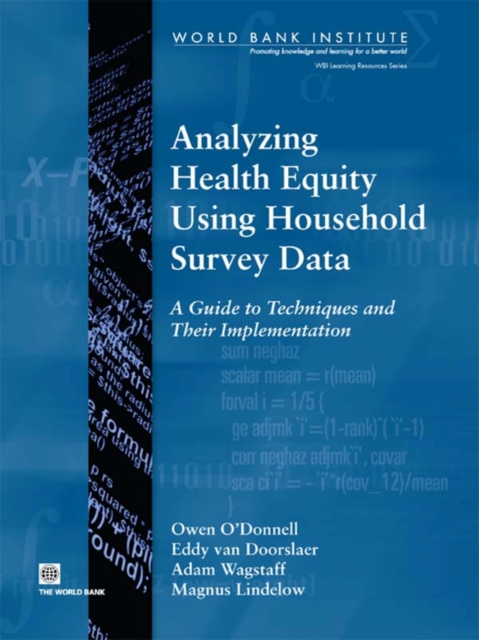
Analyzing health equity using household survey data : a guide to techniques and their implementation
This book provides a step-by-step practical guide to the measurement of a variety of aspects of health equity, with worked examples and code for Stata and SPSS. It also providespractical advice on a variety of associated issues such asmeasuring health and living standards, and the application of regression analysis to health data.
eBook

Equaliberty in the Dutch Caribbean
Equaliberty in the Dutch Caribbean is a collection of
essays that explores fundamental questions of equality and freedom
on the non-sovereign islands of the Dutch Caribbean. Drawing on
in-depth ethnographic research, historical and media analysis, the
study of popular culture, and autoethnographic accounts, the
various contributions challenge conventional assumptions about
political non/sovereignty. While the book recognizes the existence
of nationalist independence movements, it opens a critical space to
look at other forms of political articulation, autonomy, liberty,
and a good life. Focusing on all six different islands and through
a multitude of voices and stories, the volume engages with the
everyday projects, ordinary imaginaries, and dreams of equaliberty
alongside the work of independistas and traditional social
movements aiming for more or full self-determination. As such, it
offers a rich and powerful telling of the various ways of being in
and belonging to our contemporary postcolonial world.
eBook

The OBS UK Dashboard: an interactive tool for representative trial site selection to facilitate equality and diversity in maternity research
Background
Obstetric Bleeding Study UK (OBS UK) (award ID: 152057) is a National Institute for Health and Care Research (NIHR)-funded stepped wedge cluster randomised controlled trial of a complex intervention for postpartum haemorrhage. This was developed in Wales and evaluated in a feasibility study, with improvements in maternal outcomes observed. Generalisability of the findings is limited by lack of control data and limited ethnic diversity in the Welsh obstetric patient population compared to the United Kingdom (UK): 94% of the Welsh population identifies as White, versus 82% in the UK. Non-White ethnicity and socioeconomic deprivation are linked to increased risk of adverse maternal outcomes. Traditionally, decisions regarding site selection are based on desire to complete trials on target in ‘tried and tested’ research active institutions. To ensure widespread applicability of the results and investigate the impact of ethnicity and social deprivation on trial outcomes, maternity units were recruited that represent the ethnic diversity and social deprivation profiles of the UK.
Method
Using routinely collected, publicly available data, an interactive dashboard was developed that demonstrates the demographics of the population served by each maternity unit in the UK, to inform site recruitment. Data on births per year, ethnic and socioeconomic group of the population for each maternity unit, across the UK, were integrated into the dashboard.
Results
The dashboard demonstrates that OBS UK trial sites reflect the ethnic and socioeconomic diversity of the UK (study vs UK population ethnicity: White 79.2% vs 81.7%, Asian 10.5% vs 9.3%, Black 4.7% vs 4.0%, Mixed 2.5% vs 2.9%, Other 3.0% vs 2.1%) with variation in site demography, size and location. Missing data varied across sites and nations and is presented.
Conclusion
The NIHR equality, diversity and inclusion strategy states studies must widen participation, facilitating individuals from all backgrounds to engage. The development of this novel interactive dashboard demonstrates an innovative way of achieving this. National Health Service (NHS) maternity researchers should consider using this tool to enhance diversity in research, address health disparities and improve generalisability of findings. This approach could be applied to healthcare settings beyond maternity care and across different global populations.
Trial registration
ISRCTN 17679951. Registered on August 30, 2023.
Journal Article

The conciliation in the University, a matter only of women?
Work and professional life reconciling difficulties constitute, in practice, one of the main factors that causes inequality of opportunities between men and women in work and academic field. Although it is a fact that still often goes unnoticed, the Spanish Universities, despite the important efforts made in this regard, still suffer from certain defects that indirectly undermine the professional and academic career of people with family charges, having an especially impact on the female collective. In this paper, some of the causes of inequality are analyzed and improvement strategies are proposed in order to solve the problems detected.
Las dificultades de conciliar vida laboral y profesional constituyen, en la práctica, uno de los principales factores que desencadenan la desigualdad de oportunidades que hombres y mujeres presentan en el ámbito laboral y académico. Aunque se trate de un hecho que todavía muchas veces pase desapercibido, las Universidades españolas, pese a los importantes esfuerzos realizados al respecto, todavía adolecen de ciertos defectos que, de forma indirecta, lastran la carrera profesional y académica de las personas con cargas familiares, incidiendo de forma especialmente intensa sobre el colectivo femenino. En el presente trabajo se analizan algunas de las causas de desigualdad y se proponen estrategias de mejora con el fin de solventar los problemas detectados.
Journal Article

On norms and agency
This report provides tremendous insight on gender norms an area that has been resistant to change, and that constrains achievement of gender equality across many diverse cultures. The report synthesizes data collected from more than 4,000 women and men in 97 communities across 20 countries. It is the largest dataset ever collected on the topic of gender and development, providing an unprecedented opportunity to examine potential patterns across communities on social norms and gender roles, pathways of empowerment, and factors that drive acute inequalities. The analysis raises the profile of persistent social norms and their impact on agency, and catalyzes discourse on the many pathways that create opportunities for women and men to negotiate transformative change. The report is underpinned by the fact that arguably the single most important contribution to development is to unleash the full power of half the people on the planet women. It underscores how crucial making investments in learning, supporting innovations that reduce the time costs of women s mobility, and developing a critical mass of women and men pushing the boundaries of entrenched social norms are in enhancing women s agency and capacity to aspire.
eBook