
Catalogue Search | MBRL


Are you sure you want to remove the book from the shelf?

{{itemTitle}}
199
result(s) for
"Erasmus Darwin"
Sort by:

Erasmus Darwin and the Biopolitics of the Vital Habit
This essay investigates the vitalistic theory of habit formulated by Edinburgh physicians, especially Erasmus Darwin. In so doing, it elucidates how Darwin envisioned the epigenetic transmission of acquired habits to facilitate the gradual improvement and progressive transformation of the human species. As a poet-physician, Darwin employed his poetry as transformative medicine, aiming to inculcate healthier habits of imagination in his readers. Drawing on Michel Foucault’s theory of biopower and Roberto Esposito’s negative and positive biopolitics, this essay sheds light on the simultaneously radical and reactionary, or liberatory and oppressive power of vital habit in Darwin’s poetics.
Journal Article

Eighteenth-Century Environmental Humanities
This groundbreaking new volume unites eighteenth-century studies and the environmental humanities, showcasing how these fields can vibrantly benefit one another. In eleven chapters that engage a variety of eighteenth-century texts, contributors explore timely themes and topics such as climate change, new materialisms, the blue humanities, indigeneity and decoloniality, and green utopianism. Additionally, each chapter reflects on pedagogical concerns, asking: How do we teach eighteenth-century environmental humanities? With particular attention to the voices of early-career scholars who bring cutting-edge perspectives, these essays highlight vital and innovative trends that can enrich both disciplines, making them essential for classroom use.
eBook

Epigenesis by experience: Romantic empiricism and non-Kantian biology
Reconstructions of Romantic-era life science in general, and epigenesis in particular, frequently take the Kantian logic of autotelic \"self-organization\" as their primary reference point. I argue in this essay that the Kantian conceptual rubric hinders our historical and theoretical understanding of epigenesis, Romantic and otherwise. Neither a neutral gloss on epigenesis, nor separable from the epistemological deflation of biological knowledge that has received intensive scrutiny in the history and philosophy of science, Kant's heuristics of autonomous \"self-organization\" in the third Critique amount to the strategic capture of epigenesis from nature, for thought, in thought's critical transcendence of nature. This essay looks to Jean-Baptiste Lamarck and his English contemporary Erasmus Darwin to begin to reconstruct the rigorously materialist, naturalist, and empiricist theories of epigenesis (still) marginalized by Kantian argumentation. As theorists of environmental and social collaboration in the ontogeny of viable forms, Lamarck and Darwin illuminate features of our own epigenetic turn obscured by the rhetoric of \"selforganization,\" allowing us to glimpse an alternative Romantic genealogy of the biological present.
Journal Article
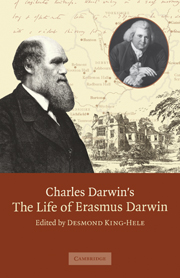
Charles Darwin's 'The Life of Erasmus Darwin'
Charles Darwin's book about his grandfather, The Life of Erasmus Darwin, is curiously fascinating. Before publication in 1879, it was shortened by 16%, with several of the cuts directed at its most provocative parts. The cutter, with Charles's permission, was his daughter Henrietta - an example of the strong hidden hand of meek-seeming Victorian women. Originally published in 2003, this first unabridged edition, edited by Desmond King-Hele, includes all that Charles originally intended, the cuts being restored and printed in italics. Erasmus Darwin was one of the leading intellectuals of the eighteenth century. He was a respected physician, a well-known poet, a keen mechanical inventor, and a founding member of the influential Lunar Society. He also possessed an amazing insight into the many branches of physical and biological science. Most notably, he adopted what we now call biological evolution as his theory of life, 65 years prior to Charles Darwin's Origin of Species.
eBook

The life of Erasmus Darwin
Charles Darwin's book about his grandfather, The Life of Erasmus Darwin, is curiously fascinating. Before publication in 1879, it was shortened by 16%, with several of the cuts directed at its most provocative parts. The cutter, with Charles's permission, was his daughter Henrietta - an example of the strong hidden hand of meek-seeming Victorian women. Originally published in 2003, this first unabridged edition, edited by Desmond King-Hele, includes all that Charles originally intended, the cuts being restored and printed in italics. Erasmus Darwin was one of the leading intellectuals of the eighteenth century. He was a respected physician, a well-known poet, a keen mechanical inventor, and a founding member of the influential Lunar Society. He also possessed an amazing insight into the many branches of physical and biological science. Most notably, he adopted what we now call biological evolution as his theory of life, 65 years prior to Charles Darwin's Origin of Species.
eBook

All Quiet with Darwin: Animal Suffering and Divine Benevolence in Historical Perspective
During the minute it takes me to compose this sentence, thousands of animals are being eaten alive; others are running for their lives, whimpering with fear; others are being slowly devoured from within by rasping parasites; thousands of all kinds are dying of starvation, thirst and disease.2 In the opinion of many, such animal life is incompatible with faith in a benevolent God who is the Creator of all living things and the source of all good.3 To reinforce these arguments, reference is often made to Darwin's theory of evolution.4 Darwinism would pose an unprecedented challenge to the belief in God because it depicts the suffering of animals not as something incidental but as an essential part of the course of events in nature.5 Apparently survival of the best adapted at the expense of what is weak is, after all, diametrically opposed to the image of God as depicted in the Bible, someone who takes care of the weak and vulnerable.6 The question, however, is to what extent the idea that believing in God only became problematic after Darwin is correct. At first sight this sounds plausible but whether the idea that God's active involvement with animal suffering in this way indeed only arose after and because of Darwin requires further investigation; without such research it cannot be ruled out with certainty that already prior to Darwin, animal suffering was viewed as something that God could use as a means to achieve the goal he intends, in which case the argument that Darwin introduced a new element into the discussion does not hold up. [...]we need to know what was written about animal suffering before Darwin and whether this changed after he published his theory. If astronomy unfolds to us the wonders of creation in the immensity of space, geology displays these wonders in the immensity of time.11 The minority who wished to hold to a six-day creation week fought a rearguard action.12 Nor did Darwin's theory of evolution pose a new threat for the belief that animals suffer and die because of Adam's sin; that his transgression had caused the fall of all living beings from primeval peace and happiness had always been a controversial doctrine throughout the ages.13 Quoting William Buckland-the founder of the science of geology-illustrates how this was thought about in the decades prior to Darwin: \"the brute creation death is in no way connected with the moral misconduct of the human race, and that whether Adam had, or had not, ever transgressed, a termination by death is, and always has been, the condition on which life was given to every individual. \"16 Deep evolutionary time was not something that Christians who wanted to hold on to the belief that God had created the universe could not accept, and Darwin's theory of evolution did not change this.
Journal Article

A Poetry of Science or a Science of Poetry?: The Speculative Method of Erasmus Darwin (1731–1802)
Specialization was not in the lexicon of Erasmus Darwin (1731–1802): doctor, scientist, poet, inventor, and socialite. By profession, he was an unparalleled general physician with a universality of mind that infused his practice of medicine as well as his technical innovation, scientific observation, and poetic vision. For Darwin, scientific findings involved a mixture of informed conjecture and imagination. Darwin’s approach to poetry hinged on this ability to illumine a scope of subjects with concise couplets supported by imaginative exposition and speculation. Scientific facts and theories interwoven with mythological places and characters constitute his “hypotheses”. Writing in an instructive and captivating manner, Darwin became the only best selling scientific poet in English history, largely due to his steadfast conviction that poetry should amuse and entertain the public. His poetry, and in particular his choice to recruit science and technology as its subject matter, will be discussed in this paper. The focus will be on two of Darwin’s long poems. The first, “The Botanic Garden”, is divided into Part I ‘The Economy of Vegetation’ (1791) and Part II ‘The Loves of the Plants’ (1789). The second poem is the posthumous “The Temple of Nature” (1803). Darwin’s speculative method will be shown through close analysis of these works.
Journal Article

Evolution, Two Darwins, and the Gestalt Imagining of Edward Lear
Edward Lear was in the vanguard of cultural assimilation of evolutionary theory. In what amounts to a gestalt relationship, some of his published \"nonsense\" figures against, and largely derives its meaning from, innovation in the natural sciences. Certain of his works, some not previously interpreted, are specific in their engagement with evolutionists, including Erasmus and Charles Darwin, Etienne Geoffroy Saint-Hilaire, and Robert Grant. Before and after the appearance of On the Origin of Species (1859), Lear backs one side against another in public debates sparked by evolutionary theory. His implicit engagement with the new biology becomes evident in close attention to the drawings, which are essential components of Lear's innovative hybridization of visual and literary artforms.
Journal Article

Erasmus Darwin, 18th-Century Polymath
Erasmus Darwin was a founding member of the Lunar Society of Birmingham, the members of which were referred to as “Lunaticks.” He is here described as a polymath, an 18th-century “natural philosopher” who was a physician, scientist (with interests in botany, zoology, meteorology, chemistry, among others), inventor, and poet who also advanced quite profound evolutionary ideas two generations prior to those of his grandson, Charles Robert Darwin.
Journal Article

Like Grandfather, Like Grandson: Erasmus and Charles Darwin on evolution
Last year (2009) marked the bicentenary of Charles Darwin's birth and the sesquicentenary of The Origin of Species . This article examines the influence of Erasmus Darwin on Charles's evolutionary thought and shows how, in many ways, Erasmus anticipated his much better-known grandson. It discusses the similarity in the mindsets of the two Darwins, asks how far the younger Darwin was exposed to the elder's evolutionary thought, examines the similarities and differences in their theories of evolution, and ends by showing the surprising similarity between their theories of inheritance. Erasmus's influence on Charles is greater than customarily acknowledged, and now is an opportune time to bring the grandfather out from behind the glare of his stellar grandson.
Journal Article