
Catalogue Search | MBRL


Are you sure you want to remove the book from the shelf?

{{itemTitle}}
4,054
result(s) for
"Error correcting codes"
Sort by:
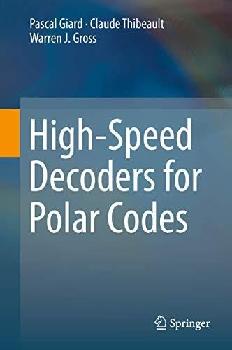
High-speed decoders for polar codes
A new class of provably capacity achieving error-correction codes, polar codes are suitable for many problems, such as lossless and lossy source coding, problems with side information, multiple access channel, etc. The first comprehensive book on the implementation of decoders for polar codes, the authors take a tutorial approach to explain the practical decoder implementation challenges and trade-offs in either software or hardware. They also demonstrate new trade-offs in latency, throughput, and complexity in software implementations for high-performance computing and GPGPUs, and hardware implementations using custom processing elements, full-custom application-specific integrated circuits (ASICs), and field-programmable-gate arrays (FPGAs). Presenting a good overview of this research area and future directions, High-Speed Decoders for Polar Codes is perfect for any researcher or SDR practitioner looking into implementing efficient decoders for polar codes, as well as students and professors in a modern error correction class. As polar codes have been accepted to protect the control channel in the next-generation mobile communication standard (5G) developed by the 3GPP, the audience includes engineers who will have to implement decoders for such codes and hardware engineers designing the backbone of communication networks.
Book

Algebra and coding theory : virtual conference in honor of Tariq Rizvi, Noncommutative rings and their Applications VII, July 5-7, 2021, Université d'Artois, Lens, France : virtual conference on Quadratic forms, rings and codes, July 8, 2021, Université d'Artois, Lens, France
This volume contains the proceedings of the Virtual Conference on Noncommutative Rings and their Applications VII, in honor of Tariq Rizvi, held from July 5-7, 2021, and the Virtual Conference on Quadratic Forms, Rings and Codes, held on July 8, 2021, both of which were hosted by the Universite d'Artois, Lens, France.The articles cover topics in commutative and noncommutative algebra and applications to coding theory. In some papers, applications of Frobenius rings, the skew group rings, and iterated Ore extensions to coding theory are discussed. Other papers discuss classical topics, such as Utumi rings, Baer rings, nil and nilpotent algebras, and Brauer groups. Still other articles are devoted to various aspects of the elementwise study for rings and modules. Lastly, this volume includes papers dealing with questions in homological algebra and lattice theory. The articles in this volume show the vivacity of the research of noncommutative rings and its influence on other subjects.
eBook

Construction of Binary Quantum Error-Correcting Codes from Orthogonal Array
By using difference schemes, orthogonal partitions and a replacement method, some new methods to construct pure quantum error-correcting codes are provided from orthogonal arrays. As an application of these methods, we construct several infinite series of quantum error-correcting codes including some optimal ones. Compared with the existing binary quantum codes, more new codes can be constructed, which have a lower number of terms (i.e., the number of computational basis states) for each of their basis states.
Journal Article

Neural-enabled quantum information hiding with error-correcting codes: a novel framework for arbitrary quantum state embedding
Quantum information hiding, as an extension of classical information hiding techniques into the realm of quantum information, currently focuses on embedding classical bits (0/1) within quantum carriers. This includes methods such as disguising classical secret information as channel noise and embedding it within quantum error correction codes. However, the embedding mechanism for arbitrary quantum states
α
|
0
〉
+
β
|
1
〉
is still in the exploratory stage. This paper proposes an innovative framework that leverages the redundant space of quantum error correction codes to construct a nonlinear decoding architecture with quantum neural networks. This approach simultaneously achieves both carrier state error correction and secret state embedding and extraction functions. Specifically, the [5,1,3] stabilizer code is used as the carrier, with secret state embedding achieved through single-qubit substitution, and a quantum autoencoder is designed for steganographic state information decoding. The proposed framework features fully quantum-based input/output systems, overcoming the limitations of traditional variational quantum circuits that rely on probabilistic measurements for output generation. By performing full ground-state measurements at the autoencoder bottleneck layer and optimizing the parallel sub-network architecture, the network achieves efficient convergence and effective extraction of single-copy quantum states. Experimental results show that under the conditions of optimized parameters and data size of 20, the training losses for the carrier and secret states are 0.03 and 0.08, respectively, with test fidelities of 0.92 and 0.93. For a data size of 50, the secret states recovery fidelity exceeds 0.87. KS test analysis indicates that the full ground-state measurement and parallel sub-network are key strategies for achieving network performance. Equivalent error analysis shows that this approach successfully utilizes the potential redundant space of quantum error correction codes, providing new research directions for quantum state information hiding.
Journal Article
Quantum Error-Correcting Codes Based on Orthogonal Arrays
In this paper, by using the Hamming distance, we establish a relation between quantum error-correcting codes ((N,K,d+1))s and orthogonal arrays with orthogonal partitions. Therefore, this is a generalization of the relation between quantum error-correcting codes ((N,1,d+1))s and irredundant orthogonal arrays. This relation is used for the construction of pure quantum error-correcting codes. As applications of this method, numerous infinite families of optimal quantum codes can be constructed explicitly such as ((3,s,2))s for all si≥3, ((4,s2,2))s for all si≥5, ((5,s,3))s for all si≥4, ((6,s2,3))s for all si≥5, ((7,s3,3))s for all si≥7, ((8,s2,4))s for all si≥9, ((9,s3,4))s for all si≥11, ((9,s,5))s for all si≥9, ((10,s2,5))s for all si≥11, ((11,s,6))s for all si≥11, and ((12,s2,6))s for all si≥13, where s=s1⋯sn and s1,…,sn are all prime powers. The advantages of our approach over existing methods lie in the facts that these results are not just existence results, but constructive results, the codes constructed are pure, and each basis state of these codes has far less terms. Moreover, the above method developed can be extended to construction of quantum error-correcting codes over mixed alphabets.
Journal Article

HEDGES error-correcting code for DNA storage corrects indels and allows sequence constraints
Synthetic DNA is rapidly emerging as a durable, high-density information storage platform. A major challenge for DNA-based information encoding strategies is the high rate of errors that arise during DNA synthesis and sequencing. Here, we describe the HEDGES (Hash Encoded, Decoded by Greedy Exhaustive Search) error-correcting code that repairs all three basic types of DNA errors: insertions, deletions, and substitutions. HEDGES also converts unresolved or compound errors into substitutions, restoring synchronization for correction via a standard Reed–Solomon outer code that is interleaved across strands. Moreover, HEDGES can incorporate a broad class of user-defined sequence constraints, such as avoiding excess repeats, or too high or too low windowed guanine–cytosine (GC) content. We test our code both via in silico simulations and with synthesized DNA. From its measured performance, we develop a statistical model applicable to much larger datasets. Predicted performance indicates the possibility of error-free recovery of petabyte- and exabyte-scale data from DNA degraded with as much as 10% errors. As the cost of DNA synthesis and sequencing continues to drop, we anticipate that HEDGES will find applications in large-scale error-free information encoding.
Journal Article

Noncommutative rings and their applications : International Conference on Noncommutative Rings and Their Applications, July 1-4, 2013, Université d'Artois, Lens, France
This volume contains the Proceedings of an International Conference on Noncommutative Rings and Their Applications, held July 1-4, 2013, at the Universite d'Artois, Lens, France. It presents recent developments in the theories of noncommutative rings and modules over such rings as well as applications of these to coding theory, enveloping algebras, and Leavitt path algebras.Material from the course ``Foundations of Algebraic Coding Theory``, given by Steven Dougherty, is included and provides the reader with the history and background of coding theory as well as the interplay between coding theory and algebra. In module theory, many new results related to (almost) injective modules, injective hulls and automorphism-invariant modules are presented. Broad generalizations of classical projective covers are studied and category theory is used to describe the structure of some modules. In some papers related to more classical ring theory such as quasi duo rings or clean elements, new points of view on classical conjectures and standard open problems are given. Descriptions of codes over local commutative Frobenius rings are discussed, and a list of open problems in coding theory is presented within their context.
eBook

PudgyTurtle Mode Resists Bit-Flipping Attacks
Cryptosystems employing a synchronous binary-additive stream cipher are susceptible to a generic attack called ’bit-flipping’, in which the ciphertext is modified to decrypt into a fraudulent message. While authenticated encryption and message authentication codes can effectively negate this attack, encryption modes can also provide partial protection against bit-flipping. PudgyTurtle is a stream-cipher mode which uses keystream to encode (via an error-correcting code) and to encipher (via modulo-2 addition). Here, we describe the behavior of this mode during bit-flipping attacks and demonstrate how it creates uncertainty about the number, positions, and identities of decrypted bits that will be affected.
Journal Article

Experimental deterministic correction of qubit loss
The successful operation of quantum computers relies on protecting qubits from decoherence and noise, which—if uncorrected—will lead to erroneous results. Because these errors accumulate during an algorithm, correcting them is a key requirement for large-scale and fault-tolerant quantum information processors. Besides computational errors, which can be addressed by quantum error correction
1
–
9
, the carrier of the information can also be completely lost or the information can leak out of the computational space
10
–
14
. It is expected that such loss errors will occur at rates that are comparable to those of computational errors. Here we experimentally implement a full cycle of qubit loss detection and correction on a minimal instance of a topological surface code
15
,
16
in a trapped-ion quantum processor. The key technique used for this correction is a quantum non-demolition measurement performed via an ancillary qubit, which acts as a minimally invasive probe that detects absent qubits while imparting the smallest quantum mechanically possible disturbance to the remaining qubits. Upon detecting qubit loss, a recovery procedure is triggered in real time that maps the logical information onto a new encoding on the remaining qubits. Although the current demonstration is performed in a trapped-ion quantum processor
17
, the protocol is applicable to other quantum computing architectures and error correcting codes, including leading two- and three-dimensional topological codes. These deterministic methods provide a complete toolbox for the correction of qubit loss that, together with techniques that mitigate computational errors, constitute the building blocks of complete and scalable quantum error correction.
A deterministic correction of errors caused by qubit loss or leakage outside the computational space is demonstrated in a trapped-ion experiment by using a minimal instance of the topological surface code.
Journal Article

Reading and writing digital data in DNA
Because of its longevity and enormous information density, DNA is considered a promising data storage medium. In this work, we provide instructions for archiving digital information in the form of DNA and for subsequently retrieving it from the DNA. In principle, information can be represented in DNA by simply mapping the digital information to DNA and synthesizing it. However, imperfections in synthesis, sequencing, storage and handling of the DNA induce errors within the molecules, making error-free information storage challenging. The procedure discussed here enables error-free storage by protecting the information using error-correcting codes. Specifically, in this protocol, we provide the technical details and precise instructions for translating digital information to DNA sequences, physically handling the biomolecules, storing them and subsequently re-obtaining the information by sequencing the DNA. Along with the protocol, we provide computer code that automatically encodes digital information to DNA sequences and decodes the information back from DNA to a digital file. The required software is provided on a Github repository. The protocol relies on commercial DNA synthesis and DNA sequencing via Illumina dye sequencing, and requires 1–2 h of preparation time, 1/2 d for sequencing preparation and 2–4 h for data analysis. This protocol focuses on storage scales of ~100 kB to 15 MB, offering an ideal starting point for small experiments. It can be augmented to enable higher data volumes and random access to the data and also allows for future sequencing and synthesis technologies, by changing the parameters of the encoder/decoder to account for the corresponding error rates.
DNA has the capacity to store large amounts of information for very long durations. This protocol describes encoding of digital files as DNA and the error-free retrieval of the stored data from the sequenced data.
Journal Article