
Catalogue Search | MBRL


Are you sure you want to remove the book from the shelf?

{{itemTitle}}
7,634
result(s) for
"Espanol"
Sort by:

El movimiento lexicográfico hispanoamericano del siglo XIX y la creación de las academias correspondientes
The purpose of this paper is to relate the creation of the corresponding academies of the RoyalSpanish Academy during the last quarter of the nineteenth century with the progress that had been takingplace for several decades in lexical studies on the Spanish language. In other words, it is intended to invertthe order of the terms by understanding that the creation of the corresponding academies was the result ofinterests in lexicographic study and not that the foundation of these corporations was what motivated the riseof the discipline to elaborate dictionaries on American Spanish.
Journal Article

Preparing for Study Abroad
Study abroad (SA) provides a space and place for second language (L2) learners to be challenged in terms of their target language skills and intercultural awareness. In order to appropriately equip learners, a task-based approach seems ideal to identify learners’ specific needs (Long 2015). The present study reports a multiphase needs analysis carried out to design a university Spanish course, geared toward students preparing to study abroad in the following semester. In phase 1, qualitative interviews were conducted by contacting resident directors and students who had returned from their study abroad programs. These interviews generated a list of 37 tasks. In phase 2, 40 students, who had completed their study abroad semester, rated the frequency and difficulty of each task on a 37-item Likert-type questionnaire. Finally, in phase 3, researchers analyzed and categorized target tasks identified in the needs assessment into five major target task types. Altogether, results suggest that learner needs in this particular institution center predominantly around tasks that involve the use of colloquial and academic speech in environments in which students need to adapt to unfamiliar situations. These reports then informed course objectives and classroom tasks.
Journal Article

Reconceptualizing Spanish Teaching and Learning in Disruptive Times
World language classrooms in the United States have been significantly impacted by the physical and ideological disruptions experienced in recent history. Such disruptive times call for the reform of pedagogical practices to raise awareness of social justice issues and ignite real change both in and out of language classrooms. This essay outlines the comprehensive curriculum redesign of a university Spanish program that reconceptualized the teaching and learning of Spanish through the lens of global competence. Informed by a sociocultural approach and current research trends in second language acquisition, the redesigned program carefully scaffolds learning across five levels that are distinguished by content themes, linguistic proficiency, and cognitive complexity. The transformations resulting from this curricular redesign have enabled members of the Spanish program to not only bring diverse societal issues to the forefront, but also make the sharp pedagogical pivots necessary since the onset of the global pandemic. By evolving with the field, the needs of learners, and societal concerns, curricular redesign can bring about real transformations that facilitate language development by reshaping how we communicate meaning ethically and equitably.
Journal Article

NOVELLA SUÁREZ, Jorge (2021). La aventura del pensamiento español. Madrid: Sindéresis
Reseña de NOVELLA SUÁREZ, Jorge (2021). La aventura del pensamiento español. Madrid: Sindéresis
Journal Article

El léxico y las variedades en los manuales de español como lengua extranjera/segunda lengua usados en Colombia: opiniones y expectativas docentes
Los manuales y materiales didácticos desempeñan un importante papel en la enseñanza-aprendizaje del español como lengua extranjera/segunda lengua (ele/L2). El presente estudio cualitativo examina cómo la experiencia y opinión de los docentes es determinante en la elección de dichos materiales y cómo es importante conocer las expectativas y valoraciones de los docentes sobre la adecuación de los manuales a las necesidades de sus aprendices. El estudio revisa los manuales y materiales de ele/L2 producidos en Colombia desde 2008 hasta la actualidad, y analiza los resultados de una encuesta de 22 preguntas, realizada a 61 profesores del ámbito, que ejercen en el país, con el fin de sondear especialmente sus creencias y actitudes, sus opiniones sobre el léxico y las variedades del español en los manuales, así como sugerencias y propuestas de mejora. Los resultados evidencian la concienciación sobre la diversidad del español y su importancia en la enseñanza-aprendizaje de ele/L2. Los encuestados mostraron una fuerte relación identitaria con su variedad lingüística y señalaron la necesidad de integrarla al aula. De igual modo, algunas sugerencias reclamaron mayor atención a los componentes cultural e intercultural y su rentabilización para trabajar léxico variable, y un tratamiento riguroso de la variación del español según secuenciación, extensión y rentabilidad. Este estudio propende por llevar el ámbito de ele hacia un modelo más realista, plural e intercultural inclinando a replantear tanto los materiales como el rol del profesor y los objetivos de aprendizaje.
Journal Article

La variation graphique du français dans les dictionnaires français-espagnol des XVIIe et XVIIIe siècles
Since the sixteenth century, the orthography inherited from Middle French, highly
historical and etymological, was questioned, both in theory and in practice, by the proponents
of its simplification. In all kinds of writings, the forms of the old spelling coexisted with those
of the new one; hence the orthographic variation inherent in the French of the sixteenth, seventeenth and eighteenth centuries. It can be seen, however, that, in printed texts, many authors
opted for one rather than the other of the two graphic models. Starting from these premises, I
analyse in this article the predominant orthographic uses in the main French-Spanish dictionaries published at the time
Depuis le XVIe siècle, l’orthographe héritée du moyen français, fortement historique
et étymologisante, était remise en question, dans la théorie et dans la pratique, par les partisans
de sa simplification. Dans tout genre d’écrits, les formes de l’ancienne orthographe coexistaient
avec celles de la nouvelle, d’où la variance orthographique inhérente au français des XVIe
, XVIIe
et XVIIIe siècles. On observe, toutefois, que, dans les textes imprimés, biens des auteurs ont
opté plutôt pour l’un que pour l’autre des deux modèles graphiques. À partir de ces prémisses,
nous analysons dans cet article les choix orthographiques prépondérants dans les principaux
dictionnaires franco-espagnols publiés à l’époque.
Desde el siglo XVI, la ortografía heredada del francés medio, fuertemente histórica y
etimologista, estaba puesta en tela de juicio, en la teoría y en la práctica, por los partidarios de
simplificarla. En toda suerte de escritos, las formas de la antigua ortografía coexistían con las
de la nueva; de ahí la variación ortográfica inherente al francés de los siglos XVI, XVII y XVIII.
Se observa, con todo, que, en los textos impresos, muchos autores optaron más bien por uno
que por el otro modelo gráfico. Con estas premisas, analizamos en este artículo los usos ortográficos preponderantes en los principales diccionarios franco-españoles publicados en la época.
Journal Article
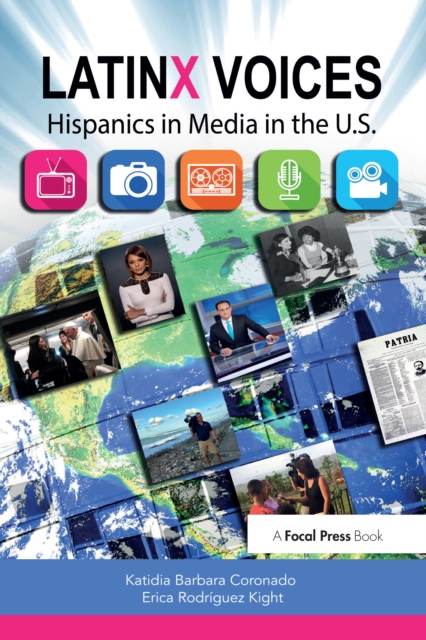
LatinX Voices
LatinX Voices: Hispanics in Media in the U.S. is the first undergraduate textbook to pro vide an overview of Hispanic/LatinX Media in the U.S., with chapters written by top scholars and professionals, giving readers an understanding of how the LatinX audience has transformed media in the United States. Editors Katidia Barbara Coronado and Erica Rodríguez Kight cover this evolving industry with years of professional and research experience, as well as years of teaching broadcast media courses in the classroom. Students will discover unique perspectives on topics related to Latin American areas of interest. With chapters from professionals who have left their mark in print, radio, television, film, and new media, this volume brings together expert voices in Hispanic/LatinX media from across the U.S., and explains the impact of this population on the media industry today.
eBook

ESTUDIOS SOBRE LA DIVERSIDAD DE LOS ENVEJECIMIENTOS EN AMÉRICA LATINA Y EL CARIBE REVISIÓN SISTEMATIZADA EN CUATRO CRUCES
El artículo presenta los resultados de una revisión bibliográfica cuyo objetivo fue producir un estado del arte sobre la diversidad en el campo gerontológico en América Latina y el Caribe. Se revisaron estudios realizados entre el 2010 y 2021, sobre las experiencias de envejecimiento de personas mayores con discapacidad, LGTB, migrantes y de los pueblos originarios. La revisión bibliográfica fue guiada por el método SALSA (Search, AppraisaL, Synthesis and Analysis). Los resultados fueron analizados por grupo, mostrando para cada uno temas centrales: para el grupo discapacidad, las limitaciones en la vejez como generadoras de deterioro y declive imposibilitando la participación social; para el grupo LGTB, el peso de las normas sociales que restringen la expresión de identidades sexuales y de género disidentes; para el grupo migraciones, el cruce con el tema de los cuidados y las ambivalencias ligadas a un curso de vida binacional; para el grupo pueblos originarios, las tensiones entre la cosmovisión de las personas y los cambios culturales impactando su rol social. Se identificaron ejes discursivos transversales en el corpus, destacando la vejez desigual y excluyente que muchas personas experimentan al mismo tiempo que la capacidad de agencia, reinvención y resistencia que manifiestan en sus prácticas cotidianas.
Journal Article