
Catalogue Search | MBRL


Are you sure you want to remove the book from the shelf?

{{itemTitle}}
1,576
result(s) for
"Estadística"
Sort by:

Univariate, bivariate, and multivariate statistics using R : quantitative tools for data analysis and data science
A practical source for performing essential statistical analyses and data management tasks in R Univariate, Bivariate, and Multivariate Statistics Using R offers a practical and very user-friendly introduction to the use of R software that covers a range of statistical methods featured in data analysis and data science.
eBook

Imaging features and safety and efficacy of endovascular stroke treatment: a meta-analysis of individual patient-level data
Evidence regarding whether imaging can be used effectively to select patients for endovascular thrombectomy (EVT) is scarce. We aimed to investigate the association between baseline imaging features and safety and efficacy of EVT in acute ischaemic stroke caused by anterior large-vessel occlusion.
In this meta-analysis of individual patient-level data, the HERMES collaboration identified in PubMed seven randomised trials in endovascular stroke that compared EVT with standard medical therapy, published between Jan 1, 2010, and Oct 31, 2017. Only trials that required vessel imaging to identify patients with proximal anterior circulation ischaemic stroke and that used predominantly stent retrievers or second-generation neurothrombectomy devices in the EVT group were included. Risk of bias was assessed with the Cochrane handbook methodology. Central investigators, masked to clinical information other than stroke side, categorised baseline imaging features of ischaemic change with the Alberta Stroke Program Early CT Score (ASPECTS) or according to involvement of more than 33% of middle cerebral artery territory, and by thrombus volume, hyperdensity, and collateral status. The primary endpoint was neurological functional disability scored on the modified Rankin Scale (mRS) score at 90 days after randomisation. Safety outcomes included symptomatic intracranial haemorrhage, parenchymal haematoma type 2 within 5 days of randomisation, and mortality within 90 days. For the primary analysis, we used mixed-methods ordinal logistic regression adjusted for age, sex, National Institutes of Health Stroke Scale score at admission, intravenous alteplase, and time from onset to randomisation, and we used interaction terms to test whether imaging categorisation at baseline modifies the association between treatment and outcome. This meta-analysis was prospectively designed by the HERMES executive committee but has not been registered.
Among 1764 pooled patients, 871 were allocated to the EVT group and 893 to the control group. Risk of bias was low except in the THRACE study, which used unblinded assessment of outcomes 90 days after randomisation and MRI predominantly as the primary baseline imaging tool. The overall treatment effect favoured EVT (adjusted common odds ratio [cOR] for a shift towards better outcome on the mRS 2·00, 95% CI 1·69–2·38; p<0·0001). EVT achieved better outcomes at 90 days than standard medical therapy alone across a broad range of baseline imaging categories. Mortality at 90 days (14·7% vs 17·3%, p=0·15), symptomatic intracranial haemorrhage (3·8% vs 3·5%, p=0·90), and parenchymal haematoma type 2 (5·6% vs 4·8%, p=0·52) did not differ between the EVT and control groups. No treatment effect modification by baseline imaging features was noted for mortality at 90 days and parenchymal haematoma type 2. Among patients with ASPECTS 0–4, symptomatic intracranial haemorrhage was seen in ten (19%) of 52 patients in the EVT group versus three (5%) of 66 patients in the control group (adjusted cOR 3·94, 95% CI 0·94–16·49; pinteraction=0·025), and among patients with more than 33% involvement of middle cerebral artery territory, symptomatic intracranial haemorrhage was observed in 15 (14%) of 108 patients in the EVT group versus four (4%) of 113 patients in the control group (4·17, 1·30–13·44, pinteraction=0·012).
EVT achieves better outcomes at 90 days than standard medical therapy across a broad range of baseline imaging categories, including infarcts affecting more than 33% of middle cerebral artery territory or ASPECTS less than 6, although in these patients the risk of symptomatic intracranial haemorrhage was higher in the EVT group than the control group. This analysis provides preliminary evidence for potential use of EVT in patients with large infarcts at baseline.
Medtronic.
Journal Article

Principios de Estadística Descriptiva y Probabilidad
Principios de estadistica descriptiva y probabilidad es una unidad didactica dirigida a quienes se esten formando en el ejercicio profesional de la carrera de Ensenanza de la Matematica de la Universidad Estatal a Distancia y, ademas, para el publico en general que desee iniciarse en el estudio autonomo del analisis estadistico de datos desde un nivel introductorio. En este libro se examinan contenidos generales de estadistica descriptiva, tales como presentacion de la informacion, distribucion de frecuencias, medidas de posicion y de dispersion, y algunos temas elementales de combinatoria, asi como introduccion al estudio de las probabilidades y las variables aleatorias discretas, y su aplicacion para resolver problemas relacionados con el contexto de la docencia de la matematica. Esta obra se enfoca en la aplicacion practica de los contenidos sin dejar de lado la parte formal y axiomatica. Por lo tanto, a traves de ejemplos y problemas resueltos, se invita a utilizar principios teoricos en situaciones concretas, para contribuir al desarrollo de habilidades y destrezas relacionadas con el analisis de datos, la toma de decisiones con base en evidencias y la comunicacion de resultados de manera clara y efectiva.
eBook

Patterns of care and dropout rates from outpatient mental healthcare in low-, middle- and high-income countries from the World Health Organization's World Mental Health Survey Initiative
There is a substantial proportion of patients who drop out of treatment before they receive minimally adequate care. They tend to have worse health outcomes than those who complete treatment. Our main goal is to describe the frequency and determinants of dropout from treatment for mental disorders in low-, middle-, and high-income countries.
Respondents from 13 low- or middle-income countries (
= 60 224) and 15 in high-income countries (
= 77 303) were screened for mental and substance use disorders. Cross-tabulations were used to examine the distribution of treatment and dropout rates for those who screened positive. The timing of dropout was examined using Kaplan-Meier curves. Predictors of dropout were examined with survival analysis using a logistic link function.
Dropout rates are high, both in high-income (30%) and low/middle-income (45%) countries. Dropout mostly occurs during the first two visits. It is higher in general medical rather than in specialist settings (nearly 60%
20% in lower income settings). It is also higher for mild and moderate than for severe presentations. The lack of financial protection for mental health services is associated with overall increased dropout from care.
Extending financial protection and coverage for mental disorders may reduce dropout. Efficiency can be improved by managing the milder clinical presentations at the entry point to the mental health system, providing adequate training, support and specialist supervision for non-specialists, and streamlining referral to psychiatrists for more severe cases.
Journal Article

Biostatistics for oral healthcare
Biostatistics for Oral Healthcare offers students, practitioners and instructors alike a comprehensive guide to mastering biostatistics and their application to oral healthcare. Drawing on situations and methods from dentistry and oral healthcare, this book provides a thorough treatment of statistical concepts in order to promote in-depth and correct comprehension, supported throughout by technical discussion and a multitude of practical examples.
eBook

A Course in Statistics with R
Integrates the theory and applications of statistics using R this book has been written to bridge the gap between theory and applications and explain how mathematical expressions are converted into R programs. The book has been primarily designed as a useful companion for a Masters student during each semester of the course, but will also help applied statisticians in revisiting the underpinnings of the subject. With this dual goal in mind, the book begins with R basics and quickly covers visualization and exploratory analysis. Probability and statistical inference, inclusive of classical, nonparametric, and Bayesian schools, is developed with definitions, motivations, mathematical expression and R programs in a way which will help the reader to understand the mathematical development as well as R implementation.
eBook


Nonparametric statistical methods
Praise for the Second Edition \"This book should be an essential part of the personal library of every practicing statistician.\"—Technometrics Thoroughly revised and updated, the new edition of Nonparametric Statistical Methods includes additional modern topics and procedures, more practical data sets, and new problems from real-life situations. The book continues to emphasize the importance of nonparametric methods as a significant branch of modern statistics and equips readers with the conceptual and technical skills necessary to select and apply the appropriate procedures for any given situation. Written by leading statisticians, Nonparametric Statistical Methods, Third Edition provides readers with crucial nonparametric techniques in a variety of settings, emphasizing the assumptions underlying the methods. The book provides an extensive array of examples that clearly illustrate how to use nonparametric approaches for handling one- or two-sample location and dispersion problems, dichotomous data, and one-way and two-way layout problems. In addition, the Third Edition features: * The use of the freely available R software to aid in computation and simulation, including many new R programs written explicitly for this new edition * New chapters that address density estimation, wavelets, smoothing, ranked set sampling, and Bayesian nonparametrics * Problems that illustrate examples from agricultural science, astronomy, biology, criminology, education, engineering, environmental science, geology, home economics, medicine, oceanography, physics, psychology, sociology, and space science Nonparametric Statistical Methods, Third Edition is an excellent reference for applied statisticians and practitioners who seek a review of nonparametric methods and their relevant applications. The book is also an ideal textbook for upper-undergraduate and first-year graduate courses in applied nonparametric statistics.
eBook
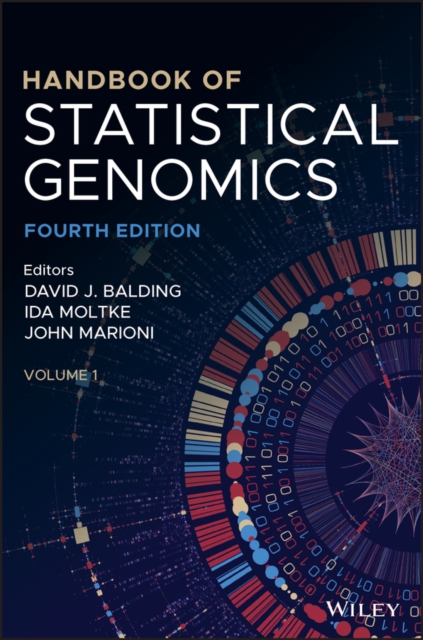
Handbook of Statistical Genomics
A timely update of a highly popular handbook on statistical genomics This new, two-volume edition of a classic text provides a thorough introduction to statistical genomics, a vital resource for advanced graduate students, early-career researchers and new entrants to the field. It introduces new and updated information on developments that have occurred since the 3rd edition. Widely regarded as the reference work in the field, it features new chapters focusing on statistical aspects of data generated by new sequencing technologies, including sequence-based functional assays. It expands on previous coverage of the many processes between genotype and phenotype, including gene expression and epigenetics, as well as metabolomics. It also examines population genetics and evolutionary models and inference, with new chapters on the multi-species coalescent, admixture and ancient DNA, as well as genetic association studies including causal analyses and variant interpretation. The Handbook of Statistical Genomics focuses on explaining the main ideas, analysis methods and algorithms, citing key recent and historic literature for further details and references. It also includes a glossary of terms, acronyms and abbreviations, and features extensive cross-referencing between chapters, tying the different areas together. With heavy use of up-to-date examples and references to web-based resources, this continues to be a must-have reference in a vital area of research. * Provides much-needed, timely coverage of new developments in this expanding area of study * Numerous, brand new chapters, for example covering bacterial genomics, microbiome and metagenomics * Detailed coverage of application areas, with chapters on plant breeding, conservation and forensic genetics * Extensive coverage of human genetic epidemiology, including ethical aspects * Edited by one of the leading experts in the field along with rising stars as his co-editors * Chapter authors are world-renowned experts in the field, and newly emerging leaders. The Handbook of Statistical Genomics is an excellent introductory text for advanced graduate students and early-career researchers involved in statistical genetics.
eBook
Estadística descriptiva y probabilidad
Uno de los principios epistemológicos de valoración de la ciencia es que todo saber debe estar en la posesión de un objeto que causa, motiva y aviva el conocimiento. Sin objeto no hay ciencia, porque no tendría esta a donde dirigir las preguntas y las soluciones. Cuando los objetos se presentan, se da en el interior del hombre la intención de conocerlos y este, motivado por la intención de generar conocimiento, se interesa por todos o algunos escorzos, proyecciones, ingredientes o partes del objeto. Cada uno de esos escorzos es susceptible de ser predicado, sea de manera lógica, ética o estética y de nuevo, esto depende de las intenciones del hombre, de sus deseos, de sus anhelos, de sus dudas, de su quehacer, de sus pretensiones, en general, de su vida como tal. Existen escorzos asociados a objetos que son susceptibles de medida, esto es, que se les puede asignar un número real que los represente y también existen escorzos que son susceptibles de categorizarse, por ejemplo, aquellos que se pueden poner en la categoría amor o en la categoría odio.Si se considera un conjunto de objetos de interés y de dichos objetos se considera, por ejemplo, un escorzo medible, se espera que en todos ellos la medida asociada sea diferente objeto a objeto. Si bien la población de estudio es el conjunto formado por todos los objetos de interés, se puede asumir de manera teórica que la población está conformada solo por el escorzo. La estadística es la ciencia que se encarga de modelar las poblaciones así pensadas, es decir, la estadística explica la manera en la cual se comporta un escorzo particular sobre un conjunto de objetos de interés. Por otra parte, cuando de manera empírica se toma un conjunto particular de objetos de la población teórica y se estudia en dicho conjunto el escorzo de interés, se obtiene un conjunto de medidas o un conjunto de datos, las cuales pueden explicar la población teórica. De esta manera, la estadística se ocupa de explicar los objetos en términos de sus escorzos mediante un subconjunto de una población de interés, es decir, la estadística se encarga de relacionar el mundo teórico y práctico mediante modelos que permiten explicar algunos escorzos.Con el estudio de este libro se logra adquirir las bases teóricas necesarias para comprender conceptos de estadística que permiten establecer relaciones entre el mundo teórico y práctico. Además, cuando se está leyendo este texto se aprende a leer y escribir problemas de naturaleza estadística. De esta manera, además de construir las bases teóricas de la inferencia estadística, este texto permite fortalecer otro tipo de competencias tales como la lectura y la escritura, así como el apropiamiento de procedimientos que son útiles en la práctica.
eBook