
Catalogue Search | MBRL


Are you sure you want to remove the book from the shelf?

{{itemTitle}}
198,989
result(s) for
"Estimation"
Sort by:

Greater estimations
Examples and colorful illustrations introduce beginning readers to the skill of making good estimations with regard to quantity, length, and volume.
Book

Measurement in Medicine
The success of the Apgar score demonstrates the astounding power of an appropriate clinical instrument. This down-to-earth book provides practical advice, underpinned by theoretical principles, on developing and evaluating measurement instruments in all fields of medicine. It equips you to choose the most appropriate instrument for specific purposes. The book covers measurement theories, methods and criteria for evaluating and selecting instruments. It provides methods to assess measurement properties, such as reliability, validity and responsiveness, and interpret the results. Worked examples and end-of-chapter assignments use real data and well-known instruments to build your skills at implementation and interpretation through hands-on analysis of real-life cases. All data and solutions are available online. This is a perfect course book for students and a perfect companion for professionals/researchers in the medical and health sciences who care about the quality and meaning of the measurements they perform.
eBook

Great estimations
Uses a giant jar of jellybeans to introduce the concept of estimation to young readers and challenges them to use the lessons provided to make good estimations of their very own.
Book
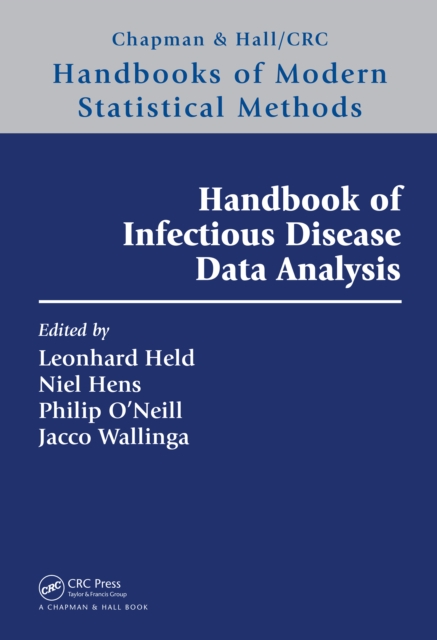
Handbook of Infectious Disease Data Analysis
Recent years have seen an explosion in new kinds of data on infectious diseases, including data on social contacts, whole genome sequences of pathogens, biomarkers for susceptibility to infection, serological panel data, and surveillance data. The Handbook of Infectious Disease Data Analysis provides an overview of many key statistical methods that have been developed in response to such new data streams and the associated ability to address key scientific and epidemiological questions. A unique feature of the Handbook is the wide range of topics covered.
Key features
Contributors include many leading researchers in the field
Divided into four main sections: Basic concepts, Analysis of Outbreak Data, Analysis of Seroprevalence Data, Analysis of Surveillance Data
Numerous case studies and examples throughout
Provides both introductory material and key reference material
I Introduction
1. Introduction Leonhard Held, Niel Hens, Philip O’Neill, Jacco Wallinga
II Basic Concepts
2. Population dynamics of pathogens Ottar Bjornstad
3. Infectious disease data from surveillance, outbreak investigation and epidemiological studies Susan Hahné, Richard Pebody
4. Key concepts in infectious disease epidemiology Nick Jewell
5. Key parameters in infectious disease epidemiology Laura White
6. Contact patterns for contagious diseases Jacco Wallinga, Jan van de Kassteele, Niel Hens
7. Basic stochastic transmission models and their inference Tom Britton
8. Analysis of vaccine studies and causal inference Betz Halloran
III Analysis of Outbreak Data
9. Markov chain Monte Carlo methods for outbreak data Philip O’Neill, Theodore Kypraios
10. Approximate Bayesian Computation methods for epidemic models Peter Neal
11. Iterated filtering methods for Markov process epidemic models Theresa Stocks
12. Pairwise survival analysis of infectious disease transmission data Eben Kenah
13. Methods for outbreaks using genomic data Don Klinkenberg, Caroline Colijn, Xavier Didelot
IV Analysis of Seroprevalence Data
14. Persistence of passive immunity, natural immunity (and vaccination) Amy Winter, Jess Metcalf
15. Inferring the time of infection from serological data Maciej Boni, Kåre Mølbak, Karen Angeliki Krogfelt
16. The use of seroprevalence data to estimate cumulative incidence of infection Ben Cowling, Jessica Wong
17. The analysis of serological data with transmission models Marc Baguelin
18. The analysis of multivariate serological data Steven Abrams
19. Mixture modelling Emanuele Del Fava, Ziv Shkedy
V Analysis of Surveillance Data
20. Modeling infectious diseases distributions: applications of point process methods Peter J Diggle
21. Prospective detection of outbreaks Benjamin Allevius, Michael Höhle
22. Underreporting and reporting delays Angela Noufaily
23. Spatio-temporal analysis of surveillance data Jon Wakefield, Tracy Q Dong, Vladimir N Minin
24. Analysing multiple epidemic data sources Daniela De Angelis, Anne Presanis
25. Forecasting based on surveillance data Leonhard Held, Sebastian Meyer
26. Spatial mapping of infectious disease risk Ewan Cameron
\"One of the editors of the book, Jacco Wallinga, is heading the group at the Dutch Institute of Public Health and the Environment that does all of the statistical analyses to feed their director with information. The latter has had a strong influence on the policy our government chose . . . The book is well produced . . . \" ~Paul Eilers, ISCB News
Leonhard Held is Professor of Biostatistics at the University of Zurich.
Niel Hens is Professor of Biostatistics at Hasselt University and the University of Antwerp.
Philip O’Neill is Professor of Applied Probability at the University of Nottingham.
Jacco Wallinga is Professor of Mathematical Modelling of Infectious Diseases at the Leiden University Medical Center.
eBook


MEASURING THE SENSITIVITY OF PARAMETER ESTIMATES TO ESTIMATION MOMENTS
We propose a local measure of the relationship between parameter estimates and the moments of the data they depend on. Our measure can be computed at negligible cost even for complex structural models. We argue that reporting this measure can increase the transparency of structural estimates, making it easier for readers to predict the way violations of identifying assumptions would affect the results. When the key assumptions are orthogonality between error terms and excluded instruments, we show that our measure provides a natural extension of the omitted variables bias formula for nonlinear models. We illustrate with applications to published articles in several fields of economics.
Journal Article


Handling Endogenous Regressors by Joint Estimation Using Copulas
We propose a new statistical instrument-free method to tackle the endogeneity problem. The proposed method models the joint distribution of the endogenous regressor and the error term in the structural equation of interest (the structural error) using a copula method, and it makes inferences on the model parameters by maximizing the likelihood derived from the joint distribution. Similar to the \"exclusion restriction\" in instrumental variable methods, extant instrument-free methods require the assumption that the unobserved instruments are exogenous, a requirement that is difficult to meet. The proposed method does not require such an assumption. Other benefits of the proposed method are that it allows the modeling of discrete endogenous regressors and offers a new solution to the slope endogeneity problem. In addition to linear models, the method is applicable to the popular random coefficient logit model with either aggregate-level or individual-level data. We demonstrate the performance of the proposed method via a series of simulation studies and an empirical example.
Journal Article


Comment
When testing a simple null hypothesis, like ... as in the present case with ART, the nonuniformity problem outlined in the preceding section is not an issue, however. Here, the quantity of interest is the distribution of the (scaled) estimation error under the null, and this distribution can often be estimated, either directly or (as in the present article) by estimating or approximating the large-sample limit distribution under the null. (ProQuest: ... denotes formulae/symbols omitted.)
Journal Article