
Catalogue Search | MBRL


Are you sure you want to remove the book from the shelf?

{{itemTitle}}
267
result(s) for
"Estime de soi."
Sort by:

Reasonable self-esteem : a life of meaning
\"In this fascinating look at the philosophy of self-esteem, Richard Keshen develops and defends the idea of reasonable self-esteem--a concept based on an ideal of reasonableness--and argues that individuals who think of themselves in terms of this paradigm will lead happier and more fulfilling lives. Keshen presents a set of guidelines for analysing self-esteem and examines various factors that influence our self-esteem, such as other people's evaluations, comparisons with others, social relationships, and inherent qualities. He asserts that self-esteem not founded on individual achievement leads to a continual search for external supports and is easily shaken when such supports are not found. A key element of Keshen's argument is the idea of egalitarian respect, and he shows how we can integrate this idea into our lives. Reasonable Self-Esteem demonstrates the attraction of a life in which reasonableness is a central commitment. It will appeal to those with an interest in philosophy, ethics, and moral psychology and is essential reading for those concerned with self-esteem.\"-- Provided by publisher.
Book

Self-Worth in Children and Young People
Challenges current adult-led approaches to working with vulnerable young people, and introduces practitioners and students to creative methods that will enhance the self-worth of children and teenagers.
Anthropologist and social worker, Rachel Burr, outlines clear communication techniques for working with children and young people to support them towards self-determination. By critically examining the dominant approaches to children and young people's mental health, she provides straightforward practical strategies that can be used to address emotional upset, loss, and aid recovery.
There has never been a more pressing time to encourage young people and children to engage in methods that allow them to develop a new sense of self-worth and purpose. Whether you're a professional already working with children, or a student studying for a child-related qualification, this strength-based approach will help you to help children and young people develop a stronger sense of self which can be taken forward and used independently.
eBook

Power moves : ignite your confidence & become a force
The ability to determine your truth without judgment is the beginning of harnessing authentic power in Christ. When we do the work of embracing where we are, we create space for God's love to meet us in our most raw form and then polish us to shine like never before. Power does not lie in success, achievement, or performance. Power rests in humility, honesty, and the commitment to continuous growth. Open your eyes to the way that God sees you and awaken your boldness to effect change in the world by living out the truth of who God says you are with confidence.
Book

Helping Adolescents and Adults to Build Self-Esteem
Packed with activities and helpful advice, this resource is designed for professionals working to help adolescents and adults break the destructive cycle of low self-esteem.
This fully updated new edition of Deborah M. Plummer's popular resource is filled with practical ideas for building healthy self-esteem. Easy-to-use photocopiable activity sheets encourage participants to use existing skills and develop new techniques to nurture confidence and feelings of self-worth. These are complemented by relaxation and breath control exercises, and expanded theoretical chapters that explains what healthy self-esteem is, why people may have low self-esteem and the consequences that can result from it.
Suitable for work with individuals and groups in a wide range of educational and therapeutic settings, this resource will prove indispensable to teachers, speech and language therapists, professionals working in adult education centres, counsellors at schools and universities, social workers and other individuals working with young people.
eBook

The role of self-esteem, self-control, parental support, and peer influence in sexual assertiveness among female adolescents
Adolescent girls often face challenges in asserting their sexual rights and boundaries, particularly due to fear of losing a partner or social pressures. This study aimed to examine the influence of self-esteem, self-control, parental support, and peer support on sexual assertiveness among female adolescents in Pacar Kembang district, Surabaya, Indonesia. A cross-sectional design was used with 100 participants who completed self-administered questionnaires. Data were analyzed using multiple linear regression, revealing that self-esteem (β = 0.227, p = 0.014), self-control (β = 0.267, p = 0.010), parental support (β = 0.319, p = 0.000), and peer support (β = 0.133, p = 0.032) significantly predicted sexual assertiveness. These findings underscore the importance of building adolescents’ self-confidence, emotional regulation, and support networks to strengthen sexual agency. Interventions that promote these factors may contribute to reducing risky or unwanted premarital sexual behaviors among young females, and similar strategies may be applicable in other low- and middle-income country settings.
Les adolescentes rencontrent souvent des difficultés à affirmer leurs droits et leurs limites en matière de sexualité, notamment par peur de perdre leur partenaire ou par la pression sociale. Cette étude visait à examiner l'influence de l'estime de soi, de la maîtrise de soi, du soutien parental et de l'entraide sur l'affirmation de soi chez les adolescentes du district de Pacar Kembang, à Surabaya, en Indonésie. Une étude transversale a été menée auprès de 100 participantes ayant rempli des questionnaires auto-administrés. Les données ont été analysées par régression linéaire multiple, révélant que l'estime de soi (β = 0,227, p = 0,014), la maîtrise de soi (β = 0,267, p = 0,010), le soutien parental (β = 0,319, p = 0,000) et l'entraide (β = 0,133, p = 0,032) prédisaient significativement l'affirmation de soi. Ces résultats soulignent l'importance de développer la confiance en soi, la régulation émotionnelle et les réseaux de soutien des adolescentes pour renforcer leur capacité d'agir sexuelle. Les interventions favorisant ces facteurs peuvent contribuer à réduire les comportements sexuels prénuptiaux à risque ou non désirés chez les jeunes femmes, et des stratégies similaires pourraient être applicables dans d'autres pays à revenu faible ou intermédiaire.
Journal Article

Confidence is my superpower
Do you want your kid(s) to feel more confident and capable? Every child faces low self-esteem and poor self-confidence at least once in their life. Children are often ready to give up on their goals, especially if they encounter obstacles and challenges. We must support them and teach them to believe in themselves. Failure is the key to success. After a series of failures at school, little Leonardo feels sad and disappointed. But, by interacting with his parents, he soon realizes that his superpower is, in fact, his self-confidence. \"I am loved! I can choose! I am brave! I am amazing!\" These are just some of the mindful affirmations that will help little Leo to overcome difficult situations. 'Confidence is my superpower' will help your little ones: - believe in themselves and love themselves as they are, - overcome the fear of failure and understand that failures are one step on the path to success, - ace their negative feelings and turn them into positive ones, - look at life from a brighter side and never give up on their goals, - support each other and help those in need. From the bestselling author of Kindness is my Superpower. Light rhymes and colorful illustrations will delight your children. In addition, they will enjoy reading this heart-warming story by identifying with the main character and the situations he encounters. This book is suitable for all ages, ESPECIALLY those looking for their superpower.
Book
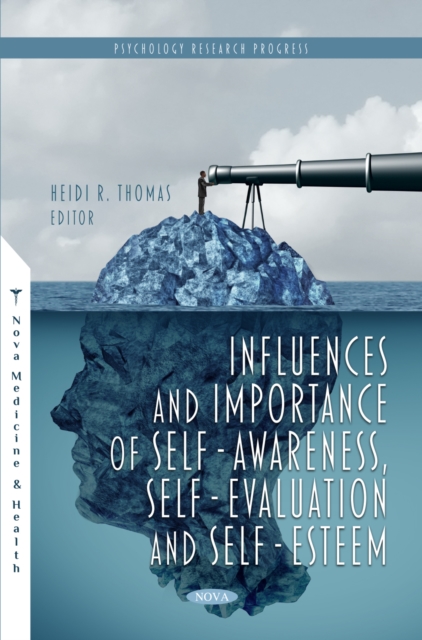
Influences and Importance of Self-Awareness, Self-Evaluation and Self-Esteem
Self-esteem forms a critical component of mental health, as an absence of self-esteem is associated with mental disorders like depression. As such, understanding the nature and meaning of self-esteem and related phenomena like self-perception is essential for treatment of a variety of mental illnesses. Chapter One utilizes terror management theory to explain what self-esteem is, how the need for self-esteem develops, how people attain and maintain self-esteem, and why self-esteem is so important for psychological well-being. Chapter Two demonstrates how self-esteem is the fundamental mental attitude that provides the qualities necessary to perform democracy and reject authoritarian threats. Chapter Three deals with the definition of self-awareness, the description of the neural substrates that have been associated with it, and the examination of an interpretive neuroanatomical model of the phenomenon, with a focus on neurological and neuropsychological diseases. Chapter Four advocates a culture of self-evaluation as part of academic and professional culture through critical reflection on teaching and the results of one's own work. Chapter Five analyzes self-concept as a predictor of the academic self-efficacy perceived by adolescents. Lastly, Chapter Six studies the relationship between testosterone levels and self-esteem in school-age boys and girls.
eBook

Worthy : how to believe you are enough and transform your life : simple steps, life-changing results
\"Are you ready to unleash your greatness and believe in the power that is YOU? Are you ready to finally stop believing the lies that you're unlovable, unqualified or not (fill in the blank) enough? Are you ready to triumph over the thoughts holding you back, destroy self-doubt and truly know and believe you have what it takes to accomplish your greatest goals and wildest dreams? Imagine...what would you do if you had zero self-doubt and unshakable self-worth? What would you do if you fully believed in YOU?\"--Amazon.
Book
The role of self-esteem and self-efficacy in women empowerment in the Kingdom of Saudi Arabia: A cross-sectional study
The study aimed to explore the role of self-esteem and self-efficacy in
women empowerment among academic and administrative staff at Saudi
universities. A cross-sectional design was carried out at 15
governmental universities. A multistage cluster sampling technique was
used to select 5587 participants. Multiple linear regression was used
to analyze the predictive relation. Data collection included
socio-demographic variables, Rosenberg self-esteem scale, general
self-efficacy scale, and women empowerment scale. The results indicated
that study participants' self-esteem was equally distributed between
moderate (49.8%) and high (50.2%). Also, 66.9% of the participants had
high self-efficacy, and 86.8% had high total women's empowerment.
Regression coefficient showed that self-esteem (B=0.521, b=0.127,
t=13.785 and p<0.001) and self-efficacy (B=2.388, b=0.702, t=76.049
and p<0.001) are important predictors of the total women
empowerment. However, self-efficacy was observed to be the most
dominant predictor (t=76.049). The total model summary shows that 73.4%
of the women empowerment level can be predicted through self-esteem and
self-efficacy. The study results can be used as a base to build women
empowerment programs in the Kingdom of Saudi Arabia (KSA) and help to
achieve the 2030 KSA vision regarding women empowerment. (Afr J Reprod
Health 2021; 25[1s]: 69-78).
L'étude visait à explorer le rôle de l'estime de soi et
de l'efficacité personnelle dans l'autonomisation des femmes parmi
le personnel académique et administratif des universités
saoudiennes. Une conception transversale a été
réalisée dans 15 universités gouvernementales. Une
technique d'échantillonnage en grappes à plusieurs
degrés a été utilisée pour sélectionner 5587
participants. Une régression linéaire multiple a
été utilisée pour analyser la relation prédictive.
La collecte de données comprenait des variables
sociodémographiques, une échelle d'estime de soi de
Rosenberg, une échelle d'auto-efficacité générale
et une échelle d'autonomisation des femmes. Les résultats ont
indiqué que l'estime de soi des participants à l'étude
était également répartie entre modérée (49,8%)
et élevée (50,2%). En outre, 66,9% des participants avaient
une auto-efficacité élevée et 86,8% avaient une forte
autonomisation totale des femmes. Le coefficient de régression a
montré que l'estime de soi (B = 0,521, b = 0,127, t = 13,785 et p
<0,001) et l'auto-efficacité (B = 2,388, b = 0,702, t = 76,049
et p <0,001) sont des prédicteurs importants du
l'autonomisation totale des femmes. Cependant, l'auto-efficacité a
été observée comme le prédicteur le plus dominant
(t = 76,049). Le résumé total du modèle montre que 73,4%
du niveau d'autonomisation des femmes peut être prédit
grâce à l'estime de soi et à l'auto-efficacité. Les
résultats de l'étude peuvent être utilisés comme
base pour élaborer des programmes d'autonomisation des femmes dans
le Royaume d'Arabie saoudite (KSA) et aider à réaliser la
vision 2030 de la KSA concernant l'autonomisation des femmes. (Afr J
Reprod Health 2021; 25[1s]: 69-78).
Journal Article