
Catalogue Search | MBRL


Are you sure you want to remove the book from the shelf?

{{itemTitle}}
5,405
result(s) for
"Ethics, Modern"
Sort by:

Ethics and the quest for wisdom
\"Modernity has challenged the ancient ideal of a universal quest for wisdom, and today's world of conflicting cultures and values has raised further doubts regarding the possibility of objective ethical standards. Robert Kane refocuses the debate on the philosophical quest for wisdom, and argues that ethical principles about right action and the good life can be seen to emerge from that very quest itself. His book contends that the search for wisdom involves a persistent striving to overcome narrowness of vision that comes from the inevitable limitations of finite points of view. When applied to questions of value and the good life, this striving has ethical implications about the way we should treat ourselves and others. This study argues for the merits of this central thesis against alternative theories in contemporary normative ethics, and discusses its practical applications for social ethics, political philosophy, law and moral education\"-- Provided by publisher.
Book

Rethinking Modernity
This edited collection examines alternative or entangled modernities as competitive narratives that blend ethics, aesthetics, and critical thinking to depict the human condition. It includes chapters covering the rivalry between scientific and aesthetic revolutions; contemporary trends in postmodernity; and study-cases on visual arts and cinema. The collection applies a philosophical view of visual arts and cinema, and competitive narratives of (post)modernity that arise from ethics and aesthetics as complementary fields. Key audiences for the book are students, PhD candidates, and scholars from the field of philosophy, aesthetics and cultural studies. This volume emerges from contributions held at the International Conference Rethinking Modernity: Transitions and Challenges, organized by the Research Center for the History and Circulation of Philosophical Ideas of the University of Bucharest.
eBook

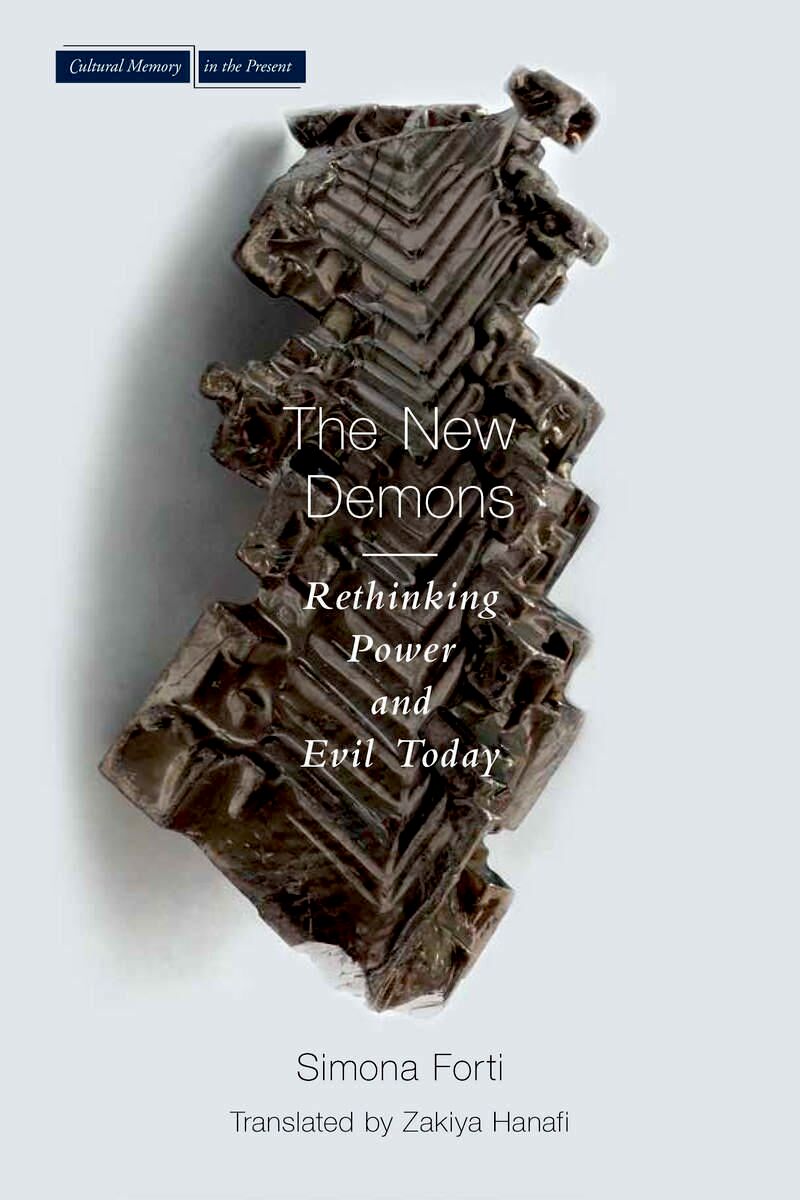
New demons : rethinking power and evil today
As long as we care about suffering in the world, says political philosopher Simona Forti, we are compelled to inquire into the question of evil. But is the concept of evil still useful in a postmodern landscape where absolute values have been leveled and relativized by a historicist perspective? Given our current unwillingness to judge others, what signposts remain to guide our ethical behavior? Surveying the nineteenth- and twentieth-century Western philosophical debates on evil, Forti concludes that it is time to leave behind what she calls \"the Dostoevsky paradigm\": the dualistic vision of an omnipotent monster pitted against absolute, helpless victims. No longer capable of grasping the normalization of evil in today's world—whose structures of power have been transformed—this paradigm has exhausted its explanatory force. In its place, Forti offers a different genealogy of the relationship between evil and power, one that finally calls into question power's recurrent link to transgression. At the center of contemporary evil she posits the passive attitude towards rule-following, the need for normalcy, and the desire for obedience nurtured by our contemporary mass democracies. In our times, she contends, evil must be explored in tandem with our stubborn desire to stay alive at all costs as much as with our deep need for recognition: the new modern absolutes. A courageous book, New Demons extends an original, inspiring call to ethical living in a biopolitical age.
eBook

An ethical compass : coming of age in the 21st century : the ethics prize of the Elie Wiesel foundation for humanity
In 1986, Elie Wiesel received the Nobel Peace Prize in recognition of his victory over \"the powers of death and degradation, and to support the struggle of good against evil in the world.\" Soon after, he and his wife, Marion, created the Elie Wiesel Foundation for Humanity. A project at the heart of the Foundation's mission is its Ethics Prize, an essay writing contest through which thousands of students from colleges across the country are encouraged to confront ethical issues of personal significance. The Ethics Prize has grown exponentially over the past twenty years. \"Of all the projects our Foundation has been involved in, none has been more exciting than this opportunity to inspire young students to examine the ethical aspect of what they have learned in their personal lives and from their teachers in the classroom,\" writes Elie Wiesel. Readers will find essays on Bosnia, the genocide in Rwanda, sweatshops and globalization, and the political obligations of the mothers of Argentina's Disappeared. Other essays tell of a white student who joins a black gospel choir, a young woman who learns to share in Ladakh, and the outsize implications of reporting on something as small as a cracked windshield. Readers will be fascinated by the ways in which essays on conflict, conscience, memory, illness (Rachel Maddow's essay on AIDS appears), and God overlap and resonate with one another. These essays reflect those who are \"sensitive to the sufferings and defects that confront a society yearning for guidance and eager to hear ethical voices,\" writes Elie Wiesel. \"And they are a beacon for what our schools must realize as an essential component of a true education.\"
Book

Posthuman Ethics
Posthuman theory asks in various ways what it means to be human in a time when philosophy has become suspicious of claims about human subjectivity. Those subjects who were historically considered aberrant, and our future lives becoming increasingly hybrid show we have always been and are continuously transforming into posthumans. What are the ethical considerations of thinking the posthuman? Posthuman Ethics asks not what the posthuman is, but how posthuman theory creates new, imaginative ways of understanding relations between lives. Ethics is a practice of activist, adaptive and creative interaction which avoids claims of overarching moral structures. Inherent in thinking posthuman ethics is the status of bodies as the site of lives inextricable from philosophy, thought, experiments in being and fantasies of the future. Posthuman Ethics explores certain kinds of bodies to think new relations that offer liberty and a contemplation of the practices of power which have been exerted upon bodies. The tattooed and modified body, the body made ecstatic through art, the body of the animal as a strategy for abolitionist animal rights, the monstrous body from teratology to fabulations, queer bodies becoming angelic, the bodies of the nation of the dead and the radical ways in which we might contemplate human extinction are the bodies which populate this book creating joyous political tactics toward posthuman ethics.
eBook

The Still Center
Burton Porter likes to make people think. His book The Still Center: A Philosophy for Our Time offers an insightful guide to navigating the complexities of modern life in pursuit of a truly fulfilling existence. This is a rich, nuanced analysis for people asking how to find purpose, set meaningful goals, and cultivate a deeper sense of meaning, even as we face the constant changes and challenges of contemporary society. Burton Porter's work is a profound examination of the values and attitudes that define our age, offering readers practical guidance on aligning their lives with deeper philosophical insights. This makes it an essential read for those seeking to enrich their understanding of themselves and the world around them. A senior Philosophy professor, Porter skillfully blends a diverse range of philosophical traditions and ethical theories, offering a comprehensive framework for personal development and self-fulfillment. He draws on an array of poetic and literary perspectives, weaving them seamlessly into profound philosophical concepts. This multidisciplinary approach deepens readers' understanding of philosophy while providing practical strategies for living a meaningful life, even amidst societal upheavals and uncertainties. Readers are encouraged to reflect on their own lives and values and to consider how philosophical wisdom can be applied to the challenges they face daily. One of the key strengths of The Still Center is Porter's ability to make complex philosophical concepts relatable to modern life. He delves into critical areas of philosophical thought, including pragmatism, formalism, relativism, and postmodernism, showing how these ideas are not just relevant but crucial to understanding contemporary issues. Porter's analysis covers the works of significant Western philosophers, ranging from the Ancient Greeks, like Plato
and Aristotle, to modern thinkers such as Nietzsche, Sartre, and Foucault. Porter also tackles the fundamental questions of ethics and morality, examining how these concepts intersect with our daily lives and influence our decisions and behaviors. He emphasizes the importance of understanding various moral theories-such as utilitarianism, deontology, and virtue ethics-and explores their implications for both personal and societal conduct. Porter's clear and concise writing makes these complex ideas accessible, allowing readers to engage deeply with the material and apply it to their lives. Whether you are new to philosophy or well-versed in it, The Still Center provides valuable insights into how ethical considerations can guide us in navigating the moral complexities of the modern world. In addition to its philosophical insights, The Still Center also serves as a call to action, urging readers to take responsibility for their own lives and engage actively with the world around them. Porter challenges readers to consider how they can contribute to the betterment of society-both through their personal actions and by engaging with broader social and political issues. He emphasizes the importance of living authentically and with integrity, offering practical advice on how to align our lives with our deepest values and beliefs. In summary, Burton Porter's book is a masterful exploration of the philosophical principles that can guide us in creating a life of meaning, purpose, and fulfillment. Combining deep philosophical insight with practical advice and engaging writing, this book is an invaluable resource for anyone seeking to navigate the complexities of modern life and find their own still center in a chaotic and unpredictable world.
eBook

Kant, Duty And Moral Worth
Kant, Duty and Moral Worth is a fascinating and original examination of Kant's account of moral worth. The complex debate at the heart of Kant's philosophy is over whether Kant said moral actions have worth only if they are carried out from duty, or whether actions carried out from mixed motives can be good. Philip Stratton-Lake offers a unique account of acting from duty, which utilizes the distinction between primary and secondary motives. He maintains that the moral law should not be understood as a normative moral reason but as playing a transcendental role. Thus a Kantian account of moral worth is one where the virtuous agent may be responsive to concrete particular considerations, whilst preserving an essential role for universal moral principles.Kant, Duty and Moral Worth is a lucid examination of Kant's moral thought that will appeal to Kant scholars and anyone interested in moral theory.
eBook