
Catalogue Search | MBRL


Are you sure you want to remove the book from the shelf?

{{itemTitle}}
150
result(s) for
"Ethics Rome."
Sort by:

Exemplary ethics in ancient Rome
\"The well-known mythographer Marina Warner has described the process of reading fairy tales and folktales as 'tasting the dragon's blood' - a magical and transformative process by which one's ears are opened to the voices of the past and of other worlds. Roman exempla, which constitute a national story-telling tradition, are very different in many ways from the dream-like fantasies of fairy-tales and other narrative folk traditions that have been the subject of Warner's studies. In (supposedly) true stories from history, battle-hardened warriors, noble maidens and honourable sons of the soil face impossible dangers, take terrible decisions and sacrifice their lives, their limbs and even their own children for the sake of justice, discipline and the Roman community. Yet for the ancient Romans too, hearing the blood-soaked stories of their ancestral heroes was an intimate and potent experience, and this 'taste of the hero's blood' had an intoxicating effect similar to the blood of Warner's dragon: evoking other worlds, shaping understanding of their own world\"-- Provided by publisher.
Book
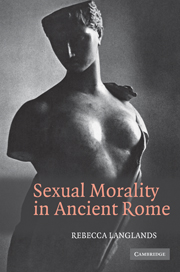
Sexual Morality in Ancient Rome
Traditionally, scholars have approached Roman sexuality using categories of sexual ethics drawn from contemporary, Western society. In this 2006 book Dr Langlands seeks to move away from these towards a deeper understanding of the issues that mattered to the Romans themselves, and the ways in which they negotiated them, by focusing on the untranslatable concept of pudicitia (broadly meaning 'sexual virtue'). She offers a series of nuanced close readings of texts from a wide spectrum of Latin literature, including history, oratory, love poetry and Valerius Maximus' work Memorable Deeds and Sayings. Pudicitia emerges as a controversial and unsettled topic, at the heart of Roman debates about the difference between men and women, the relation between mind and body, and the ethics of power and status differentiation within Roman culture. The book develops strategies for approaching the study of an ancient culture through sensitive critical readings of its literary productions.
eBook

How should one live? : comparing ethics in ancient China and Greco-Roman antiquity
Chinese and Greco-Roman ethics present highly articulate views on how one should live; both of these traditions remain influential in modern philosophy.The question arises how these traditions can be compared with one another.Comparative ethics is a relatively young discipline, and this volume is a major contribution to the field.
eBook

Exemplary epic : Silius Italicus' Punica
The force of example was a distinctive determiner of Roman identity. In this study of the representation of certain central characters in Silius Italicus' 'Punica', Ben Tipping considers the virtues & vices they embody, their status as exemplars, & the process by which Silius as epic poet heroizes, demonizes, & establishes models.
Book

The Good Life and Conceptions of Life in Early China and Graeco-Roman Antiquity
Chinese and Greek ethics remain influential in modern philosophy, yet it is unclear how they can be compared to one another. This volume, following its predecssor 'How should one live?' (DeGruyter 2011), is a contribution to comparative ethics, loosely centered on the concepts of life and the good life. Methods of comparing ethics are treated in three introductory chapters (R.A.H.King, Ralph Weber, G.E.R. Lloyd), followed by chapters on core issues in each of the traditions: human nature (David Wong, Guo Yi), ghosts (Paul Goldin), happiness (Christoph Harbsmeier), pleasure (Michael Nylan), qi (Elisabeth Hsu & Zhang Ruqing), cosmic life and individual life (Dennis Schilling), the concept of mind (William Charlton), knowledge and happiness (Jörg Hardy), filial piety (Richard Stalley), the soul (Hua-kuei Ho), and deliberation (Thomas Buchheim). The volume closes with three essays in comparison - Mencius and the Stoics (R.A.H. King), equanimity (Lee Yearley), autonomy and the good life (Lisa Raphals). An index locorum each for Chinese and Greco-Roman authors, and a general index complete the volume.
eBook

Reasons not to worry : how to be Stoic in chaotic times
\"Like many people today, Brigid Delaney was searching for answers to timeless questions: How can we be good? Find inner peace? Properly grieve? Tame our insecurities, such as the fear of missing out? Determine what truly matters? Centuries ago, the Stoics pondered many of these same questions. And so, at an important inflection point in her own life, Brigid decided to let these ancient philosophers be her guide. Brigid is rash where the Stoics are logical; she runs on chaos, while the Stoics relinquish control of things beyond their reach. Over the course of a year, she dedicated herself to following the wisdom of Seneca, Epictetus, and Marcus Aurelius. She hoped to discover how best to live, how she could use the wisdom of these ancient thinkers to navigate life in the modern world. Here, Brigid shares what she learned, showing us how we, too, can draw on the Stoics to regain a sense of agency and tranquility and find meaning in our lives. From learning to relinquish control to cultivating daily awareness of our mortality to building community, Brigid's insights are very funny and very wise.\" -- Provided by publisher.
Book

To Tend or to Subdue? Technology, Artificial Intelligence, and the Catholic Ecotheological Tradition
In February 2020, the president of Microsoft, the executive vice president of IBM, the director general of the Food and Agriculture Organization (FAO) of the United Nations, and the former Italian Minister of Innovation joined the president of the Vatican’s Pontifical Academy for Life in Rome to sign The Rome Call for AI Ethics. In doing so, they promoted a shared sense of responsibility and commitment—by industry, government, and Church—to uphold certain ethical standards in the areas of digital innovation, artificial intelligence, and technological progress. In this article, I discuss The Rome Call for AI Ethics in conjunction with Pope Francis’ rendering of integral ecology and the technocratic paradigm in Laudato Si’. My aim here is to link Catholic teaching on technology (using AI as a starting point) to the environment and the ecological crisis.
Journal Article


Emotion, restraint, and community in ancient Rome
Emotion, Restraint, and Community examines the ways in which emotions, and talk about emotions, interacted with the ethics of the Roman upper classes in the late Republic and early Empire. By considering how various Roman forms of fear, dismay, indignation, and revulsion created an economy of displeasure that shaped society in constructive ways, the book casts new light both on the Romans and on cross-cultural understanding of emotions.
eBook