
Catalogue Search | MBRL


Are you sure you want to remove the book from the shelf?

{{itemTitle}}
334
result(s) for
"Ethnoscience."
Sort by:

African indigenous knowledge and the disciplines
\"This text explores the multidisciplinary context of African Indigenous Knowledge Systems from scholars and scholar activists committed to the interrogation, production, articulation, dissemination and general development of endogenous and indigenous modes of intellectual activity and praxis. The work reinforces the demand for the decolonization of the academy and makes the case for a paradigmatic shift in content, subject matter and curriculum in institutions in Africa and elsewhere- with a view to challenging and rejecting disinformation and intellectual servitude. Indigenous intellectual discourses related to diverse disciplines take center stage in this volume with a focus on education, mathematics, medicine, chemistry and engineering in their historical and contemporary context\"--Back cover.
Book


Indigenous knowledge and learning in Asia/Pacific and Africa : perspectives on development, education, and culture
\"This collection makes a unique contribution towards the amplification of indigenous knowledge and learning by adopting an inter/trans-disciplinary approach to the subject that considers a variety of spaces of engagement around knowledge in Asia and Africa\"--Provided by publisher.
Book
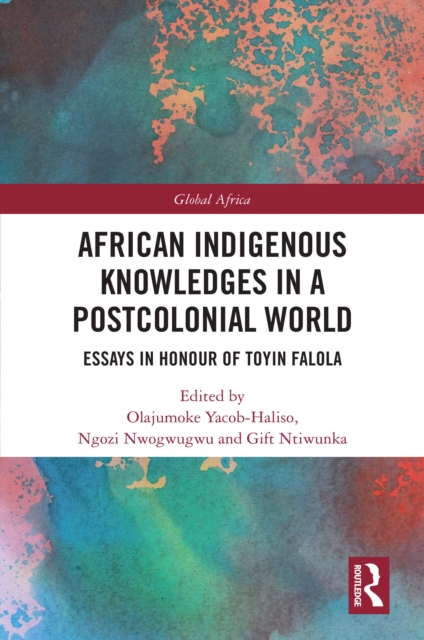
African Indigenous Knowledges in a Postcolonial World
This book argues that ancient and modern African indigenous knowledges remain key to Africa’s role in global capital, technological and knowledge development and to addressing her marginality and postcoloniality.
The contributors engage the unresolved problematics of the historical and contemporary linkages between African knowledges and the African academy, and between African and global knowledges. The book relies on historical and comparative political analysis to explore the global context for the application of indigenous knowledges for tackling postcolonial challenges of knowledge production, conflict and migration, and women’s rights on the continent in transcontinental African contexts.
Asserting the enduring potency of African indigenous knowledges for the transformation of policy, the African academy and the study of Africa in the global academy, this book will be of interest to scholars of African Studies, postcolonial studies and decolonisation and global affairs.
eBook

Knowledge in motion : constellations of learning across time and place
\"This book brings together archaeologists, historians, and cultural anthropologists to explore communities engaged in a range of practices, from spiritual mediums in east Africa, healers and fishermen in the Amazon, potters of the U.S. Southwest, and populations navigating climate change in the deep past, drawing on the growing interdisciplinary situated learning scholarship to explore processes of learning\"--Provided by publisher.
Book

Indigenous knowledge and learning in Asia/Pacific and Africa : perspectives on development, education, and culture
This collection makes a unique contribution towards the amplification of indigenous knowledge and learning by adopting an inter/trans-disciplinary approach to the subject that considers a variety of spaces of engagement around knowledge in Asia and Africa.
eBook

Indigenous knowledge and education in Africa
This open access book presents a strong philosophical, theoretical and practical argument for the mainstreaming of indigenous knowledge in curricula development, and in teaching and learning across the African continent. Since the dawn of political independence in Africa, there has been an ongoing search for the kind of education that will create a class of principled and innovative citizens who are sensitive to and committed to the needs of the continent. When indigenous or environment-generated knowledge forms the basis of learning in classrooms, learners are able to immediately connect their education with their lived reality. The result is much introspection, creativity and innovation across fields, sectors and disciplines, leading to societal transformation. Drawing on several theoretical assertions, examples from a wide range of disciplines, and experiences gathered from different continents at different points in history, the book establishes that for education to trigger the necessary transformation in Africa, it should be constructed on a strong foundation of learners' indigenous knowledge. The book presents a distinct and uncharted pathway for Africa to advance sustainably through home-grown and grassroots based ideas, leading to advances in science and technology, growth of indigenous African business and the transformation of Africans into conscious and active participants in the continent's progress. Indigenous Knowledge and Education in Africa is of interest to educators, entrepreneurs, policymakers, researchers and individuals engaged in finding sustainable and strategic solutions to regional and global advancement. Chika Ezeanya-Esiobu is a researcher, teacher, non-fiction and fiction writer, and a well-known intellectual who holds a Ph.D. in African Development and Policy Studies from Howard University in Washington D.C. Chika has published numerous academic articles in peer-reviewed journals, book chapters and short essays, and has also produced documentary films. Chika has conducted research on indigenous knowledge and homegrown approaches to sub-Saharan Africa's growth for such organizations as the United Nations University World Institute for Development Economics Research (UNU-WIDER), United Nations Research Institute for Social Development (UNRISD), the Swedish International Development Agency (Sida), International Development Research Center (IDRC) Canada and the African Economic Research Consortium.
Book


A Multi-Perspective Reflection on How Indigenous Knowledge and Related Ideas Can Improve Science Education for Sustainability
Indigenous knowledge provides specific views of the world held by various indigenous peoples. It offers different views on nature and science that generally differ from traditional Western science. Futhermore, it introduces different perspectives on nature and the human in nature. Coming basically from a Western perspective on nature and science, the paper analyzes the literature in science education focusing on research and practices of integrating indigenous knowledge with science education. The paper suggests Didaktik models and frameworks for how to elaborate on and design science education for sustainability that takes indigenous knowledge and related non-Western and alternative Western ideas into consideration. To do so, indigenous knowledge is contextualized with regards to related terms (e.g., ethnoscience), and with Eastern perspectives (e.g., Buddhism), and alternative Western thinking (e.g., post-human Bildung). This critical review provides justification for a stronger reflection about how to include views, aspects, and practices from indigenous communities into science teaching and learning. It also suggests that indigenous knowledge offers rich and authentic contexts for science learning. At the same time, it provides chances to reflect views on nature and science in contemporary (Western) science education for contributing to the development of more balanced and holistic worldviews, intercultural understanding, and sustainability.
Journal Article