
Catalogue Search | MBRL


Are you sure you want to remove the book from the shelf?

{{itemTitle}}
337
result(s) for
"Etruscan"
Sort by:


Kainua (Marzabotto)
This volume brings together leading scholars of Etruria to
provide up-to-date findings from the key archaeological site of
Kainua. Located in what is now the Italian town of Marzabotto,
Kainua is the only Etruscan site whose complete urban layout has
been preserved, making it possible to trace houses, roads, drainage
systems, cemeteries, craft workshops, and an acropolis.
Under excavation since the 1850s, Kainua offers a trove of
insights into Etruscan culture and society. The volume's editor,
Elisabetta Govi, and her fellow experts examine the material
evidence underlying our understanding of the history, economy,
religion, and social structures of Kainua, including trade routes
that linked the city with the wider Mediterranean. Particularly
exciting are recent discoveries of sanctuaries dedicated to Tinia
and Uni, analogous to the Greek Zeus and Hera, which provide new
information about Etruscan cults. Kainua (Marzabotto) also
draws on the latest research to reconstruct the city's foundation
rites, a sacred charter, and urban plan. Finally, the authors
explore the site's archaeological history, discussing new knowledge
made possible since the introduction of modern techniques of remote
sensing and 3D modeling.
eBook

The collection of antiquities of the American Academy in Rome
The foundation of the American Academy in Rome dates back more than one hundred years to the early decades of the last century. Over the years, the Academy has acquired a study collection of material goods from antiquity, including coins, statues and figurines, lamps, stucco and other architectural fragments, jewelry, and inscriptions. While most are Roman in origin, some pieces are Greek or Etruscan. Some were gifts, others come from long-ago excavations, a few were bought. The Collection of Antiquities of the American Academy in Rome, the latest addition to the Supplements to the Memoirs of the American Academy in Rome series, focuses on highlights of the collection.
Book
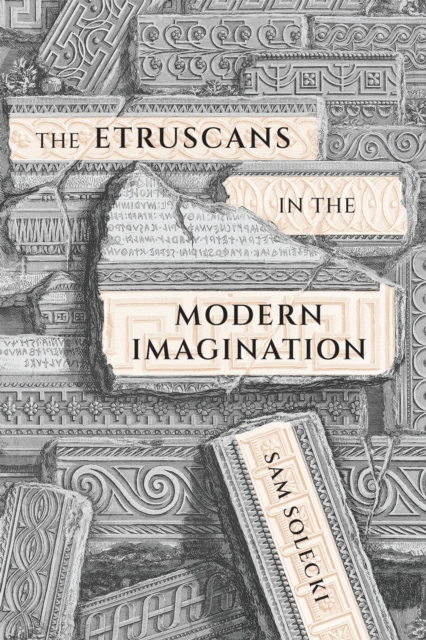
The Etruscans in the Modern Imagination
The Etruscans, a revenant and unusual people, had an Italian
empire before the Greeks and Romans did. By the start of the
Christian era their wooden temples and writings had vanished, the
Romans and the early church had melted their bronze statues, and
the people had assimilated. After the last Etruscan augur served
the Romans as they fought back the Visigoths in 408 CE, the
civilization disappeared but for ruins, tombs, art, and vases. No
other lost culture disappeared as completely and then returned to
the same extent as the Etruscans. Indeed, no other ancient
Mediterranean people was as controversial both in its time and in
posterity. Though the Greeks and Romans tarred them as
superstitious and decadent, D.H. Lawrence praised their way of life
as offering an alternative to modernity. In The Etruscans in
the Modern Imagination Sam Solecki chronicles their unexpected
return to intellectual and cultural history, beginning with
eighteenth-century scholars, collectors, and archaeologists. The
resurrection of this vanished kingdom occurred with remarkable
vigour in philosophy, literature, music, history, mythology, and
the plastic arts. From Wedgwood to Picasso, Proust to Lawrence,
Emily Dickinson to Anne Carson, Solecki reads the disembodied
traces of Etruscan culture for what they tell us about cultural
knowledge and mindsets in different times and places, for the way
that ideas about the Etruscans can serve as a reflection or foil to
a particular cultural moment, and for the creative alchemy whereby
artists turn to the past for the raw materials of contemporary
creation. The Etruscans are a cultural curiosity because of their
disputed origin, unique language, and distinctive religion and
customs, but their destination is no less worthy of our curiosity.
The Etruscans in the Modern Imagination provides a
fascinating meditation on cultural transmission between ancient and
modern civilizations.
eBook


The Religion of the Etruscans
Devotion to religion was the distinguishing characteristic of the Etruscan people, the most powerful civilization of Italy in the Archaic period. From a very early date, Etruscan religion spread its influence into Roman society, especially with the practice of divination. The Etruscan priest Spurinna, to give a well-known example, warned Caesar to beware the Ides of March. Yet despite the importance of religion in Etruscan life, there are relatively few modern comprehensive studies of Etruscan religion, and none in English. This volume seeks to fill that deficiency by bringing together essays by leading scholars that collectively provide a state-of-the-art overview of religion in ancient Etruria.
The eight essays in this book cover all of the most important topics in Etruscan religion, including the Etruscan pantheon and the roles of the gods, the roles of priests and divinatory practices, votive rituals, liturgical literature, sacred spaces and temples, and burial and the afterlife. In addition to the essays, the book contains valuable supporting materials, including the first English translation of an Etruscan Brontoscopic Calendar (which guided priests in making divinations), Greek and Latin sources about Etruscan religion (in the original language and English translation), and a glossary. Nearly 150 black and white photographs and drawings illustrate surviving Etruscan artifacts and inscriptions, as well as temple floor plans and reconstructions.
eBook


Excavations at Poggio Civitate (Murlo): The 2023 Field Season
Excavation during the 2023 field season at Poggio Civitate focused on areas immediately west of Piano del Tesoro and further refined our understanding of the form and development of the building known as Early Phase Orientalizing Complex Building 4 (abbreviated EPOC4). In addition, excavation re-examined the western area of Orientalizing Complex Building 2/Workshop (abbreviated OC2/Workshop) as well as areas immediately north of OC2/Workshop.
Journal Article