
Catalogue Search | MBRL


Are you sure you want to remove the book from the shelf?

{{itemTitle}}
131
result(s) for
"Eurasia In literature."
Sort by:

Narratives of kingship in Eurasian empires, 1300-1800
\"In 'Narratives of Kingship in Eurasian Empires, 1300-1800' Richard van Leeuwen analyses representations and constructions of the idea of kingship in fictional texts of various genres, especially belonging to the intermediate layer between popular and official literature. The analysis shows how ideologies of power are embedded in the literary and cultural imagination of societies, their cultural values and conceptualizations of authority. By referring to examples from various empires (Chinese, Indian, Persian, Arabic, Turkish, European) the parallels between literary traditions are laid bare, revealing remarkable common concerns. The process of interaction and transmission are highlighted to illustrate how literature served as a repository for ideological and cultural values transforming power into authority in various imperial environments.\"--Cover page 4.
Book
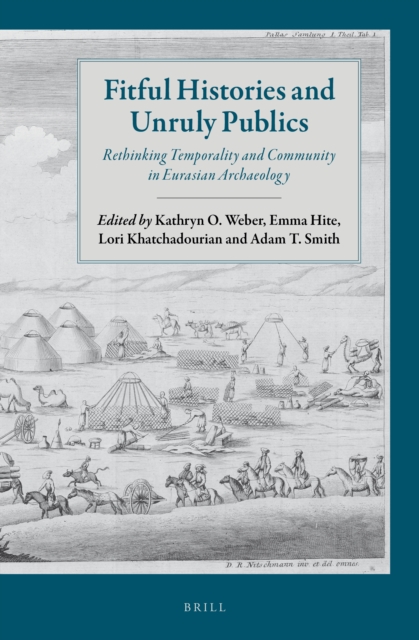
Fitful Histories and Unruly Publics
Fitful Histories and Unruly Publics re-examines the relationship between Eurasia's past and its present by interrogating the social construction of time and the archaeological production of culture. Traditionally, archaeological research in Eurasia has focused on assembling normative descriptions of monolithic cultures that endure for millennia, largely immune to the forces of historical change. The papers in this volume seek to document forces of difference and contestation in the past that were produced in the perceptible engagements of peoples, things, and places. The research gathered here convincingly demonstrates that these forces made social life in ancient Eurasia rather more fitful and its publics considerably more unruly than archaeological research has traditionally allowed.Contributors are Mikheil Abramishvili, Paula N. Doumani Dupuy, Magnus Fiskesjö, Hilary Gopnik, Emma Hite, Jean-Luc Houle, Erik G. Johannesson, James A. Johnson, Lori Khatchadourian, Ian Lindsay, Maureen E. Marshall, Mitchell S. Rothman, Irina Shingiray, Adam T. Smith, Kathryn O. Weber and Xin Wu.
eBook

Mediating Spaces
In Mediating Spaces James Robertson offers an intellectual history of the diverse supranational politics of Yugoslav socialism, beginning with its birth in the 1870s and concluding with its violent collapse in the 1990s.
eBook

Invasion history of Gyraulus chinensis (Gastropoda: Planorbidae) in Europe: a molecular and literature-based approach
Invasion of alien species is one of the major environmental problems in the globalised world. Therefore, identifying pathways for the introduction and spread of alien species can help to mitigate their impact on invaded ecosystems. This study focused on the freshwater snail
Gyraulus chinensis
, which invades Europe from eastern Eurasia, where it is native. It was first recorded in Europe about 50 years ago and has since expanded its distribution. However, its origin and the mechanisms of its spread have not yet been studied. Therefore, we performed molecular identification and estimated its origin and dispersal mechanisms based on a literature review, molecular phylogenetics, and population genetics. We found that the haplotypes of
G. chinensis
in Europe are closely related to southern East Asia, namely Hong Kong, Taiwan, and the Ryukyu Islands. The results also suggest multiple introductions, mainly due to the diversity of haplotypes detected in European
G. chinensis
populations. Currently, the distribution and invasion of the species in the outdoor environments are concentrated in southern Europe, probably due to thermal constraints. However, the species has been recorded in many indoor habitats in the northern part of Europe, indicating a high potential for its spread in the warmer world.
Journal Article

Earthworm occurrence dataset extracted from Russian-language literature
Earthworms are one of the most important components of temperate ecosystems and groups of soil animals globally, but data on their distribution around the world are still incomplete and uneven. Northern Eurasia is a region for which available data on earthworm distribution is extremely poor. At the same time, generations of Soviet and Russian researchers have performed extensive research and accumulated a large amount of data on the distribution of earthworms in this vast region. Most of this information was published in Russian, not digitised and, therefore, hardly accessible to researchers. Our dataset fills this gap and provides occurrence data extracted from 159 literature sources in Russian published between 1868 and 2022. The dataset contains 5,304 occurrences of 109 species and 14 subspecies. The collected data cover the territory of 27 countries. The dataset extends the data available through GBIF.org on earthworm distribution in Russia, Belarus, and Ukraine. For Transcaucasia and Central Asia countries, our resource has become the main GBIF source on earthworm diversity distribution. On a global scale, our dataset contributes to filling gaps in biodiversity, which facilitates more accurate estimates of the response of biodiversity to global climate change as well as the spreading of invasive species.
Journal Article

NorthEuraLex: a wide-coverage lexical database of Northern Eurasia
This article describes the first release version of a new lexicostatistical database of Northern Eurasia, which includes Europe as the most well-researched linguistic area. Unlike in other areas of the world, where databases are restricted to covering a small number of concepts as far as possible based on often sparse documentation, good lexical resources providing wide coverage of the lexicon are available even for many smaller languages in our target area. This makes it possible to attain near-completeness for a substantial number of concepts. The resulting database provides a basis for rich benchmarks that can be used to test automated methods which aim to derive new knowledge about language history in underresearched areas.
Journal Article

Changes in river ice cover in the context of climate change and dam impacts: a review
This article presents a review of previous studies on the impacts of climate change and the operation of dam reservoirs on the characteristics of river ice cover. Based on a review of the existing literature, the spatial and temporal variability of trends in individual river ice cover conditions and their relationship to both climate change and the operation of dam reservoirs is explored. From this analysis, climate change is identified as the main determinant of the river ice cover disturbances observed since the start of the twentieth century. The study found that in the twentieth century, climate change contributed to a decrease in the duration of ice cover on rivers. The shortening of ice cover duration occurs primarily through earlier breakup rather than later formation. The trends in ice cover freeze-up and breakup are less spatially variable across Eurasia than in North America. The analysis indicates that dam reservoirs can exert a significant control on the spatiotemporal distribution of ice cover occurrence on rivers, even on a global scale. The first quantitative estimate of the number of dam reservoirs in river ice cover areas was also presented based on climatological and reservoir location data. The obtained results highlight the need to research river ice cover changes based on remote sensing data; such studies will make it possible to recognize the temporal–spatial distribution of trends in river ice cover parameters and the strength and extent of the influence of dam reservoirs.
Journal Article

Water resource development and sturgeon (Acipenseridae): state of the science and research gaps related to fish passage, entrainment, impingement and behavioural guidance
Acipenserids (sturgeons) live in large rivers and lakes in North America and Eurasia, where many species and populations are considered imperiled. One of the most pervasive threats across the global range of sturgeon is water resource development (e.g., hydropower dams, water intakes for irrigation, industrial use, or human consumption). We report on the outcome of a literature review focused on interactions between sturgeon and water resource development. We focused on the persistent issue of dam passage (both upstream and downstream), impingement, and entrainment, which are all relevant issues for both existing and planned facilities. We discuss aspects of sturgeon sensory physiology, and how knowledge of sensory physiology can be used for behavioural guidance. We also consider how the swimming ability and style of sturgeon is relevant for passage. Most of the literature emanated from research on just a few species (especially lake sturgeon, white sturgeon, green sturgeon, and shortnose sturgeon). Although there are several examples of apparent “success stories” (e.g., successful upstream fish passage, efforts to reduce impingement and entrainment), there are also many failures, and such examples are likely under-reported. Without significant investments in solutions-oriented research related to sturgeon-water resource development interactions, we submit that fish passage, entrainment and impingement problems for acipenserids will remain. There is a need for research that spans life-stages, compares different species, and considers how passage, entrainment, and impingement influence demography. Further, there is a need for investment into evidence-based implementation of mitigation infrastructure and management strategies to ensure conservation needs of sturgeons are adequately considered.
Journal Article

Women Artists in the Early Modern Courts of Europe
Women Artists in the Early Modern Courts of Europe, c. 1450.1700 presents the first collection of essays dedicated to women as producers of visual and material culture in the Early Modern European courts, offering fresh insights into the careers of, among others, Caterina van Hemessen, Sofonisba Anguissola, Luisa Roldán, and Diana Mantuana. Also considered are groups of female makers, such as ladies-in-waiting at the seventeenth-century Medici court. Chapters address works by women who occupied a range of social and economic positions within and around the courts and across media, including paintings, sculpture, prints, and textiles. Both individually and collectively, the texts deepen understanding of the individual artists and courts highlighted and, more broadly, consider the variety of experiences of female makers across traditional geographic and chronological distinctions. The book is also accompanied by the Global Makers: Women Artists in the Early Modern Courts digital humanities project (www.globalmakers.ua.edu), extending and expanding the work begun here.
eBook

A Scoping Review on Progression Towards Freedom from Peste des Petits Ruminants (PPR) and the Role of the PPR Monitoring and Assessment Tool (PMAT)
Peste des Petits Ruminants (PPR) is a highly contagious viral disease of small ruminants that severely threatens rural livelihoods and global food security. Under the Global Framework for the Progressive Control of Transboundary Animal Diseases (GF-TADs), the international animal health community has set the ambitious goal of eradicating PPR by 2030. However, significant disparities persist in the progression of PPR control across regions. This scoping review assesses the setbacks, deviations, and progress of 42 countries in Eastern, Western, and Northern Africa, as well as West Eurasia, toward achieving official freedom-from-PPR status. Progress was evaluated across key areas using the stepwise PPR Global Control and Eradication Strategy (GCES) approach and the PPR Monitoring and Assessment Tool (PMAT). The eligibility criteria included PubMed peer-reviewed studies, FAO/WOAH reports, presentations, guidelines, and country/region-specific PPR control plans from 2014 through 2024. The data are generated using qualitative and quantitative analyses, including spatial mapping and GCES stepwise progress evaluation. The findings reveal that many (31%) countries in the assessed regions remain in Stage 1 of the Progressive Stepwise Approach, whereas 59.5% have reached Stages 2 and 3, and only 4.8% are in Stage 4. Countries in Western Eurasia have achieved significant progress towards PPR control, with countries achieving PPR-free status, whereas, compared to Eastern and Northern Africa, the Western African region remains in the early control stages due to infrastructure gaps and resource constraints. Additionally, the recent suspension of PPR-free status in Romania, Greece and Hungary following disease emergence underscored vulnerabilities in historically free countries. The analysis results reiterate the critical role of regional collaboration, surveillance tools, and the integration of wildlife monitoring in advancing PPR control. These insights provide actionable pathways to addressing persistent barriers, highlighting the importance of adaptable, evidence-based approaches in achieving the global goal of PPR eradication by 2030.
Journal Article