
Catalogue Search | MBRL


Are you sure you want to remove the book from the shelf?

{{itemTitle}}
156
result(s) for
"Euripides Criticism and interpretation."
Sort by:


Brill's Companion to Euripides
Brill's Companion to Euripides, as well as presenting a comprehensive and authoritative guide to understanding Euripides and his masterworks, provides scholars and students with compelling fresh perspectives upon a broad range of issues in the field of Euripidean studies.
eBook


Brill's Companion to the Reception of Euripides
Brill's Companion to the Reception of Euripides offers a comprehensive account of the reception of Euripides' plays over the centuries, across cultures and within a range of different fields, such as literature, intellectual history, visual arts, music, dance, stage and cinema.
eBook


Seeing with Free Eyes
Responding to Plato's challenge to defend the political thought of
poetic sources, Marlene K. Sokolon explores Euripides's
understanding of justice in nine of his surviving tragedies.
Drawing on Greek mythological stories, Euripides examines several
competing ideas of justice, from the ancient ethic of helping
friends and harming enemies to justice as merit and relativist
views of might makes right. Reflecting Dionysus, the paradoxical
god of Greek theater, Euripides reveals the human experience of
understanding justice to be limited, multifaceted, and
contradictory. His approach underscores the value of understanding
justice not only as a rational idea or theory, but also as an
integral part of the continuous and unfinished dialogue of
political community. As the first book devoted to Euripidean
justice, Seeing with Free Eyes adds to the growing
interest in how citizens in democracies use storytelling genres to
think about important political questions, such as \"What is
justice?\"
eBook

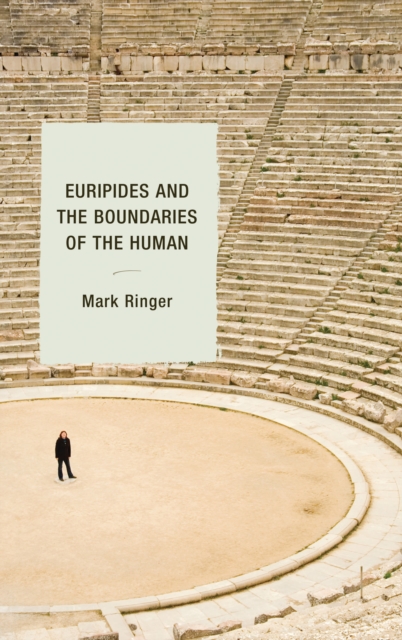
Euripides and the Boundaries of the Human
Euripides and the Boundaries of the Human presents the first single-volume reading in nearly fifty years of all of Euripides' surviving plays. Rather than examining one or a handful of dramas in monograph or article form, Mark Ringer insists on the thematic and stylistic parallels that unite a diverse canon of works. Euripides is often referred to as the most modern of the three Ancient Greek tragedians, but in what way can the work of this fifth-century B.C. artist be claimed as modern? The multi-layered presentation of character is new within the context of Athenian Tragedy. The plays also reveal equal concern with the preservation and re-vitalization of tradition, especially with respect to the portrayal of the Olympian gods. Euripidean drama upholds tradition just as vigorously as it posits a new kind of realism in character portrayal in the Ancient Theatre. Euripidean drama fuses what was old with what was new in order to revitalize and perpetuate the art of tragedy. This book will be of interest to professionals and students in the fields of classics, Greek drama in translation or in the original Greek, theater studies, comparative literature, tragedy, and religion.
eBook

Enraged : why violent times need ancient Greek myths
\"Millennia ago, Greek myths exposed the dangers of violent rage and the need for empathy and self-restraint. Homer's Iliad, Euripides' Hecuba, and Sophocles' Ajax show that anger and vengeance destroy perpetrators and victims alike. Composed before and during the ancient Greeks' groundbreaking movement away from autocracy toward more inclusive political participation, these stories offer guidelines for modern efforts to create and maintain civil societies. Emily Katz Anhalt reveals how these three masterworks of classical Greek literature can teach us, as they taught the ancient Greeks, to recognize violent revenge as a marker of illogical thinking and poor leadership. These time-honored texts emphasize the costs of our dangerous penchant for glorifying violent rage and those who would indulge in it. By promoting compassion, rational thought, and debate, Greek myths help to arm us against the tyrants we might serve and the tyrants we might become.\"--Amazon
BOOK

Euripides and the instruction of the Athenians
Political by its very nature, Greek tragedy reflects on how life should be lived in the polis, and especially the polis that was democratic Athens. Instructional as well, drama frequently concerns itself with the audience's moral education. Euripides and the Instruction of the Athenians draws on these political and didactic functions of tragedy for a close analysis of five plays: Alcestis, Hippolytus, Hecuba, Heracles, and Trojan Women. Clearly written and persuasively argued, this volume addresses itself to all who are interested in Greek tragedy. Nonspecialists and scholars alike will deepen their understanding of this complex writer and the tumultuous period in which he lived.
eBook