
Catalogue Search | MBRL


Are you sure you want to remove the book from the shelf?

{{itemTitle}}
739
result(s) for
"Europe, Central -- Ethnic relations -- History"
Sort by:

With their backs to the mountains : a history of Carpathian Rus' and Carpatho-Rusyns
\"This is a history of a stateless people, the Carpatho-Rusyns, and their historic homeland, Carpathian Rus', located in the heart of central Europe. At the present, when it is fashionable to speak of nationalities as 'imagined communities' or as transnational constructs 'created' by intellectuals\\elites who may live in the historic 'national' homeland or in the diaspora, Carpatho-Rusyns provide an ideal example of a people made--or some would say still being made--before our very eyes. The book traces the evolution of Carpathian Rus' from earliest pre-historic times to the present and the complex manner in which a distinct Carpatho-Rusyn people, since the mid-nineteenth century, came into being, disappeared, and then re-appeared in the wake of the revolutions of 1989 and the collapse of Communist rule in central and eastern Europe. The book, while based on the author's four decades of erudition on the subject, eschews scholarly jargon and is written in an accessible reader-friendly style\"--Provided by publisher.
Book

With Their Backs to the Mountains
With Their Backs to the Mountains is the history of a stateless people, the Carpatho-Rusyns, and their historic homeland, Carpathian Rus’, located in the heart of central Europe. A little over 100,000 Carpatho-Rusyns are registered in official censuses but their number could be as high as 1,000,000, the greater part living in Ukraine and Slovakia. The majority of the diaspora—nearly 600,000—lives in the US. At present, when it is fashionable to speak of nationalities as “imagined communities” created by intellectuals or elites who may or may not live in the historic homeland, Carpatho-Rusyns provide an ideal example of a people made—or some would say still being made—before our very eyes. The book traces the evolution of Carpathian Rus’ from earliest prehistoric times to the present, and the complex manner in which a distinct Carpatho-Rusyn people, since the mid-nineteenth century, came into being, disappeared, and then re-appeared in the wake of the revolutions of 1989 and the collapse of Communist rule in central and eastern Europe. To help guide the reader further there are 39 text inserts, 34 detailed maps, plus an annotated discussion of relevant books, chapters, and journal articles.
eBook

Slav outposts in Central European history : the Wends, Sorbs and Kashubs
\"While many think of European history in terms of the major states that today make up the map of Europe, this approach tends to overlook submerged nations like the Wends, the westernmost Slavs who once inhabited the lands which later became East Germany and Western Poland. This book examines the decline and gradual erosion of the Wends from the time when they occupied all the land between the River Elbe and the River Vistula around 800 AD to the present, where they still survive in tiny enclaves south of Berlin (the Wends and Sorbs) and west of Danzig (the Kashubs). Slav Outposts in Central European History--which also includes numerous images and maps--puts the story of the Wends, the Sorbs and the Kashubs in a wider European context in order to further sophisticate our understanding of how ethnic groups, societies, confessions and states have flourished or floundered in the region. It is an important book for all students and scholars of central European history and the history of European peoples and states more generally\"--From publisher's website.
Book

Ethnicity, Nationalism and Conflict in the South Caucasus
This book examines the underlying factors of the Nagorno-Karabakh conflict in the South Caucasus from 1905 to 1994, and explores the ways in which issues of ethnicity and nationalism contributed to that conflict. The author examines the historiography and politics of the conflict, and the historical, territorial and ethnic dimensions which contributed to the dynamics of the war. The impact of Soviet policies and structures are also included, pinpointing how they contributed to the development of nationalism and the maintenance of national identities. The book firstly explores the historical development of the Armenian and Azerbaijani national identities and the overlapping claims to the territory of Nagorno-Karabakh. The author goes on to assess the historical link between ethnicity and territorial location as sources of ethnic identification and conflict. He examines how identity differences shaped the relationsa between Armenians and Azerbaijanis during the different phases of conflict and presents a detailed historical account of Soviet nationalities policy and ethno-territorial federalism - the basis of which ethnic relations were conducted between governing and minority nations in the south Caucasus. This invaluable book offers students and scholars of post-Soviet politics and society a unique insight into the causes and consequences of this long-standing conflict.
eBook


The Young Turks' crime against humanity : the Armenian genocide and ethnic cleansing in the Ottoman Empire
Introducing evidence from more than 600 secret Ottoman documents, this book demonstrates in unprecedented detail that the Armenian Genocide and the expulsion of Greeks from the late Ottoman Empire resulted from an official effort to rid the empire of its Christian subjects.
eBook

The mark of rebels : indios fronterizos and Mexican independence
\"This work explores social and cultural transformations among the indigenous communities of western Mexico, especially the indios fronterizos (Frontier Indians), preceding and during the struggle for independence\"--Provided by publisher.
Book
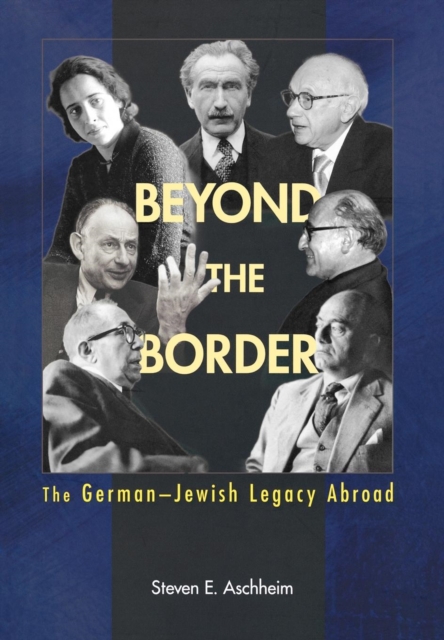
Beyond the Border : The German-Jewish Legacy Abroad
The modern German-Jewish experience through the rise of Nazism in 1933 was characterized by an explosion of cultural and intellectual creativity. Yet well after that history has ended, the influence of Weimar German-Jewish intellectuals has become ever greater. Hannah Arendt, Gershom Scholem, Theodor Adorno, Walter Benjamin, Franz Rosenzweig, and Leo Strauss have become household names and possess a continuing resonance. \"Beyond the Border\" seeks to explain this phenomenon and analyze how the German-Jewish legacy has continuingly permeated wider modes of Western thought and sensibility, and why these Émigrés occupy an increasingly iconic place in contemporary society. Steven Aschheim traces the odyssey of a fascinating group of German-speaking Zionists--among them Martin Buber and Hans Kohn--who recognized the moral dilemmas of Jewish settlement in pre-Israel Palestine and sought a binationalist solution to the Arab-Israel conflict. He explores how German-Jewish Émigré historians like Fritz Stern and George Mosse created a new kind of cultural history written against the background of their exile from Nazi Germany and in implicit tension with postwar German social historians. And finally, he examines the reasons behind the remarkable contemporary canonization of these Weimar intellectuals--from Arendt to Strauss--within Western academic and cultural life. Beyond the Border is about more than the physical act of departure. It also points to the pioneering ways these Émigrés questioned normative cognitive boundaries and have continued to play a vital role in addressing the predicaments that engage and perplex us today.
eBook
The Holocaust in the Borderlands
Violence against Jews, Roma, and other persecuted minorities in the multiethnic borderlands of Eastern, Central, and Southeastern Europe.Includes: Anca Filipovici: The Rise of Antisemitism in the Multiethnic Borderland of Bukovina: Student Movements and Interethnic Clashes at the University of Cern?u?i (1922-1938)Doris Bergen: Saving Christianity, Killing Jews: German Religious Campaigns and the Holocaust in the BorderlandsLinda Margittai: Hungarians, Germans, Serbs, and Jews in Wartime Vojvodina: Patterns of Attitudes and Behaviors towards Jews in a Multiethnic Border Region of HungaryGoran Miljan: The \"Ideal Nation-State\" for the \"Ideal New Croat\": The Ustasha Youth and the Aryanization of Jewish Property in the Independent State of Croatia, 1941-1945Svetlana Suveica: Appropriation of Jewish Property in the Borderlands: Local Public Employees in Bessarabia during the Romanian HolocaustAnna Wylega?a: Listening to Contradictory Voices: Jewish, Polish, and Ukrainian Narratives on Jewish Property in Nazi-Occupied Eastern GaliciaMiriam Schulz: Gornisht oyser verter?!: The Yiddish Language as a Mirror of Interethnic Relations and Dynamics of Violence in German-Occupied Eastern Europe
eBook

Unequal Citizenship and Ethnic Boundaries in the Migration Experience of Polish Roma
Since the early 1990s, large numbers of Polish Roma have emigrated, mainly to Germany and Great Britain. Unlike the migration of Polish (non-Roma) citizens there was an intriguing silence regarding the migration of this ethnic group. The absence of Roma in the grand narrative of migrations from Poland, as we argue, suggests that the notion of belonging and citizenship were unequally distributed among Poland’s population. Based on our ongoing ethnographic research among Polish Roma migrants, complemented by an analysis of relevant documents, we argue that these inequalities and hierarchies are deeply rooted and there is an interesting continuity in how they were produced and reproduced prior to and after the 1989 regime change. We argue that one of the key factors in these movements, the collectiveness of the migration project – i.e. migrating as an extended family group as a component of the moral economy of Roma mobility – is mutually produced by unequal citizenship, mobility regimes and strong moral obligations stemming from kinship ties.
Journal Article