
Catalogue Search | MBRL


Are you sure you want to remove the book from the shelf?

{{itemTitle}}
116
result(s) for
"Europe, Eastern -- Politics and government -- 1945"
Sort by:

Women and Citizenship in Central and Eastern Europe
The transformations seen in women's active citizenship in Central and Eastern Europe mirror the social political and economic transformations in the region since the fall of communism at the end of the 1980s. This book challenges the universal notion of 'citizenship' by focusing on the diversity of situations women in this region have found themselves in since the end of the 1980s, looking at the challenges and struggles they have faced to assert themselves as citizens and their citizenship rights. Featuring detailed case studies which demonstrate the social and political discrimination between women that still exists, the book will be of interest to academics and post-graduate students in women's/gender studies, political sociology and European studies.
Contents: Introduction, Joanna Regulska, Jasmina Lukic, Darja Zavirsek. Part 1 Regimes: Romanian gender regimes and women's citizenship, Eniko Magyari-Vincze; Women and the law in Poland: towards active citizenship, Malgorzata Fuszara and Eleonora Zielinska; Citizenship, systemic change, and the gender division of labour in rural Hungary, Salvatore A. Engel-Di Mauro; Clashes and ordeals of women's citizenship in Central and Eastern Europe, Jacqueline Heinen; Gender equality in Latvia: achievements and challenges, Irina Novikova. Part 2 Agency: The parameters of the political: does meaning matter for participation in public life for women in Poland and in Ukraine?, Ann Graham and Joanna Regulska; Belgrade's protests 1996/97: from women in the movement to women's movement?, Marina Blagojevic; 'A right and a great need': food rights and praxis in Silesia, Poland, Anne C. Bellows; Disabled women everyday citizenship rights in East Europe: examples from Slovenia, Darja Zavirsek; The making of political responsibility: Hannah Arendt and/in the case of Serbia, Dasa Duhacek. Part 3 Transnational Dialogues: Poetics, politics and gender, Jasmina Lukic; Looking at Western Feminisms through the double lens of Eastern Europe and the Third World, Kornelia Slavova; Women's NGOs in Central and Eastern Europe and the former Soviet Union: the imperialist criticism, Nanette Funk; Cautionary tales, Ann Snitow; Epilogue: persisting struggles, Darja Zavirsek, Joanna Reguiska, Jasmina Lukic; Indexes.
Jasmina Lukic is a Recurrent Visiting Associate Professor in the Department of Gender Studies at the Central European University, Budapest, Hungary. Joanna Regulska is Professor of Women's and Gender Studies and Geography at Rutgers University, USA. Darja Zaviršek is Associate Professor of Disability and Gender Studies and teaches at the Faculty of Social Work, University of Ljubljana, Slovenia.
eBook


Austerities and Aspirations
This monograph provides an analysis of the economic performance and living standard in Czechoslovakia and its successor states, Hungary, and Poland since 1945. The novelty of the book lies in its broad comparative perspective: it places East Central Europe in a wider European framework that underlines the themes of regional disparities and European commonalities. Going beyond the traditional growth paradigm, the author systematically studies the historical patterns of consumption, leisure, and quality of life-aspects that Tomka argues can best be considered in relation to one other. By adopting this \"triple approach,\" he undertakes a truly interdisciplinary research drawing from history, economics, sociology, and demography.
As a result of Tomka's three-pillar comparative analysis, the book makes a major contribution to the debates on the dynamics of economic growth in communist and postcommunist East Central Europe, on the socialist consumer culture along with its transformation after 1990, and on how the accounts on East Central Europe can be integrated into the emerging field of historical quality of life research.
eBook

Unsettled 1968 in the troubled present : revisiting the 50 years of discussions from East and Central Europe
\"Why does 1968 matter today? The authors of this volume believe that it is a crucial point of reference for the current developments, especially the 'illiberal turn' both in Europe and America. If we want to understand it, we need to look back into 1968 - the year that founded the cultural and political order of today's world. The book consists of the following four sections: '1968 and Transnationality', '1968 and the Transformation of Meanings', 'Artistic Representations of 1968', and '1968 and the European Contemporaity.' This is followed by an afterword from the significant key-note speaker of the original conference: Irena Grudzinska Gross, herself a Polish '68er', reflects upon the conference and leaves remarks on her fifty years of engagement with what happened in 1968\"-- Provided by publisher.
Book

The final revolution : the resistance church and the collapse of communism
In The Final Revolution, George Weigel provides an in-depth exploration of how the Catholic Church shaped the moral revolution inside the political revolution of 1989. Drawing on extensive interviews with key leaders of the human rights and resistance movements, he opens a unique window into the soul of the Revolution and into the hearts and minds of those who shaped this stirring vindication of the human spirit. He also examines the central role played by Pope John Paul II, and he suggests what the future role of the Church might be in consolidating democracy in the countries of the old Warsaw Pact. The \"final revolution\" is not the end of history, Weigel concludes. It is the human quest for a freedom that truly satisfies the deepest yearnings of the human heart. The Final Revolution illustrates how that quest changed the face of the twentieth century and redefined world politics in the year of miracles, 1989.
eBook


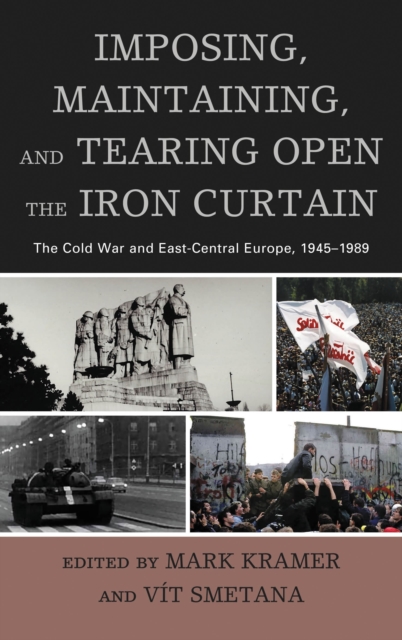
Imposing, maintaining, and tearing open the Iron Curtain
The Cold War began in Europe in the mid-1940s and ended there in 1989. Notions of a “global Cold War” are useful in describing the wide impact and scope of the East-West divide after World War II, but first and foremost the Cold War was about the standoff in Europe. The Soviet Union established a sphere of influence in Eastern Europe in the mid-1940s that later became institutionalized in the Warsaw Pact, an organization that was offset by the North Atlantic Treaty Organization (NATO) led by the United States. The fundamental division of Europe persisted for forty years, coming to an end only when Soviet hegemony in Eastern Europe dissolved. Imposing, Maintaining, and Tearing Open the Iron Curtain: The Cold War and East-Central Europe, 1945–1989, edited by Mark Kramer and Vít Smetana, consists of cutting-edge essays by distinguished experts who discuss the Cold War in Europe from beginning to end, with a particular focus on the countries that were behind the iron curtain. The contributors take account of structural conditions that helped generate the Cold War schism in Europe, but they also ascribe agency to local actors as well as to the superpowers. The chapters dealing with the end of the Cold War in Europe explain not only why it ended but also why the events leading to that outcome occurred almost entirely peacefully.
eBook