
Catalogue Search | MBRL


Are you sure you want to remove the book from the shelf?

{{itemTitle}}
432
result(s) for
"Europe - Foreign relations - 1945"
Sort by:


The United States and Western Europe since 1945 : from \Empire\ by invitation to transatlantic drift
Based on new and existing research by a world‐class scholar, this is the first book in twenty years to examine the dynamics of the entire American–Western European relationship since 1945. The relationship between the US and Western Europe has always been crucial, and current events dictate that it is becoming ever more so. In this book, the author analyses the balance between the cooperation and conflict that has characterized this relationship in the post‐war period. He examines talk of transatlantic drift, and the strain now apparent between the US and the nation states of Western Europe. The first nine chapters are, for the most part, arranged as a chronological account of the relationship. In the concluding Ch. 10 section, the author offers a topical view of the future of transatlantic interaction. Throughout the work, the author's much cited ‘“Empire” by invitation’ thesis is both put into practice and extended in time and scope. This book is essential reading for anyone interested in one of the most important and enduring international relationships of the last sixty years.
eBook

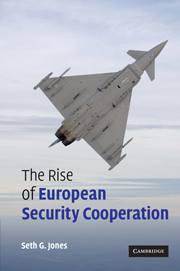
The rise of European security cooperation
A systematic and comprehensive analysis of European security cooperation, which argues that European states have increasingly cooperated in the security realm in order to preserve peace within Europe whilst increasing power abroad. European power is particularly important because of the rise of the United States as the world's only 'superpower'.
eBook


Europe United
The construction of the European Community (EC) has widely been
understood as the product of either economic self-interest or
dissatisfaction with the nation-state system. In Europe United,
Sebastian Rosato challenges these conventional explanations,
arguing that the Community came into being because of balance of
power concerns. France and the Federal Republic of Germany-the two
key protagonists in the story-established the EC at the height of
the cold war as a means to balance against the Soviet Union and one
another.
More generally, Rosato argues that international institutions,
whether military or economic, largely reflect the balance of power.
In his view, states establish institutions in order to maintain or
increase their share of world power, and the shape of those
institutions reflects the wishes of their most powerful members.
Rosato applies this balance of power theory of cooperation to
several other cooperative ventures since 1789, including various
alliances and trade pacts, the unifications of Italy and Germany,
and the founding of the United States. Rosato concludes by arguing
that the demise of the Soviet Union has deprived the EC of its
fundamental purpose. As a result, further moves toward political
and military integration are improbable, and the economic community
is likely to unravel to the point where it becomes a shadow of its
former self.
The construction of the European Community (EC) has widely been
understood as the product of either economic self-interest or
dissatisfaction with the nation-state system. In Europe
United , Sebastian Rosato challenges these conventional
explanations, arguing that the Community came into being because of
balance of power concerns. France and the Federal Republic of
Germany-the two key protagonists in the story-established the EC at
the height of the cold war as a means to balance against the Soviet
Union and one another.
More generally, Rosato argues that international institutions,
whether military or economic, largely reflect the balance of power.
In his view, states establish institutions in order to maintain or
increase their share of world power, and the shape of those
institutions reflects the wishes of their most powerful members.
Rosato applies this balance of power theory of cooperation to
several other cooperative ventures since 1789, including various
alliances and trade pacts, the unifications of Italy and Germany,
and the founding of the United States. Rosato concludes by arguing
that the demise of the Soviet Union has deprived the EC of its
fundamental purpose. As a result, further moves toward political
and military integration are improbable, and the economic community
is likely to unravel to the point where it becomes a shadow of its
former self.
eBook


Israel and the European Union
Israel's relations with the European Union stretch back to the early days of the European Community and the signing of the Treaty of Rome in 1957. From that point onward, Israel and Europe have developed an increasingly strong network of political, economic, scientific, and cultural ties. These relations have, however, consisted of a number of conflicting trends. Indeed, even while the EU has become Israel's most important trading partner, the political relationship has been marked by disappointment, frustration, and, at times, even anger. Israel and the European Union: A Documentary History, by Sharon Pardo and Joel Peters, traces the history of these complex relations by bringing together over two hundred documents in one volume. The documents contained in this book are divided into five time periods: i) 1957–1966, Israel Looks to Europe; ii) 1967–1979, Between War and Peace; iii) 1980–1991, From Venice to Madrid; iv) 1992–2003, From Oslo to Barcelona; and v) 2004–2011, A Renaissance Cut Short?. Each section is preceded by a short essay outlining the major themes of Israeli-European Relations during those years. The authors have not added any commentary to the documents themselves and instead have allowed the documents to speak for themselves. The aim of this book is to offer a public record for future researchers and students of the dynamics of European-Israeli relations—as well as of Europe's relationship with the Middle East—over the past fifty years. Israel and the European Union is designed to serve as a companion volume to Pardo and Peters' Uneasy Neighbors: Israel and the European Union (Lexington Books, 2010).
eBook


European-American Relations and the Middle East
This book examines the evolution of European-American relations with the Middle East since 1945.
Placing the current transatlantic debates on the Middle East into a broader context, this work analyses how, why, and to what extent European and US roles, interests, threat perceptions, and policy attitudes in the region have changed, relating to both the region as a whole and the two main issues analysed: Gulf Security and the Arab-Israeli Conflict. The contributors then go on to discuss the implications of these developments for Western policymaking.
The volume makes four key contributions. First, it examines the subject matter from a truly transatlantic perspective, with all chapters adopting a bi- or multilateral approach, taking into account the views from both the US and individual European countries or the EC/EU collectively. Second, the book takes a long-term view, covering a series of crises and developments over the past six decades. Third, it has a systematic structure, with the predominantly chronological order of the chapters being geared towards depicting trends and evolutions with regard to the key themes of the book. Finally, the book builds bridges between historians and political scientists/analysts, as well as between experts of transatlantic relations and Middle East scholars.
This book will be of great interest to students of transatlantic relations, the Middle East, US foreign policy, European politics, international history and IR in general.
Daniel Möckli is a Senior Researcher at the Center for Security Studies (CSS), ETH Zurich. He is also the editor of CSS Analyses in Security Policy.
Victor Mauer is Deputy Director and Head of Research of the Center for Security Studies (CSS), ETH Zurich, and Lecturer in the Department of Social Sciences and Humanities at ETH Zurich.
Daniel Möckli is a Senior Researcher at the Center for Security Studies (CSS), ETH Zurich. He is also the editor of CSS Analyses in Security Policy.
Victor Mauer is the Deputy Director and Head of Research of the Center for Security Studies (CSS), ETH Zurich, and Lecturer in the Department of Social Sciences and Humanities at ETH Zurich.
Introduction Daniel M öckli and Victor Mauer Part 1: Changing Roles and Interests: From Suez to Iraq 1. Suez 1956: European Colonial Interests and US Cold War Prerogatives Tore T. Petersen 2. Iraq 2003: Regime Change and Its European Discontents Victor Mauer Part 2: The Arab-Israeli Conflict and the West 3. Anglo-American Relations and the Palestine Question, 1945-56 John Sakkas 4. At Odds in the Middle East: Paris, Washington, and the Six-Day War, 1967 Garret Martin 5. The EC-Nine and Transatlantic Conflict During the October War and the Oil Crisis, 1973/74 Daniel Möckli 6. The Euro-Arab Dialogue, the Venice Declaration, and Beyond: The Limits of a Distinct EC Policy, 1974-89 David Allen and Andrin Hauri 7. From Madrid to Camp David: Europe, the US, and the Middle East Peace Process in the 1990s Patrick Müller and Claire Spencer 8. The Middle East Quartet: A New Role for Europe? Constanza Musu Part 3: Gulf Security and Transatlantic Relations 9. Dealing with Iran: The US, Britain, and Regime Change 1951-3 Malcolm Byrne 10. Securing Gulf Oil: Britain, NATO, and the Question of Military Intervention East of Suez, 1949-68 Stephen Blackwell 11. Subcontracting Security: The US, Britain, and Gulf Security Before the Carter Doctrine Roland Popp 12. Great Game Redux: The US, Europe, and Gulf Security in the Late Cold War Peter John Brobst 13. Europe, the US, and the Gulf After the Cold War Gerd Nonneman 14. Iran and the Bomb: Washington, the EU, and Iranian Nuclear Ambitions Harsh V. Pant. Conclusion: Major Trends in European-American Relations and the Middle East since 1945 Daniel Möckli and Victor Mauer
eBook