
Catalogue Search | MBRL


Are you sure you want to remove the book from the shelf?

{{itemTitle}}
1,283
result(s) for
"Europe -- Boundaries"
Sort by:

The boundaries of Europe : from the fall of the ancient world to the age of decolonisation
\"Europe's boundaries have mainly been shaped by cultural, religious, and political conceptions rather than by geography. In this context, this volume outlines the transformation of Europe's boundaries from the fall of the ancient world to the age of decolonization and explores, among other aspects, the confrontation of Christian Europe with Islam and the changing role of the Mediterranean from 'mare nostrum' to a frontier between nations\"-- Provided by publisher.
Book

Bordered lives
The headlines about Europe’s migration crisis have now subsided, though they continue to influence the political agenda all over the continent. Though there are moments when the human reality cuts through, as with the shocking picture of baby Alan Kurdi’s body on the beach, for the most part, the individual stories are lost amid the hysteria over cutting migrant numbers and shutting the doors of Fortress Europe. More than 25,000 migrants have died in their attempt to reach or stay in Europe since 2000. More than 5,000 migrants lost their lives crossing the Mediterranean and Aegean seas in 2016 – they were drowned, suffocated or crushed during the crossing. In 2017 over 3,000 migrants lost their lives crossing the Mediterranean. Award-winning journalist Hsiao-Hung Pai specializes in communicating poignant human stories that many people find it convenient to keep out of sight and out of mind. She travels to meet migrants and asylum-seekers who have just been washed up on the shores of Lampedusa or Sicily and have been absorbed into dismal reception camps. While journalists ordinarily pitch up in such places and file their colour pieces before moving on to the next hot topic, Hsiao-Hung follows through, staying in touch with some of those she encounters – many of them children – throughout their journeys: into mainland Italy, to Germany where they face harassment from far-right groups, and to the appalling conditions in the camps on the coast of northwest France. These personal stories of individuals break apart the false distinction between ‘refugees’ and ‘migrants’, between ‘those seeking refuge’ and ‘those wanting a better life’, a distinction that has resulted in denying many people of their human rights.
eBook

New Borders for a Changing Europe
The \"deepening and widening\" of the EU has thrown its changing internal and external borders into sharp relief. This work demonstrates that borders are key spaces within which issues such as identity, memory and trust, and communication between states continue to be played out and transformed.
eBook


Shatterzone of Empires
Shatterzone of Empires is a comprehensive analysis of interethnic relations, coexistence, and violence in Europe's eastern borderlands over the past two centuries. In this vast territory, extending from the Baltic to the Black Sea, four major empires with ethnically and religiously diverse populations encountered each other along often changing and contested borders. Examining this geographically widespread, multicultural region at several levels-local, national, transnational, and empire-and through multiple approaches-social, cultural, political, and economic-this volume offers informed and dispassionate analyses of how the many populations of these borderlands managed to coexist in a previous era and how and why the areas eventually descended into violence. An understanding of this specific region will help readers grasp the preconditions of interethnic coexistence and the causes of ethnic violence and war in many of the world's other borderlands both past and present.
eBook

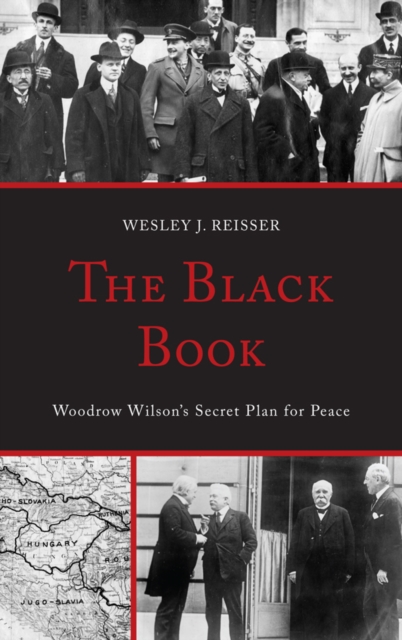
The black book
Prior to the end of World War I, President Wilson gathered a group of expert geographers, historians, economists, and political scientists – The Inquiry – to make plans for the coming peace conference. The Inquiry produced a secret document, the Black Book, containing maps and plans for the territorial settlements to be negotiated. This secret plan was brought daily by the President into negotiations and much of it came to fruition on the world map. This work takes an in-depth look at the Black Book and the lasting legacy of American negotiators at the Paris Peace Conference. Many of the successes, and failures, from these peace settlements trace directly back to this remarkable, and heretofore, almost unstudied plan.
eBook

The Soviet-Polish Peace of 1921 and the Creation of Interwar Europe
The Soviet-Polish peace treaty of 1921, also known as the \"Riga peace,\" ended the war of 1919-1920 and may be considered the most important Eastern European treaty of the interwar period. This deeply researched book offers the first post-Soviet account of how Bolshevik Russia and Poland came to sign the treaty-a pact that established the central part of the Soviet western border and provided Eastern Europe with a measure of stability that lasted until 1939.
Jerzy Borzecki draws on a wealth of untapped materials in Russian and Polish archives to recreate the negotiations and behind-the-scenes maneuvers leading to and surrounding the treaty. He examines the significance of the agreement not only to its signatories but also to Ukraine, Belarus, Lithuania, and Latvia. The Riga peace represented an authentic compromise between Poland and Bolshevik Russia, Borzecki shows, and he offers new interpretations of other crucial aspects of the negotiations as well.
eBook