
Catalogue Search | MBRL


Are you sure you want to remove the book from the shelf?

{{itemTitle}}
294
result(s) for
"Europe Civilization 20th century."
Sort by:


Sounds of modern history
Long ignored by scholars in the humanities, sound has just begun to take its place as an important object of study in the last few years. Since the late 19th century, there has been a paradigmatic shift in auditory cultures and practices in European societies. This change was brought about by modern phenomena such as urbanization, industrialization and mechanization, the rise of modern sciences, and of course the emergence of new sound recording and transmission media. This book contributes to our understanding of modern European history through the lens of sound by examining diverse subjects such as performed and recorded music, auditory technologies like the telephone and stethoscope, and the ambient noise of the city.
eBook


Eastern Europe Unmapped
Arguably more than any other world regions, the area known as Eastern Europe has been defined by its location on the map. Rather than expound on borders and neighbors, Eastern Europe Unmapped raises questions about the meaning and relevance of the area's non-contiguous, frequently global or extraterritorial, entanglements.
eBook

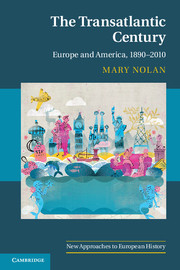
The Transatlantic Century
This is a fascinating new overview of European-American relations during the long twentieth century. Ranging from economics, culture and consumption to war, politics and diplomacy, Mary Nolan charts the rise of American influence in Eastern and Western Europe, its mid-twentieth century triumph and its gradual erosion since the 1970s. She reconstructs the circuits of exchange along which ideas, commodities, economic models, cultural products and people moved across the Atlantic, capturing the differing versions of modernity that emerged on both sides of the Atlantic and examining how these alternately produced co-operation, conflict and ambivalence toward the other. Attributing the rise and demise of American influence in Europe not only to economics but equally to wars, the book locates the roots of many transatlantic disagreements in very different experiences and memories of war. This is an unprecedented account of the American Century in Europe that recovers its full richness and complexity.
eBook

Crossing Central Europe : continuities and transformations, 1900 and 2000
\"Crossing Central Europe is a pioneering volume that focuses on the complex networks of transcultural interrelations in Central Europe from 1900 to 2000. Scholars from Canada, the United States, and Europe identify the motifs, topics, and ways of artistic creation that define this cross-cultural region. This interdisciplinary volume is divided into two historical periods and includes analyses of literature, film, music, architecture, and media. By focusing first on the interrelations in the nineteenth and early twentieth-century, the contributors reveal a complex trans-ethnic network at play that disseminated aesthetic ideals. This network continued to be a force of aesthetic influence leading into the twenty-first century despite globalization and the influence of mass media. Helga Mitterbauer and Carrie Smith-Prei have embarked on a study of the overlapping artistic influences that have outlasted both the National Socialist regime and the Cold War.\"-- Provided by publisher.
Book
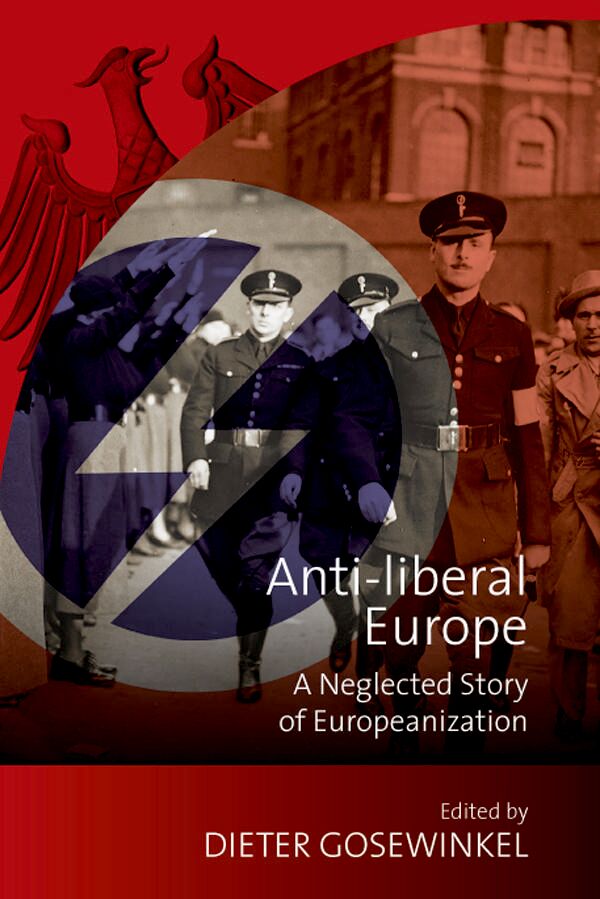
Anti-liberal Europe
The history of modern Europe is often presented with the hindsight of present-day European integration, which was a genuinely liberal project based on political and economic freedom. Many other visions for Europe developed in the 20th century, however, were based on an idea of community rooted in pre-modern religious ideas, cultural or ethnic homogeneity, or even in coercion and violence. They frequently rejected the idea of modernity or reinterpreted it in an antiliberal manner. Anti-liberal Europe examines these visions, including those of anti-modernist Catholics, conservatives, extreme rightists as well as communists, arguing that antiliberal concepts in 20th-century Europe were not the counterpart to, but instead part of the process of European integration.
eBook

The transatlantic century : Europe and America, 1890-2010
\"This is a fascinating new overview of European-American relations during the long twentieth century. Ranging from economics, culture and consumption to war, politics and diplomacy, Mary Nolan charts the rise of American influence in Eastern and Western Europe, its mid-twentieth century triumph and its gradual erosion since the 1970s. She reconstructs the circuits of exchange along which ideas, commodities, economic models, cultural products and people moved across the Atlantic, capturing the differing versions of modernity that emerged on both sides of the Atlantic and examining how these alternately produced co-operation, conflict and ambivalence toward the other. Attributing the rise and demise of American influence in Europe not only to economics but equally to wars, the book locates the roots of many transatlantic disagreements in very different experiences and memories of war. This is an unprecedented account of the American Century in Europe that recovers its full richness and complexity\"-- Provided by publisher.
Book

The Green Bloc
Expanding the horizon of established accounts of Central European art under socialism, this book uncovers the neglected history of artistic engagement with the natural environment in the Eastern Bloc. The turbulent legacy of 1968, which saw the confluence of political upheaval, spread of counterculture, rise of ecological consciousness, and emergence of global conceptual art, provides the setting for Maja Fowkes's innovative reassessment of the environmental practice of the Central European neo-avant-garde. Focussing on artists and artist groups whose ecological dimension has rarely been considered, including the Pécs Workshop from Hungary, OHO in Slovenia, TOK in Croatia, Rudolf Sikora in Slovakia, and the Czech artist Petr Štembera, 'The Green Bloc: Neo-avant-garde Art and Ecology under Socialism' brings to light an array of distinctive approaches to nature, from attempts to raise environmental awareness among socialist citizens to the exploration of non-anthropocentric positions and the quest for cosmological existence in the midst of red ideology. Embedding artistic production in social, political, and environmental histories of the region, this book reveals the Central European artists' sophisticated relationship to nature, at the precise moment when ecological crisis was first apprehended on a planetary scale.
eBook