
Catalogue Search | MBRL


Are you sure you want to remove the book from the shelf?

{{itemTitle}}
571
result(s) for
"Europe Description."
Sort by:

Tasting Tourism: Travelling for Food and Drink
Along with basic practical reasons, our practices concerning food and drink are driven by context and environment, belief and convention, aspiration and desire to display - in short, by culture. Similarly, culture guides how tourism is used and operates. This book examines food and drink tourism, as it is now and is likely to develop, through a cultural 'lens'. It asks: what is food and drink tourism, and why have food and drink provisions and information points become tourist destinations in their own right, rather than remaining among a number of tourism features and components? While it offers a range of international examples, the main focus is on food and drink tourism in the UK. What with the current diversification of tourism in rural areas, the increased popularity of this type of tourism in the UK, the series of BSE, vCJD and foot and mouth crises in British food production, and the cultural and ethnic fusion in British towns and cities, it makes a particularly rich place in which to explore this subject. The author concludes that the future of food and drink tourism lies in diversity and distinctiveness. In an era of globalisation, there is a particular desire to enjoy varied, rather than mono-cultural ambiance and experience. She also notes that there is an immediacy of gratification in food and drink consumption which has become a general requirement of contemporary society.
Contents: Food and drink, from past to present; Food and drink become a leisure destination; Food for thought and visit; Ripe time for providers; Initiative and opinion; Production and display centres and venues; Outlets and markets; Accommodation; Feeding and drinking; Special events and devices, and resources for education; The wine dimension; From among the Cornucopia; The crop now, and for sowing in future; Bibliography; Index.
eBook

Europe on a shoestring
Lonely Planet's Europe on a Shoestring is your passport to having big experiences on a small budget, offering the most relevant, up-to-date advice on what to see and skip, what hidden discoveries await you, and how to optimise your budget for an extended continental trip. Hit the streets and free museums of one of the world's greatest capital cities, London; soak up history and art by day and party by night in Berlin; pick your Greek island for fresh food and golden beaches. All with your trusted travel companion.
Book

Europe within Reach
In Europe within Reach Gerrit Verhoeven traces some sweeping evolutions in the early modern travel behaviour of Dutch and Flemish elites (1585-1750), as the classical Grand Tour to Italy was slowly but surely overshadowed by other modes of travelling.
eBook


News from Abroad
This book provides a selection of private letters written to family and friends from a variety of people while they were on the Grand Tour in the eighteenth century. Although many have been published previously, this is the first time that letters of this kind have been brought together in a single volume. Readers can compare the various responses of travellers to the sights, pleasures and discomforts encountered on the journey. People of diverse backgrounds, with different expectations and interests, give personal accounts of their particular experiences of the Grand Tour. Unlike most collections of letters from the Tour, which recount the views of a single person, this selection emphasises diversity. Readers can juxtapose for example the letters of a conscientious young nobleman like Lyttelton with those of the excitable philanderer Boswell, or the well-travelled aristocratic lady, Caroline Lennox. While the travellers represented here follow much the same route via Paris, through France and across the Alps via the terrifying Mount Cenis, to Rome, in the pursuit of learning and pleasure, the Tour turns out to mean something quite different to each of them.
eBook

Being American in Europe, 1750-1860
When eighteenth- and nineteenth-century Americans made their Grand Tour of Europe, what did they learn about themselves? While visiting Europe In 1844, Harry McCall of Philadelphia wrote to his cousin back home of his disappointment. He didn't mind Paris, but he preferred the company of Americans to Parisians. Furthermore, he vowed to be \"an American, heart and soul\" wherever he traveled, but \"particularly in England.\" Why was he in Europe if he found it so distasteful? After all, travel in the eighteenth and early nineteenth centuries was expensive, time consuming, and frequently uncomfortable. Being American in Europe, 1750–1860 tracks the adventures of American travelers while exploring large questions about how these experiences affected national identity. Daniel Kilbride searched the diaries, letters, published accounts, and guidebooks written between the late colonial period and the Civil War. His sources are written by people who, while prominent in their own time, are largely obscure today, making this account fresh and unusual. Exposure to the Old World generated varied and contradictory concepts of American nationality. Travelers often had diverse perspectives because of their region of origin, race, gender, and class. Americans in Europe struggled with the tension between defining the United States as a distinct civilization and situating it within a wider world. Kilbride describes how these travelers defined themselves while they observed the politics, economy, morals, manners, and customs of Europeans. He locates an increasingly articulate and refined sense of simplicity and virtue among these visitors and a gradual disappearance of their feelings of awe and inferiority.
eBook

The Rough guide to first-time Europe
This book won't tell you where to go, but it will give you the tools to custom design the best possible journey for your time frame and budget. There are some things, such as rail passes, volunteer projects or cooking courses, that need to be booked in advance. This book will explain which things to plan for, which are best done on the fly, and how to do it. It will also help you pack what you need, so you don't end up carrying around items you never use and give budget tricks and skills so you can save a lot. Essentially, this book contains the sort of information you could probably figure out on your own after about four or five years on the road. Just seems a little easier to get it in an hour or two.
Book
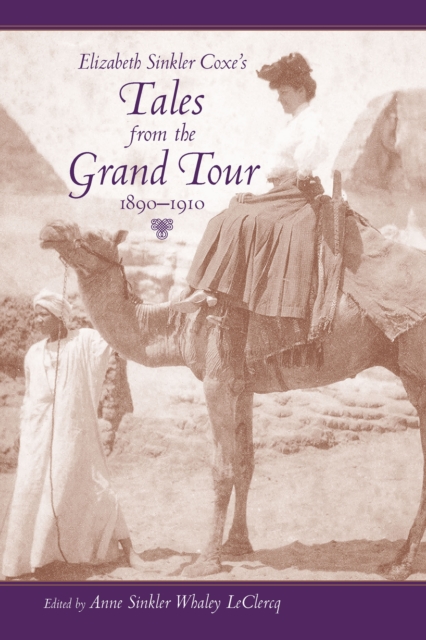
Elizabeth Sinkler Coxe's Tales from the Grand Tour, 1890-1910
The international adventures of a southern widow turned patron of historical discovery, Elizabeth Sinkler Coxe's Tales from the Grand Tour, 1890–1910 is a travelogue of captivating episodes in exotic lands as experienced by an intrepid American aristocrat and her son at the dawn of the twentieth century. A member of the prominent Sinkler family of Charleston and Philadelphia, Elizabeth \"Lizzie\" Sinkler married into Philadelphia's wealthy Coxe family in 1870. Widowed just three years later, she dedicated herself to a lifelong pursuit of philanthropy, intellectual endeavor, and extensive travel. Heeding the call of their dauntless adventuresome spirits, Lizzie and her son, Eckley, set sail in 1890 on a series of odysseys that took them from the United States to Cairo, Luxor, Khartoum, Algiers, Istanbul, Naples, Vichy, and Athens. The Coxes not only visited the sites and monuments of ancient civilizations but also participated in digs, funded entire expeditions, and ultimately subsidized the creation of the Coxe Wing of Ancient History at the University of Pennsylvania Museum. A prolific correspondent, Lizzie conscientiously recorded her adventures abroad in lively prose that captures the surreal exhilarations and harsh realities of traversing the known and barely known worlds of Africa and the Middle East. She journeyed through foreign lands with various nieces in tow to expose them to the educational and social benefits of the Grand Tour. Her letters and recollections are complemented by numerous photographs and several original watercolor paintings.
eBook