
Catalogue Search | MBRL


Are you sure you want to remove the book from the shelf?

{{itemTitle}}
188
result(s) for
"Europe Economic conditions 21st century"
Sort by:


Gypsy economy
Economic arrangements of Romanies are complexly related to their social position. The authors of this volume explore these complexities, including how economic exchanges forge key social relationships of gender and ethnicity, how economic opportunities are constructed and seized, and how economic success and failure are transformed into attributes of social persons. They explore how, despite — or perhaps because of — their unstable and ambiguous position within the market economy, shared today with a growing number of people facing precarity and informalisation, Roma and Gypsy communities continuously re-create more or less viable economic strategies. The ethnographically based chapters share accounts of socially and economically vulnerable populations that face their situation with self-determination and creativity.
eBook

The strange death of Europe : immigration, identity, Islam
This book is not only an analysis of demographic and political realities in Europe, but also an eyewitness account of a continent in self-destruct mode. It includes reporting from across the entire continent, from the places where migrants land to the places they end up, from the people who appear to welcome them in to the places which cannot accept them.
Book

Resocialising Europe in a Time of Crisis
Terms such as 'Social Europe' and 'European Social Model' have long resided in the political and regulatory lexicon of European integration. But in recent years, and in spite of the adoption of the Charter of Fundamental Rights, the EU social profile has entered a profound period of crisis. The ECJ judgments of Viking and Laval exemplify the unresolved tension between the EU's strong market imperatives and its fragile social aspirations while the ongoing economic crisis, while the various 'bail out' packages are producing a constant retrenchment of social rights. The status quo is one in which workers appear to shoulder most of the risks attendant on making and executing arrangements for the doing of work. Chapters in this book advocate a reversal of this trend in favour of fair mutualization, so as to disperse these risks and share them more equitably between employers, the state, and society at large.
eBook

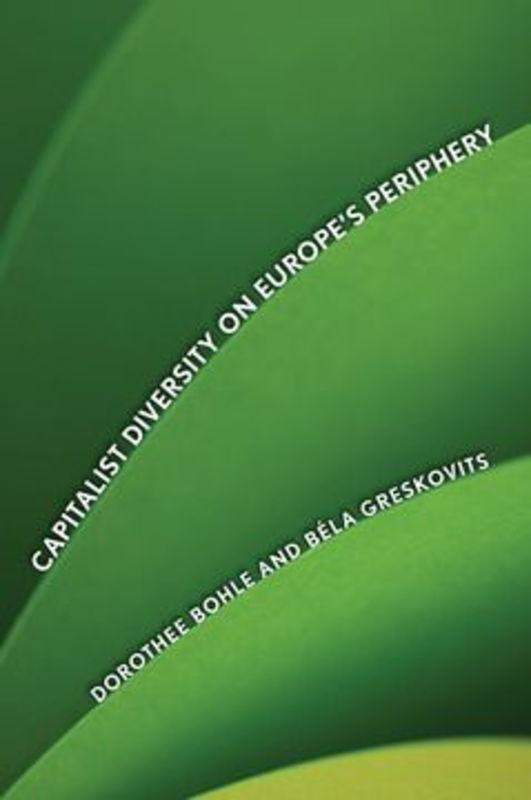
Capitalist Diversity on Europe's Periphery
With the collapse of the Council for Mutual Economic Assistance in 1991, the Eastern European nations of the former socialist bloc had to figure out their newly capitalist future. Capitalism, they found, was not a single set of political-economic relations. Rather, they each had to decide what sort of capitalist nation to become. InCapitalist Diversity on Europe's Periphery, Dorothee Bohle and Béla Geskovits trace the form that capitalism took in each country, the assets and liabilities left behind by socialism, the transformational strategies embraced by political and technocratic elites, and the influence of transnational actors and institutions. They also evaluate the impact of three regional shocks: the recession of the early 1990s, the rolling global financial crisis that started in July 1997, and the political shocks that attended EU enlargement in 2004.
Bohle and Greskovits show that the postsocialist states have established three basic variants of capitalist political economy: neoliberal, embedded neoliberal, and neocorporatist. The Baltic states followed a neoliberal prescription: low controls on capital, open markets, reduced provisions for social welfare. The larger states of central and eastern Europe (Poland, Hungary, and the Czech and Slovak republics) have used foreign investment to stimulate export industries but retained social welfare regimes and substantial government power to enforce industrial policy. Slovenia has proved to be an outlier, successfully mixing competitive industries and neocorporatist social inclusion. Bohle and Greskovits also describe the political contention over such arrangements in Romania, Bulgaria, and Croatia. A highly original and theoretically sophisticated typology of capitalism in postsocialist Europe, this book is unique in the breadth and depth of its conceptually coherent and empirically rich comparative analysis.
eBook

Were you born on the wrong continent? : how the European model can help you get a life
Explains why the worker-friendly European model for employment, especially that of Germany, may thrive well into the twenty-first century without compromising its citizens' ease of living--and may actually be the best example for the United States to follow.--[source unknown].
Book


The Consequences of the International Crisis for European SMEs
The book explores how, to what extent and with what consequences the international crisis of 2007-2008 and the recession which followed have affected European SMEs (small and medium enterprises) in both the well established market economies of the old member countries and in the post-transformation new member countries, and what can be done at the institutional and political level to uphold them.
eBook