
Catalogue Search | MBRL


Are you sure you want to remove the book from the shelf?

{{itemTitle}}
2,577
result(s) for
"Europe History, Local."
Sort by:

The Power of Place : Rulers and Their Palaces, Landscapes, Cities, and Holy Places
\"The Power of Place explores the nature of power--the power of kings, emperors, and popes--through the places that these rulers created or developed, including palaces, cities, landscapes, holy places, inauguration sites, and burial places. Ranging across all of Europe from the first to the sixteenth centuries--from Prague and Seville to Palermo and the Oslo Fjord--David Rollason examines how these places conveyed messages of power and what those messages were. Rollason draws on the latest research in a range of disciplines--principally archaeology, and the histories of art, architecture, and landscape, as well as historical and literary studies--to investigate what the power of rulers consisted of. Was their power based on impersonal bureaucratic mechanisms, on personal relationships between rulers and subjects, or on strong beliefs in the quasi-divine status of rulers? How did impressive edifices support and emphasize these practices of power? Rollason takes readers to spectacular sites, including the remarkable remains of the tenth-century city of Madinat al-Zahra near Cordoba, the remarkably preserved palace-church of the emperor Charlemagne in Aachen, and the soaring shrine-church of the Saint-Chapelle of King Louis IX. Giving readers the tools to analyze rulers' palaces, landscapes, cities, and holy places, The Power of Place offers a fascinating perspective on the development of power throughout history\"-- Provided by publisher.
Book

Cultural History of Early Modern European Streets
Six essays explore the evolving cultural and material life of the early modern European street, a contested place of shaded meanings where public met private space, and state and society vied for control of urban form.
eBook

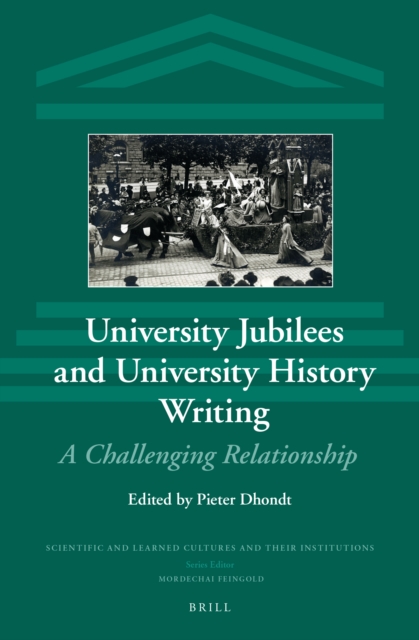
University Jubilees and University History Writing
Through various case studies, this book shows the continuity of the close relationship between jubilees and university historiography and the impact of this interaction on the jubilee publications and academic heritage. Yet it also goes beyond the jubilee by presenting three other ways of writing university history.
eBook

Place and locality in modern France
\"Place and Locality in Modern France is an edited collection that successfully analyses the significance and changing constructions of local place in modern France. Drawing on the expertise of a range of scholars from around the world, this book is a timely overview of the cross-disciplinary thinking that is currently taking place over a central issue in French history. The book investigates the politics of administrative reform, regionalism and projects of decentralization. It looks at the role of commerce in engendering narratives and experience of local place, explores the importance of ethnic, class and gender distinctions, and considers the generation and transmission of knowledge about local place and culture through academia, civic heritage and popular memory. In short, this text provides a sweeping account of the concept of the 'local' in French history in a way that will effectively bridge the divide between micro- and macro-history for those interested in ideas of locality and culture in modern French and European history\"-- Provided by publisher.
Book

Political Transformations and Public Finances
How did today's rich states first establish modern fiscal systems? To answer this question, Political Transformations and Public Finances by Mark Dincecco examines the evolution of political regimes and public finances in Europe over the long term. The book argues that the emergence of efficient fiscal institutions was the result of two fundamental political transformations that resolved long-standing problems of fiscal fragmentation and absolutism. States gained tax force through fiscal centralization and restricted ruler power through parliamentary limits, which enabled them to gather large tax revenues and channel funds toward public services with positive economic benefits. Using a novel combination of descriptive, case study and statistical methods, the book pursues this argument through a systematic investigation of a new panel database that spans eleven countries and four centuries. The book's findings are significant for our understanding of economic history and have important consequences for current policy debates.
eBook


Austerities and Aspirations
This monograph provides an analysis of the economic performance and living standard in Czechoslovakia and its successor states, Hungary, and Poland since 1945. The novelty of the book lies in its broad comparative perspective: it places East Central Europe in a wider European framework that underlines the themes of regional disparities and European commonalities. Going beyond the traditional growth paradigm, the author systematically studies the historical patterns of consumption, leisure, and quality of life-aspects that Tomka argues can best be considered in relation to one other. By adopting this \"triple approach,\" he undertakes a truly interdisciplinary research drawing from history, economics, sociology, and demography.
As a result of Tomka's three-pillar comparative analysis, the book makes a major contribution to the debates on the dynamics of economic growth in communist and postcommunist East Central Europe, on the socialist consumer culture along with its transformation after 1990, and on how the accounts on East Central Europe can be integrated into the emerging field of historical quality of life research.
eBook

Feminism and motherhood in Western Europe, 1890-1970 : the maternal dilemma
According to Allen, motherhood and citizenship are terms that are closely linked and have been redefined over the past century due to changes in women's status, feminist movements, and political developments. Mother-child relationships were greatly affected by political decisions during the early 1900s, and the maternal role has been transformed over the years. To understand the dilemmas faced by women concerning motherhood and work, for example, Allen argues that the problem must be examined in terms of its demographic and political development through history. Allen highlights the feminist movements in Western Europe - primarily Britain, France, Germany and the Netherlands, and explores the implications of the maternal role for women's aspirations to the rights of citizenship. Among the topics Allen explores the history of the maternal role, psychoanalysis and theories on the mother-child relationship, changes in family law from 1890-1914, the economic status of mothers, and reproductive responsibility.
eBook

Defending democracy : reactions to extremism in interwar Europe
Winner, Best Book on European Politics, 2005, European Politics and Society Section, American Political Science Association How does a democracy deal with threats to its stability and continued existence when those threats come from political parties that play the democratic game? In Defending Democracy, political scientist Giovanni Capoccia studies key European nations between World Wars I and II which survived such democratic crises. A comprehensive and thoughtful historical analysis of the democracies of interwar Europe, Defending Democracy provides a unique perspective on the many lessons to be learned from their successes and failures. With this exclusively empirical investigative approach, Capoccia develops a methodology for analyzing contemporary democracies—such as Algeria, Turkey, Israel, and others—where similar political conditions are present. Given the rise of terrorism and the persistence of extremism in both established and new democracies today, continued research and dialogue on the defense of democracy are necessary for its preservation.
eBook