
Catalogue Search | MBRL


Are you sure you want to remove the book from the shelf?

{{itemTitle}}
152
result(s) for
"Europe Intellectual life 19th century."
Sort by:

The Cambridge history of modern European thought
\"It is something of a truism that each age must work through the legacy of its predecessors. In the case of the nineteenth century, this obvious statement gains poignancy when one considers the novel challenges and possibilities of the eighteenth century, which was, after all, the age of the Enlightenment. In its many guises and national variations, the Enlightenment asserted provocative and epoch-making claims about the role of reason, science, and criticism vis a vis the traditional authority of religion, state, and received knowledge. It drew new roadmaps for the conscious and reflexive reform of society and the betterment of people. At its core, it articulated a new emancipatory project - at once philosophical and political - chiefly oriented toward the ideal of individual autonomy. The cultural, social and political configuration that shaped the Enlightenment came to something of an end in the closing decade of the eighteenth century, partly through processes of internal critique but also, spectacularly, through the political collapse of the Old Regime. In the changed circumstances of the early nineteenth century, the Enlightenment fragmented into a multitude of contests over the meaning of its legacy\"-- Provided by publisher.
Book

A Half-Century of Greatness
Choice Outstanding Academic Title for 2008
A Half-Century of Greatness paints a vivid and dramatic picture of the creative thought of mid- to late nineteenth century Europe and the influence of the unsuccessful revolutions of 1848. It reveals often unexpected links between novelists, poets, and philosophers from England, Germany, Austria, Hungary, Russia, and Ukraine—especially Dickens, Carlyle, Mill, the Brontës, and George Eliot; Hegel, Strauss, Feuerbach, Marx, Engels, Wagner, and several German poets; the Hungarian poet Sándor Petöfi; Gogol, Dostoevsky, Bakunin, and Herzen in Russia, and the great Ukrainian poet Shevchenko. Ewen goes on to trace the transition from Romanticism to Victorianism, or what he calls “the Victorian compromise”—the ascendancy of the middle class.
The book was reconstructed and edited by Dr. Jeffrey Wollock from Ewen’s final manuscript. It includes the author's own reference citations throughout, a reconstructed bibliography, and an updated “further reading” list.
This is Ewen’s last work, the long-lost companion to his Heroic Imagination . Together, these books present a panorama of the social, political, and artistic aspects of European Romanticism, especially foreshadowing and complementing recent work on the relation of Marxism to romanticism. Anyone interested in what Lukacs called “Romantic anticapitalism,”; who appreciates such books as Marshall Berman's Adventures in Marxism or E.P. Thompson's The Romantics (1997), will find Ewen’s work a welcome addition.
eBook


Giuseppe Mazzini’s Young Europe and the Birth of Modern Nationalism in the Slavic World
This book explores the influence of Young Europe - an international alliance founded by Giuseppe Mazzini in 1834 - on the Polish, Slovak, Czech, and Ukrainian intelligentsia in the first half of the nineteenth century.
eBook

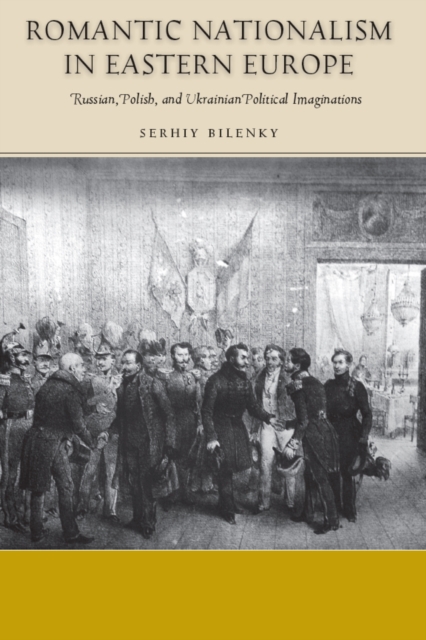
Romantic Nationalism in Eastern Europe
This book explores the political imagination of Eastern Europe in the 1830s and 1840s, when Polish, Russian, and Ukrainian intellectuals came to identify themselves as belonging to communities known as nations or nationalities. Bilenky approaches this topic from a transnational perspective, revealing the ways in which modern Russian, Polish, and Ukrainian nationalities were formed and refashioned through the challenges they presented to one another, both as neighboring communities and as minorities within a given community. Further, all three nations defined themselves as a result of their interactions with the Russian and Austrian empires. Fueled by the Romantic search for national roots, they developed a number of separate yet often overlapping and inclusive senses of national identity, thereby producing myriad versions of Russianness, Polishness, and Ukrainianness.
eBook


When information came of age
1. Information and its History2. Organizing Information: The Language of Science3. Transforming Information: The Origin of Statistics4. Displaying Information: Maps and Graphs5. Storing Information: Dictionaries and Encyclopedias6. Communicating Information: Postal and Telegraphic Systems7. Information Ages, Past and Present.
eBook


The life of J.D. Åkerblad : Egyptian decipherment and orientalism in revolutionary times
This intellectual biography of Johan David Âkerblad presents a new account of the decipherment of ancient Egyptian. Oriental and classical studies and their entwinement in the turbulent politics of this age of revolutions are presented from a novel perspective.
eBook