
Catalogue Search | MBRL


Are you sure you want to remove the book from the shelf?

{{itemTitle}}
75
result(s) for
"Europe-History-476-1492"
Sort by:

The expansion of Europe, 1250-1500
Later medieval Europe saw a great deal of change and expansion of different kinds. This geographically broad textbook explores these events in a series of core chapters on the different countries, covering the Holy Roman Empire, East-Central Europe, Scandinavia and Russia. It looks not only at political history but also at economy, society and culture, including art, architecture, literature and music. North shows the significance of the different lines of development that each country/region experienced, thereby offering a very important corrective to the usual western-European focus that characterizes other textbooks in the field. In this way he demonstrates that Europe did not consist of a core and periphery, but of different regions that had divergent developments, and makes sense of these various patterns of historical change. A review of current research debates also introduces readers to the most up to date discussions in the field.
Book

Europe\ in the Middle Ages
From the nineteenth century onwards, historians described the Middle Ages as the 'cradle' of the nation state-then, after World War II, they increasingly identified the period as the 'cradle' of Europe. A close look at the sources demonstrates that both interpretations are misleading: while 'Europe' was not a rare word, its use simply does not follow modern expectations. This volume contrasts modern historians' constructions of 'Europe in the Middle Ages' with a fresh analysis of the medieval sources and discourses. The results force us to recognize that medieval ideas of ordering the world differ from modern expectations, thereby inviting us to reflect upon the use and limits of history in contemporary political discourse.
eBook
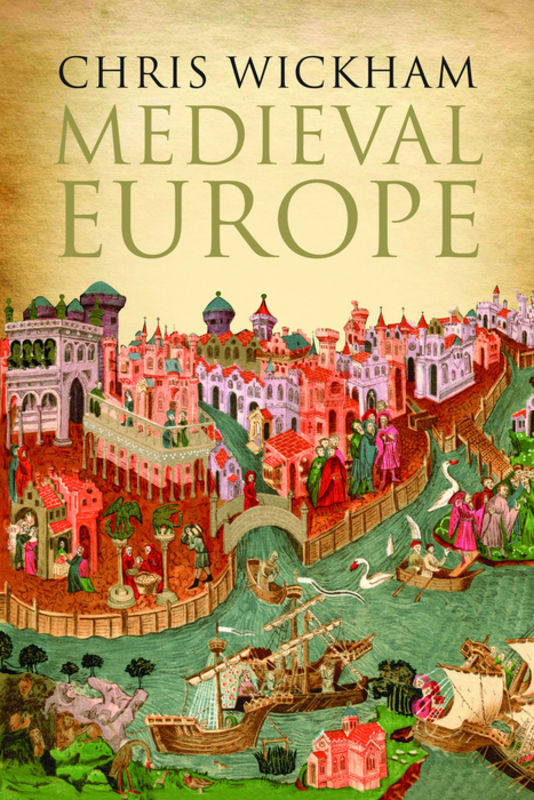
Medieval Europe
A spirited history of the changes that transformed Europe during the 1,000-year span of the Middle Ages: \"A dazzling race through a complex millennium.\"— Publishers Weekly
The millennium between the breakup of the western Roman Empire and the Reformation was a long and hugely transformative period—one not easily chronicled within the scope of a few hundred pages. Yet distinguished historian Chris Wickham has taken up the challenge in this landmark book, and he succeeds in producing the most riveting account of medieval Europe in a generation.
Tracking the entire sweep of the Middle Ages across Europe, Wickham focuses on important changes century by century, including such pivotal crises and moments as the fall of the western Roman Empire, Charlemagne's reforms, the feudal revolution, the challenge of heresy, the destruction of the Byzantine Empire, the rebuilding of late medieval states, and the appalling devastation of the Black Death. He provides illuminating vignettes that underscore how shifting social, economic, and political circumstances affected individual lives and international events—and offers both a new conception of Europe's medieval period and a provocative revision of exactly how and why the Middle Ages matter.
\"Far-ranging, fluent, and thoughtful—of considerable interest to students of history writ large, and not just of Europe.\"— Kirkus Reviews, (starred review)
Includes maps and illustrations
eBook


Seasonal Settlement in the Medieval and Early Modern Countryside
For the first time seasonality is placed at the centre of the study of rural settlement. Using a Europe-wide approach, it provides a primer of examples, of techniques and of ideas for the identification and understanding of seasonal settlement. As such, it marks an important new step in the interpretation of the use of the countryside by historic communities linked to the annual passage of the year. The particular studies are introduced by an opening essay which draws wider conclusions about the study of seasonal settlement, followed by 31 papers by authors from all parts of Europe and beyond. By its very nature ephemeral, seasonal settlement in the medieval and early modern periods is less well researched than permanent settlement. It is often presumed that seasonal settlement is the result of transhumance, but it was only one facet of seasonal settlement. It was also necessitated by other forms of economic activity, such as fishing, charcoal-burning, or iron-smelting, including settlements of pastoralists such as nomads, drovers, herders as well as labourers’ huts within the farming context. The season a settlement was occupied varied from one activity to another and from one place to another - summer is good for grazing in many mountainous areas, but winter proved best for some industrial processes. While upland and mountainous settlements built of stone are easily recognised, those that use wood and more perishable materials are less obvious. Despite this, the settlements of nomadic pastoralists in both tundra and desert or of fishermen in the Baltic region are nonetheless identifiable. Yet for all that definitive recognition of seasonal settlement is rarely possible on archaeological grounds alone. Although material remains can be of particular importance, generally it is the combination of documentary information, ethnography, geographical context and palaeo-environmental data that provide frameworks for interpreting seasonal settlements.
eBook

Dealing With The Dead
From revenant legends to the regulation of burial space; from martyrologies to accounts of murder; and from the danse macabre to funerals both lavish and simple, this volume examines how communities dealt with their dead as continual, albeit non-living members.
eBook

The rights and aspirations of the Magna Carta
This book provides an original and multidisciplinary approach on Magna Carta (1215) as a joint heritage, a source of inspiration both for long established democracies and countries which only recently experienced the Rule of Law. Far from simply extolling the virtues associated with Magna Carta, it explores the gaps of the Great Charter. Instead of dealing separately with the historians' and the lawyers' outlooks as two conflicting perspectives, it juxtaposes the views of medievalist and contemporary historians with those of practicing lawyers and law academics, offering readers a thorough yet accessible historic and legal analysis of the charter and its meaning for the citizens of twenty-first century democracies. At a time of the erosion of civil liberties and fundamental rights, The Rights and Aspirations of the Magna Carta provides a rare insight into the 1215 medieval charter and its legacy.
eBook