
Catalogue Search | MBRL


Are you sure you want to remove the book from the shelf?

{{itemTitle}}
101
result(s) for
"European Union (EU), North Atlantic Treaty Organisation (NATO)"
Sort by:
The enlargement of the European Union and NATO : ordering from the menu in Central Europe
In 2004 the EU and NATO each added ten new member states, most from Eastern and Central Europe. In order to qualify for membership, they often emulated practices common in Western Europe. Professor Jacoby examines the successes and failures in a number of fields and in several countries.
eBook
Geopolitics reframed : security and identity in Europe's eastern enlargement
This book traces the shifting meanings of security and geopolitics in Central European states that acceded into the EU or NATO in 2004. The author examines assumptions that shaped these debates and influenced policy-making, combining fresh theoretical approaches from international relations and political geography with rich empirical material from Central Europe. This book provides the first in-depth analysis of security discourse in the region.
eBook
NATO and the Middle East
Despite having been active in the region since the mid-1990s, the role of NATO in the Middle East has attracted particular attention since the events of 11th September 2001. This book analyses the limits of NATO’s role in the Middle East region and examines whether or not the Alliance is able to help in improving the fragile regional security environment through cooperative links with select Middle Eastern partners.
The author reviews the strategic importance of the region from a Western perspective and why it has become a source of instability in world politics, looks at US and international initiatives to counteract this instability, and charts the development of NATO in this context. He also examines NATO’s role with regard to two pressing Middle Eastern crises, Iraq and Darfur, assessing whether or not this role has been consistent with, if not an expression of, US strategic interests.
A comprehensive examination of the impacts of 9-11 events on world security and the development of NATO’s role in the Middle East, this book will be an important addition to the existing literature on security and strategic affairs, US foreign policy, Middle Eastern politics, European politics, and terrorism studies.
Introduction: The Geopolitical Context of NATO's Role in the Middle East 1. Western Interests and Stability in the Middle East 2. NATO’s New Global Role and its Relevance to the Middle East 3. NATO’s Role in the Middle East Before 9/11 4. NATO’s Role in the Middle East Post-9/11 5. The United States and NATO’s Role in the Middle East. Conclusion: NATO and Security Challenges in the Middle East
Mohammed Moustafa Orfy is an Egyptian diplomat, writer and academic lecturer. With a wide practical and academic experience in various fields including mass communication, diplomacy, international law, human rights and international relations, he has published four books and written a number of articles covering a wide range of foreign policy issues.
eBook
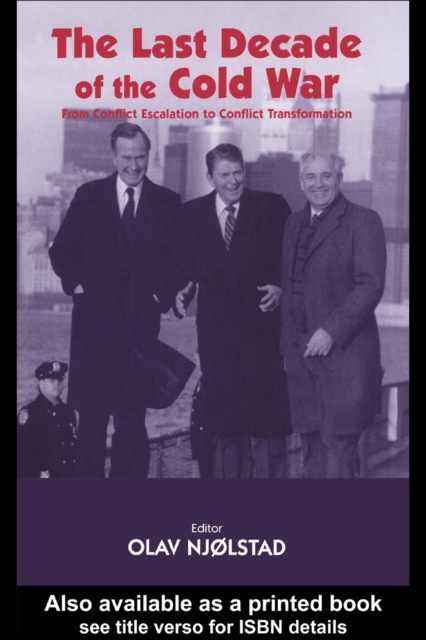
The Last Decade of the Cold War
The 1980s was a period of almost unprecedented rivalry and tension between the two main actors in the East-West conflict, the United States and the Soviet Union. Why and how that conflict first escalated and thereafter, in an amazingly swift process, was reversed and brought to its peaceful conclusion at the end of the decade is the topic of this volume. With individual contributions by eighteen well-known scholars of international relations and history from various countries, the book addresses the role of the United States, the former Soviet Union, and the countries of western and eastern Europe in that remarkable last decade of the Cold War, and discusses how particular events as well as underlying political, ideological, social, and economic factors may have contributed to the remarkable transformation that took place.
Olav Njølstad is Research Director at the Norwegian Nobel Institute, Oslo, Norway. He holds a Ph.D. in international history from the University of Oslo (1994), where he also teaches. He has published a number of books and articles on the history of nuclear weapons and atomic energy research, US-Soviet relations in the 1970s, and Norwegian foreign policy.
Part 1: The 1980s in Historical Context 1. The 1980s Revisited or the Cold War as History - Again 2. The Beginning and the End: Time, context and the Cold War 3. The European Role in the Beginning and Particularly the End of the Cold War Part 2: Explaining the Shift in Soviet Thinking and Policy 4. Economic Constraints and the Turn toward Superpower Cooperation in the 1980s 5. Explaining the End of the Cold War: Turning points in Soviet security policy 6. The Sources of 'New Thinking' in Soviet Politics 7. The Messianic Character of Gorbachev's 'New Thinking': Why and what for? Part 3: The United States and the Ending of the Cold War 8. The US Role in Winding Down the Cold War, 1980-90 9. The Carter Legacy: Entering the second era of the Cold War 10. The US and the Transformation of the Cold War 11. Reagan's Anti-revolutionary Offensive in the Third World Part 4: Europe in the Last Decade of the Cold War 12. Germany in the Last Decade of the Cold War 13. Before the Wall: French diplomacy and the last decade of the Cold War, 1979-89 14. Helping to Open the Door?: Britain in the last decade of the Cold War 15. Italy and the Battle of the Euromissiles 16. NATO's Northern Frontline in the 1980s 17. Playground of Superpowers: Poland 1980-89 - A view from inside 18. Did Gorbachev Liberate Eastern Europe?
eBook

Why NATO Enlargement Does Not Spread Democracy
Supporters of NATO enlargement contend that it will promote the spread of democracy, which in turn will lead to greater stability in Europe. Reiter maintains that the historical record--during and after the Cold War--fails to establish any correlation between NATO membership and the expansion of democracy.
Journal Article


Developing security community in the Western Balkans: The role of the EU and NATO
This article examines how external third parties, particularly international organizations, can facilitate the development of security community and international integration within post-conflict societies. Focusing on seven countries in the Western Balkan region, this study offers unique insight into how and why feelings of trust and a sense of community can be encouraged by external actors – the EU and NATO in this case – and how and if trust and community can filter down to the most local levels within post-conflict societies. Ultimately, we argue that both the EU and NATO have, primarily through membership requirements to engage in regional interaction and cooperation, significantly contributed to the development of security community among Western Balkan neighbors at the elite level. However, we also find that feelings of trust and belongingness are still very much lacking among the general population of the Western Balkan region. Such insights will further efforts to enhance conflict resolution and post-conflict reconstruction in the Western Balkans and elsewhere.
Journal Article