
Catalogue Search | MBRL


Are you sure you want to remove the book from the shelf?

{{itemTitle}}
59
result(s) for
"European carp"
Sort by:

Biology and Ecology of Carp
Carp are the backbone of a growing aquaculture industry. They facilitate scientific progress as a model species in laboratories, cause concern for ecosystem managers as an invasive species, and mesmerize anglers as big game. In addition, ornamental koi carp fascinate hobby breeders. Biology and Ecology of Carp covers all these facets of this freshw
eBook

eDNA surveys to detect species at very low densities
Eradications of invasive species are usually expensive and difficult to conduct. Knowing when to declare an eradication successful requires distinguishing between failed detection of the target species due to imperfect sensitivity of the detection method and true species absence. This is difficult because the sensitivities of many detection methods are unknown. Environmental DNA (eDNA) methods can be used to detect species by analysing DNA present in environmental samples. eDNA has been promoted as a particularly sensitive and cost‐effective way to detect species at low densities and, importantly, the sensitivity of eDNA surveys can be quantified. Nevertheless, the effort and costs involved in detecting species at extremely low densities, such as required during eradication, have not been previously calculated. We evaluated the sensitivity of eDNA surveys in detecting the invasive European carp, Cyprinus carpio, in two lakes in Tasmania, Australia, one in which carp have been eradicated and a second in which carp are currently being eradicated. We determined the sampling effort and associated cost required to detect the species at very low density in these lakes. While our eDNA survey detected the current low density carp population present in Lake Sorell, we show that an exponential increase in sampling effort and associated cost will be required to confidently detect the species as the population declines. Similarly, while our eDNA survey corroborated the species absence from Lake Crescent, our detection confidence was low. We quantify the survey effort and financial investment required to confidently establish eradication success in Lake Crescent. Synthesis and applications. Estimating the environmental DNA (eDNA) survey effort and cost required to detect species at a given density will enable practitioners to make informed decisions on the feasibility of implementing such surveys. Quantifying the sensitivity of eDNA surveys will also inform the confidence practitioners should place in eDNA detection results to ensure appropriate management actions are implemented and provide a suitable stopping point at which to confidently declare eradication success. Estimating the environmental DNA (eDNA) survey effort and cost required to detect species at a given density will enable practitioners to make informed decisions on the feasibility of implementing such surveys. Quantifying the sensitivity of eDNA surveys will also inform the confidence practitioners should place in the results of eDNA detection surveys to ensure appropriate management actions are implemented and provide a suitable stopping point at which to confidently declare eradication success.
Journal Article

Genetic Investigation of Aral Wild Common Carp Populations (Cyprinus carpio) Using ddRAD Sequencing
Common carp (Cyprinus carpio) is a widespread freshwater fish species of the Cyprinidae family, one of the largest and most diverse fish families. The natural habitats of C. carpio extend from Western Europe to South-East Asia. Common carp has remained an economically important fish species in aquaculture for many centuries and its production nowadays exceeds 4 million tons worldwide and continues to grow. The taxonomy of C. carpio is complicated, since this species is usually distinguished in two, three, and even four distinct subspecies. In the present study, we used ddRAD-sequencing to genotype 30 specimens from five wild common carp populations from the Ponto-Caspian, Balkhash-Ile, and Aral Sea geographical regions. It is demonstrated that they differ at the population level according to F-statistics analysis. At the same time, the subspecies status of C. carpio aralensis has not yet been confirmed. We found several loci that can be used as a discriminant for Aral and Ponto-Caspian wild common carp populations. It is suggested that Aral carp (C. carpio aralensis), which inhabits Balkhash-Ile and Aral Sea basins, is related to Ponto-Caspian or European carp (C. carpio carpio). Moreover, Aral carp might be the ancestor for European carp subspecies. Our results can be used to develop population-specific, high-density SNP marker panels, allowing the trade control of common carp production in the Eurasian Economic Union
Journal Article
Koi Carp
Koi carp are ornamental carp developed from the domestic form of the common carp (Cyprinus carpio) in Japan in the early nineteenth century. This chapter provides information on the biological parameters of European wild carp Koi carp. It discusses the aquatic environment, clinical examination, basic sampling techniques, sedation and anaesthesia, analgesia, hospitalisation, common medical conditions, and euthanasia of Koi carp. There are a huge number of potential water quality issues that can have an impact of the health of fish in a pond system. The chapter covers a few of the most commonly encountered water quality issues in Koi pond systems. The sampling techniques discussed include skin scrapes, impression smears, swim bladder aspirate, blood sampling, and bacteriology. The medical conditions covered are skin trauma, bacterial skin disease, fungal skin disease, abdominal distension, occular trauma, and neoplasia.
Book Chapter

Potential Use of Irrigation Drains as Wetlands
There are over 6000 km of irrigation drains in the Murray-Darling Basin, Australia. The maintenance of aquatic plants may be critical to the utility of the watercourses in scavenging nutrients, yet the plants are often removed by extensive herbicide spraying and large-scale mechanical excavation and desilting. Results for four out of five experiments showed that water clarity improved when vegetation was left unmanaged. High concentrations of inflowing nitrate from subsurface tile drainage was quickly dissipated. There was an unexpectedly poor correlation between turbidity and phosphorus concentration overall; but in four experiments concentrations of total phosphorus declined during transport through vegetated stretches of channel. There was an important interaction between plant cover and sediment bioperturbation, since in bare stretches of channel the roiling of carp increased the concentrations of suspended sediments and nutrients. Irrigation drainage water quality may be improved by management of aquatic plants to trap suspended paniculate load and reduce the effects of carp.
Journal Article
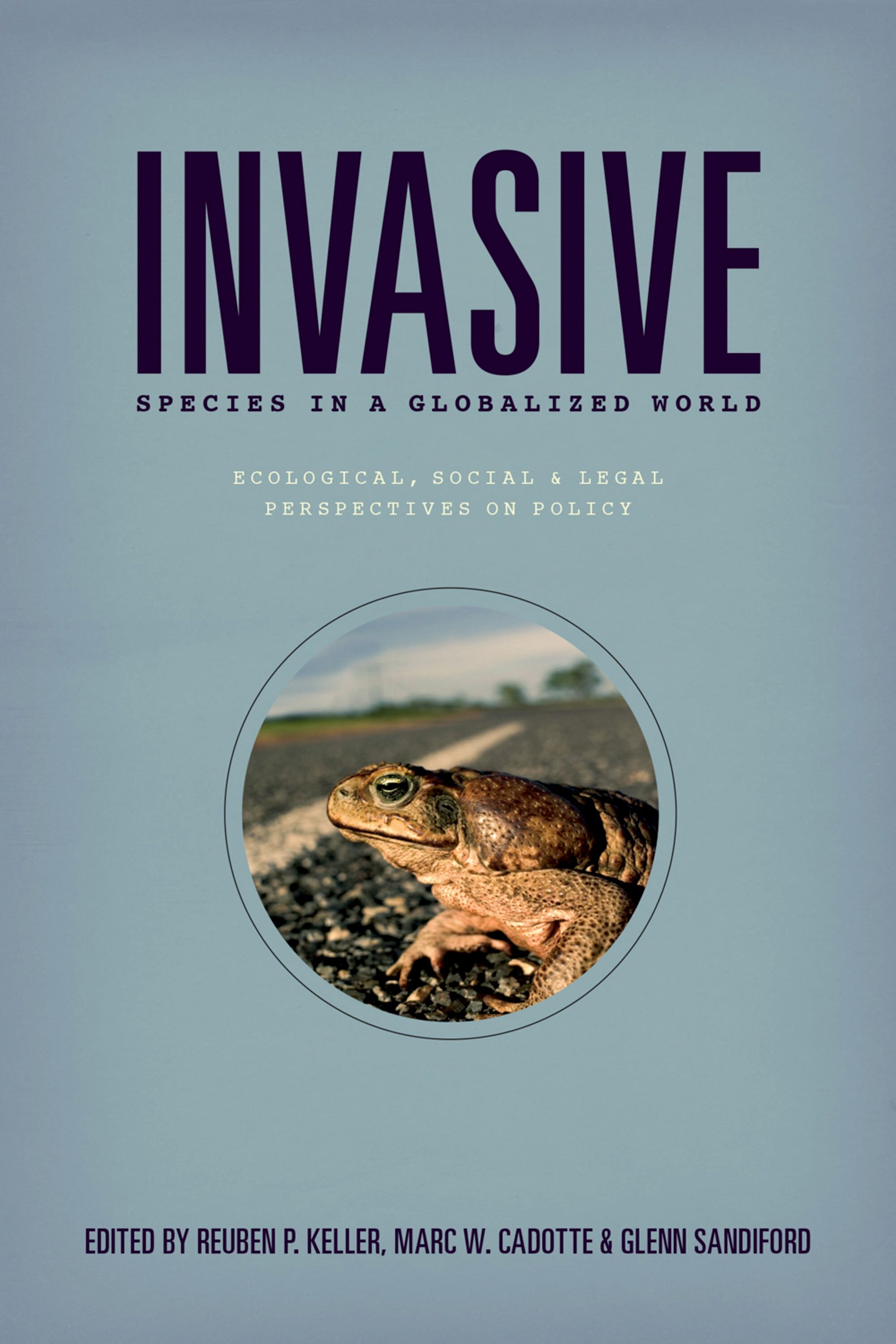
Invasive species in a globalized world : ecological, social, and legal perspectives on policy
Over the past several decades, the field of invasion biology has rapidly expanded as global trade and the spread of human populations have increasingly carried animal and plant species across natural barriers that have kept them ecologically separated for millions of years. Because some of these nonnative species thrive in their new homes and harm environments, economies, and human health, the prevention and management of invasive species has become a major policy goal from local to international levels.
Yet even though ecological research has led to public conversation and policy recommendations, those recommendations have frequently been ignored, and the efforts to counter invasive species have been largely unsuccessful. Recognizing the need to engage experts across the life, social, and legal sciences as well as the humanities, the editors of this volume have drawn together a wide variety of ecologists, historians, economists, legal scholars, policy makers, and communications scholars, to facilitate a dialogue among these disciplines and understand fully the invasive species phenomenon. Aided by case studies of well-known invasives such as the cane toad of Australia and the emerald ash borer, Asian carp, and sea lampreys that threaten US ecosystems, Invasive Species in a Globalized World offers strategies for developing and implementing anti-invasive policies designed to stop their introduction and spread, and to limit their effects.
eBook

Chlorpyrifos levels within permitted limits induce nuclear abnormalities and DNA damage in the erythrocytes of the common carp
The organophosphate pesticide chlorpyrifos (CPF) is defined as a priority pollutant in surface freshwaters according to Directive 2013/39/EU of the European Parliament. The focus of this study was to assess the potential cytotoxic and genotoxic effects of permissible CPF levels on juvenile forms of the common carp. We found that low-level CPF exposure did not induce elevated levels of micronuclei, but significantly increased the frequency of total nuclear abnormalities (NAs) proportional to dose and time; notched, blebbed, lobed and eight-shaped nuclei, nuclear buds, nuclear bridges and binucleated cells were all detected. Decreased frequencies of polychromatic erythrocytes (PCEs) and DNA damage detected by comet assay were also observed, confirming the cytotoxic and genotoxic effects of CPF. Altogether, these data (1) demonstrate that CPF is toxic even at permissible levels, possessing considerable genotoxic and cytotoxic potential in peripheral erythrocytes of exposed fish and (2) validate the assessment of NAs, PCEs and comet assay performance as sensitive biomarkers for the early detection of CPF pollution. These findings can be applied to guide environmental risk assessment and biomonitoring programs.
Journal Article

Silver Nanoparticles Proved to Be Efficient Antivirals In Vitro against Three Highly Pathogenic Fish Viruses
The efficacy of silver nanoparticles (AgNPs) was tested in vitro against three different fish viruses, causing significant economic damage in aquaculture. These viruses were the spring viraemia of carp virus (SVCV), European catfish virus (ECV), and Ictalurid herpesvirus 2 (IcHV-2). The safe concentration of AgNPs that did not cause cytotoxic effects in EPC cells proved to be 25 ng/mL. This dose of AgNPs decreased significantly (5–330×) the viral load of all three viruses in three different types of treatments (virus pre-treatment, cell pre-treatment, and cell post-treatment with the AgNPs). In a higher concentration, the AgNPs proved to be efficient against ECV and IcHV-2 even in a delayed post-cell-treatment experiment (AgNP treatment was applied 24 h after the virus inoculation). These first in vitro results against three devastating fish viruses are encouraging to continue the study of the applicability of AgNPs in aquaculture in the future.
Journal Article
Metal concentrations in water, sediment and three fish species from the Danube River, Serbia: a cause for environmental concern
The aim of this study was to investigate the presence of metal contamination in water, sediments and three different fish species. All samples were taken from the Danube River in Belgrade Region, a location upstream from Grocka. Concentrations of Cd, Hg and Pb in water samples were not detected, while concentrations of Zn, Fe, Cu and As were in the range of 0.004–0.41 mg L
−1
. Iron was the most deposited metal in sediment samples (17,530.00 mg kg
−1
). For the purpose of heavy metal determination in fish tissue, silver carp, common carp and wels catfish were collected. Concentrations of Pb, Cd and As were determined in muscle, digestive tract and liver by inductively coupled plasma-optical emission spectrophotometry (IPC-OES). The highest concentration of Pb was in the digestive tract of all three fish species, while Cd was mostly deposited in the liver. The highest concentration of Hg was in the muscle tissue of wels catfish, and these values are above the maximum residual levels prescribed by the European Union and the maximum allowed concentrations (MACs) for Serbia. Concentration of As was mostly deposited in the liver, but under the MAC.
Journal Article

Differential impacts of carp and salmon pituitary extracts on induced oogenesis, egg quality, molecular ontogeny and embryonic developmental competence in European eel
Low egg quality and embryonic survival are critical challenges in aquaculture, where assisted reproduction procedures and other factors may impact egg quality. This includes European eel (Anguilla anguilla), where pituitary extract from carp (CPE) or salmon (SPE) is applied to override a dopaminergic inhibition of the neuroendocrine system, preventing gonadotropin secretion and gonadal development. The present study used either CPE or SPE to induce vitellogenesis in female European eel and compared impacts on egg quality and offspring developmental competence with emphasis on the maternal-to-zygotic transition (MZT). Females treated with SPE produced significantly higher proportions of floating eggs with fewer cleavage abnormalities and higher embryonic survival. These findings related successful embryogenesis to higher abundance of mRNA transcripts of genes involved in cell adhesion, activation of MZT, and immune response (dcbld1, epcam, oct4, igm) throughout embryonic development. The abundance of mRNA transcripts of cldnd, foxr1, cea, ccna1, ccnb1, ccnb2, zar1, oct4, and npm2 was relatively stable during the first eight hours, followed by a drop during MZT and low levels thereafter, indicating transfer and subsequent clearance of maternal mRNA. mRNA abundance of zar1, epcam, and dicer1 was associated with cleavage abnormalities, while mRNA abundance of zar1, sox2, foxr1, cldnd, phb2, neurod4, and neurog1 (before MZT) was associated with subsequent embryonic survival. In a second pattern, low initial mRNA abundance with an increase during MZT and higher levels persisting thereafter indicating the activation of zygotic transcription. mRNA abundance of ccna1, npm2, oct4, neurod4, and neurog1 during later embryonic development was associated with hatch success. A deviating pattern was observed for dcbld1, which mRNA levels followed the maternal-effect gene pattern but only for embryos from SPE treated females. Together, the differences in offspring production and performance reported in this study show that PE composition impacts egg quality and embryogenesis and in particular, the transition from initial maternal transcripts to zygotic transcription.
Journal Article