
Catalogue Search | MBRL


Are you sure you want to remove the book from the shelf?

{{itemTitle}}
7
result(s) for
"European letters Renaissance, 1450-1600 History and criticism."
Sort by:


Unknowing Fanaticism
Shows how poetry and politics are entangled in the development of the Reformation concept of religious fanaticism.Proposes a new relationship between poetic form and history.
We may think we know what defines religious fanaticism: violent action undertaken with dogmatic certainty. But the term fanatic, from the European Reformation to today, has never been a stable one. Then and now it has been reductively defined to justify state violence and to delegitimize alternative sources of authority. Unknowing Fanaticism rejects the simplified binary of fanatical religion and rational politics, turning to Renaissance literature to demonstrate that fanaticism was integral to how both modern politics and poetics developed, from the German Peasants' Revolt to the English Civil War.
The book traces two entangled approaches to fanaticism in this long Reformation moment: the targeting of it as an extreme political threat and the engagement with it as a deep epistemological and poetic problem. In the first, thinkers of modernity from Martin Luther to Thomas Hobbes and John Locke positioned themselves against fanaticism to pathologize rebellion and abet theological and political control. In the second, which arose alongside and often in response to the first, the poets of fanaticism investigated the link between fanatical self-annihilation-the process by which one could become a vessel for divine violence-and the practices of writing poetry. Edmund Spenser, John Donne, and John Milton recognized in the fanatic's claim to be a passive instrument of God their own incapacity to know and depict the origins of fanaticism. Yet this crisis of unknowing was a productive one. It led these writers to experiment with poetic techniques that would allow them to address fanaticism's tendency to unsettle the boundaries between human and divine agency and between individual and collective bodies. These poets demand a new critical method, which this book attempts to model: a historically-minded and politicized formalism that can attend to the complexity of the poetic encounter with fanaticism. While a study of the seventeenth century, the book opens up broader cultural and theoretical questions relating to religion and the secular, to selfhood, and to political theology.
eBook
Performing the Renaissance Body
The interdisciplinary series \"Law & Literature\" takes a systematic look at the correlation between literature and the law. The studies presented in this series analyze the complex interrelation between two cultural spheres which are not only at the basis of Western Culture and Society, but share in a common focus on texts. Bringing together contributions by jurists, historians of law, legal philosophers, and specialists in literary and cultural studies, this series reflects a trend in current inter- and transdisciplinary research which has recently shown rapid growth both in Europe and the United States.
eBook
Renaissance Culture in Context
Scholarly traditions of the nineteenth and twentieth centuries have led us to assume that national traditions were defining in a way that they may not have been during the Renaissance, when Latin remained an international language. This collection interrogates the historical importance of national traditions, many of which depend upon geographical boundaries that took their shape only after the emergence of the nation state in the modern period. In a seminal essay on Scottish literature, R.D.S. Jack delineates the problems of defining a national literature. Zirka Zaremba Filipczak traces connections between Italy and The Netherlands while Jozef Ijsewijn examines the use of Italian models by neo-Latin authors and Francis M. Higman offers a preliminary study of European translations of Reformation authors. Paul W. Knoll reminds us that the division between western and eastern Europe dates from this century by demonstrating the impact of Italian humanism on Polish universities. Divisions among disciplines are also challenged by the contributors to this volume. Arthur F. Kinney brilliantly shows that literature is enriched by an understanding of historical and political texts. Jacqueline L. Glomski questions the division between historiography and art while Howard Mayer Brown indicates the importance of literary concepts such as rhetoric and genre for the Italian madrigal, and Norman K. Farmer, Jr, of theological texts for interpreting poetry. Minna Skafte Jensen traces the impact of a major reformer on some Danish poets. Conceptual forms of internationality are explored in essays by Bart Westerweel on time, Bruce P. Lenman on geography, and Karen Skovgaard-Petersena and Karin Tilmans on historiography. Taken together, the essays in this volume offer a compelling and persuasive justification for an interdisciplinary and international aproach to the study of Renaissance culture.
eBook
Re-thinking Renaissance objects : design, function, and meaning
Inspired by research undertaken for the new Medieval & Renaissance Galleries at the Victoria and Albert Museum, Re-thinking Renaissance Objects explores and often challenges some of the key issues and current debates relating to Renaissance art and culture. * Puts forward original research, including evidence provided by an in-depth study arising from the Medieval & Renaissance Gallery project * Contributions are unusual in their combination of a variety of approaches, but with each paper starting with an examination of the objects themselves * New theories emerge from several papers, some of which challenge current thinking
eBook
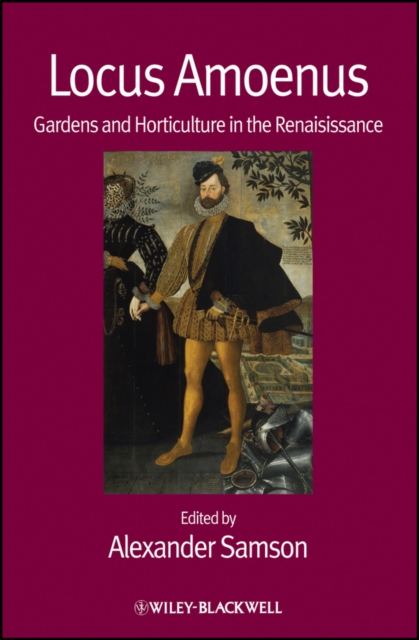
Locus amoenus
Locus Amoenus provides a pioneering collection of new perspectives on Renaissance garden history, and the impact of its development.Experts in the field illustrate the extent of our knowledge of how the natural world looked and how humans related to their environment.
eBook

Elysium: A Prelude to Renaissance Theater
In 1473 a wooden building was constructed to provide the setting for the entertainment offered in honor of the marriage of Eleonora of Aragon, daughter of Ferrante, king of Naples, to Ercole d'Este, duke of Ferrara. The building and the poetry written to describe the events surrounding the wedding are discussed, and a letter from Eleanora of Aragon to Diomede Carafa and Bernadino Corio's 1473 \"Storia di Milano\" are included.
Journal Article