
Catalogue Search | MBRL


Are you sure you want to remove the book from the shelf?

{{itemTitle}}
377
result(s) for
"Evolutionary programming (Computer software)"
Sort by:

Incremental software architecture : a method for saving failing IT implementations
\"This book will depict rare insights into actual failed-to-perform software systems, followed by comprehensive root-cause analyses identifying the reasons for their unsuccessful execution in production. Remedies will be provided that offer strategies to tackle the chief issues. Last, architecture and design best practices will conclude the discussion. The book will assist users to: Mitigate risks of software development projects Increase return on investments (ROI) Provide effective tools to assess technological achievability and viability Introduce software design best practices for enterprise architecture efforts Identify actual software construction value proposition Foster software assets reuse and consolidation Accelerate time-to-market \"-- Provided by publisher.
Book

Cytoscape Automation: empowering workflow-based network analysis
Cytoscape is one of the most successful network biology analysis and visualization tools, but because of its interactive nature, its role in creating reproducible, scalable, and novel workflows has been limited. We describe Cytoscape Automation (CA), which marries Cytoscape to highly productive workflow systems, for example, Python/R in Jupyter/RStudio. We expose over 270 Cytoscape core functions and 34 Cytoscape apps as REST-callable functions with standardized JSON interfaces backed by Swagger documentation. Independent projects to create and publish Python/R native CA interface libraries have reached an advanced stage, and a number of automation workflows are already published.
Journal Article

RevBayes: Bayesian Phylogenetic Inference Using Graphical Models and an Interactive Model-Specification Language
Programs for Bayesian inference of phylogeny currently implement a unique and fixed suite of models. Consequently, users of these software packages are simultaneously forced to use a number of programs for a given study, while also lacking the freedom to explore models that have not been implemented by the developers of those programs. We developed a new open-source software package, RevBayes, to address these problems. RevBayes is entirely based on probabilistic graphical models, a powerful generic framework for specifying and analyzing statistical models. Phylogeneticgraphical models can be specified interactively in RevBayes, piece by piece, using a new succinct and intuitive language called Rev. Rev is similar to the R language and the BUGS model-specification language, and should be easy to learn for most users. The strength of RevBayes is the simplicity with which one can design, specify, and implement new and complex models. Fortunately, this tremendous flexibility does not come at the cost of slower computation; as we demonstrate, RevBayes outperforms competing software for several standard analyses. Compared with other programs, RevBayes has fewer black-box elements. Users need to explicitly specify each part of the model and analysis. Although this explicitness may initially be unfamiliar, we are convinced that this transparency will improve understanding of phylogenetic models in our field. Moreover, it will motivate the search for improvements to existing methods by brazenly exposing the model choices that we make to critical scrutiny. RevBayes is freely available at http://www.RevBayes.com.
Journal Article
Ageing as a software design flaw
Ageing is inherent to all human beings, yet why we age remains a hotly contested topic. Most mechanistic explanations of ageing posit that ageing is caused by the accumulation of one or more forms of molecular damage. Here, I propose that we age not because of inevitable damage to the hardware but rather because of intrinsic design flaws in the software, defined as the DNA code that orchestrates how a single cell develops into an adult organism. As the developmental software runs, its sequence of events is reflected in shifting cellular epigenetic states. Overall, I suggest that to understand ageing we need to decode our software and the flow of epigenetic information throughout the life course.
Journal Article
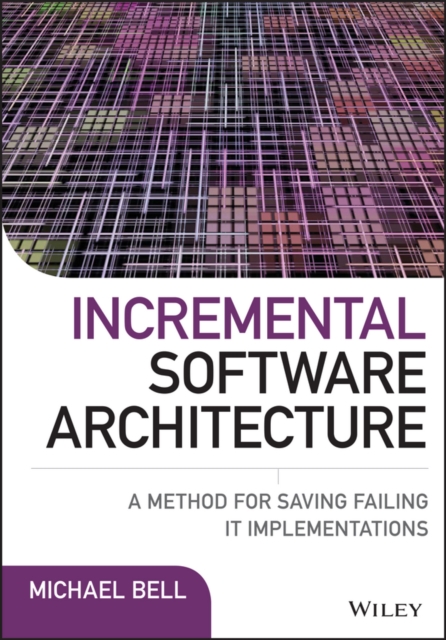
Incremental Software Architecture
The best-practices solution guide for rescuing broken software systems
Incremental Software Architecture is a solutions manual for companies with underperforming software systems. With complete guidance and plenty of hands-on instruction, this practical guide shows you how to identify and analyze the root cause of software malfunction, then identify and implement the most powerful remedies to save the system. You'll learn how to avoid developing software systems that are destined to fail, and the methods and practices that help you avoid business losses caused by poorly designed software. Designed to answer the most common questions that arise when software systems negatively impact business performance, this guide details architecture and design best practices for enterprise architecture efforts, and helps you foster the reuse and consolidation of software assets.
Relying on the wrong software system puts your company at risk of failing. It's a question of when, not if, something goes catastrophically wrong. This guide shows you how to proactively root out and repair the most likely cause of potential issues, and how to rescue a system that has already begun to go bad.
* Mitigate risks of software development projects
* Increase ROI and accelerate time-to-market
* Accurately assess technological achievability and viability
* Identify actual software construction value propositions
Fierce competition and volatile commerce markets drive companies to invest heavily in the construction of software systems, which strains IT and business budgets and puts immense strain on existing network infrastructure. As technology evolves, these ever-more-complex computing landscapes become more and more expensive and difficult to maintain. Incremental Software Architecture shows you how to revamp the architecture to effectively reduce strain, cost, and the chance of failure.
eBook
Pair consensus decoding improves accuracy of neural network basecallers for nanopore sequencing
We develop a general computational approach for improving the accuracy of basecalling with Oxford Nanopore’s 1D
2
and related sequencing protocols. Our software PoreOver (
https://github.com/jordisr/poreover
) finds the consensus of two neural networks by aligning their probability profiles, and is compatible with multiple nanopore basecallers. When applied to the recently-released Bonito basecaller, our method reduces the median sequencing error by more than half.
Journal Article

An empirical study of automated unit test generation for Python
Various mature automated test generation tools exist for statically typed programming languages such as Java. Automatically generating unit tests for dynamically typed programming languages such as Python, however, is substantially more difficult due to the dynamic nature of these languages as well as the lack of type information. Our Pynguin framework provides automated unit test generation for Python. In this paper, we extend our previous work on Pynguin to support more aspects of the Python language, and by studying a larger variety of well-established state of the art test-generation algorithms, namely DynaMOSA, MIO, and MOSA. Furthermore, we improved our Pynguin tool to generate regression assertions, whose quality we also evaluate. Our experiments confirm that evolutionary algorithms can outperform random test generation also in the context of Python, and similar to the Java world, DynaMOSA yields the highest coverage results. However, our results also demonstrate that there are still fundamental remaining issues, such as inferring type information for code without this information, currently limiting the effectiveness of test generation for Python.
Journal Article

microbetag: simplifying microbial network interpretation through annotation, enrichment tests, and metabolic complementarity analysis
Microbial co-occurrence network inference is often hindered by low accuracy and tool dependency. We introduce
microbetag
, a comprehensive software ecosystem designed to annotate microbial networks. Nodes, representing taxa, are enriched with phenotypic traits, while edges are enhanced with metabolic complementarities, highlighting potential cross-feeding relationships.
microbetag
’s online version relies on
microbetagDB
, a database of 34,608 annotated representative genomes.
microbetag
can be applied to custom (metagenome-assembled) genomes via its stand-alone version.
MGG
, a Cytoscape app designed to support
microbetag
, offers a streamlined, user-friendly interface for network retrieval and visualization.
microbetag
effectively identified known metabolic interactions and serves as a robust hypothesis-generating tool.
Journal Article
DANCE: a deep learning library and benchmark platform for single-cell analysis
DANCE is the first standard, generic, and extensible benchmark platform for accessing and evaluating computational methods across the spectrum of benchmark datasets for numerous single-cell analysis tasks. Currently, DANCE supports 3 modules and 8 popular tasks with 32 state-of-art methods on 21 benchmark datasets. People can easily reproduce the results of supported algorithms across major benchmark datasets via minimal efforts, such as using only one command line. In addition, DANCE provides an ecosystem of deep learning architectures and tools for researchers to facilitate their own model development. DANCE is an open-source Python package that welcomes all kinds of contributions.
Journal Article