
Catalogue Search | MBRL


Are you sure you want to remove the book from the shelf?

{{itemTitle}}
1,079
result(s) for
"Exchequer"
Sort by:


Gordon Brown, Alistair Darling, and the Great Financial Crisis: Leadership traits and policy responses
Gordon Brown’s management of the Great Financial Crisis was one of the few successes of his premiership and was seen as a distinctly personal triumph. Yet, in the aftermath of the crisis, Brown’s leadership led to a damaging split on economic policy with his Chancellor, Alistair Darling. To explain the role of Brown and Darling in the crisis and its aftermath, this article uses quantitative content analysis of speech to develop leadership trait profiles of both men. Both leaders score high in proactive beliefs; Brown especially had great faith in his ability to shape economic matters. Brown scores consistently higher than Darling in the use of power imagery, whilst the Chancellor maintained a significantly more complex worldview than the Prime Minister. Although many factors contributed to the turmoil and ultimate demise of the Brown government, the personality of the Prime Minister, and the clash of policy beliefs and decision-making style with his Chancellor, played a key role. This indicates that explanations of economic crises should include analysis of the policy preferences and decision-making styles of the leaders who manage them. Further, studies of the leadership styles of political leaders, which usually focus solely on the predominant leader, should instead examine interactions and conflicts amongst the several personalities at the top of a government.
Journal Article

Silver coins, wooden tallies and parchment rolls in Henry III's Exchequer
In the mid thirteenth century, England used only a single coin, the silver penny. The flow of coins into and out of the government's treasury was recorded in the rolls of the Exchequer of Receipt. These receipt and issue rolls have been largely ignored, compared to the pipe rolls, which were records of audit. Some more obscure records, the memoranda of issue, help to show how the daily operations of government finance worked, when cash was the only medium available. They indicate something surprising: the receipt and issue rolls do not necessarily record transactions which took place during the periods they nominally cover. They also show that the Exchequer was experimenting with other forms of payment, using tally sticks, several decades earlier than was previously known. The rolls and the tallies indicate that the objectives of the Exchequer were not, as we would now expect, concerned with balancing income and expenditure, drawing up a budget, or even recording cash flows within a particular year. These concepts were as yet unknown. Instead, the Exchequer's aim was to ensure the accountability of officials, its own and those in other branches of government, by allocating financial responsibility to individuals rather than institutions.
Journal Article

The Federal Court of Canada
This book is an authoritative history of the Federal Court of Canada. The judges' work in various areas of substantive law provides illustrations of the functioning of the Court in the adjudication of disputes.
eBook
To see ourselves: The rhetorical construction of an ideal citizenry in the perorations of twentieth-century budget speeches
For classical writers the peroration represented a recapitulation of the arguments that had been deployed in a speech, but was also considered the part which sought to engage the emotions of the audience. In their use of pathos, perorations are therefore particularly revealing. This article considers how they have been used by Chancellors, who have employed the collective concepts of ‘country’, ‘nation’ and ‘people’ to rouse, exhort, persuade, console, applaud, and inspire their audiences through the rhetorical construction of an ideal British citizenry.
Journal Article
‘A new species of mony’: British Exchequer bills, 1701-1711
This article studies the relationship between Bank and Treasury during the War of the Spanish Succession. It examines two new series of Exchequer bills implemented in 1707 and 1709. Far from being loans-for-rents contracts, the principal aim was to accommodate war-related pressures on the nation's monetary system by manufacturing a substitute for scarce specie. The article also shows there was a covert struggle within the financial community for access to the specie flows associated with the nation's system of public finance.
Journal Article

Christopher Saxton's Last Maps: Nichol Forest and the Debatable Land, 1607
Although it has been generally held that Saxton in his later life did not work far from home, two previously unrecognized maps in The National Archives show him surveying in 1607 for the Earl of Cumberland in the dangerous Border country. These maps throw new light onto the working methods of Saxton and his son, suggesting that by this date Robert was doing most of the work. The original map appears to have been commissioned as an estate map but was then copied to be re-used as evidence in a law suit, thus separating the maps from their context.
Journal Article

Reasons Giuen by Me, Why I am in Debt
This essay examines the changing views of John Egerton, second Earl of Bridgewater, of the emerging consumer economy of late seventeenth-century England. Robin Hermann analyzes the earl's accounts, correspondence, and other manuscripts to explore a revealing case of the post-Restoration encounter between the customary values of the aristocracy and the commercial interests of the merchant. Of particular interest is a “debt document,” a memorandum in which Bridgewater explains to himself and to his progeny the reasons for his crippling indebtedness.
Journal Article

Elizabethan Naval Administration
This is the first general selection from the substantial body of surviving documents about Elizabeth’s navy. This collection mainly concentrates on the early years of Elizabeth’s reign when there was no formal war. From 1558-1585 the navy was involved in a number of small-scale campaigns, pursuit of pirates and occasional shows of force. The documents selected emphasize the financial and administrative processes that supported these operations, such as mustering, victualing, demobilisation, and ship maintenance and repair. The fleet varied in size from about 30 to 45 ships during the period and a vast amount of maintenance and repair was required. The documents illustrate just how efficiently the dockyards functioned. They were one of the great early Elizabethan achievements.
eBook
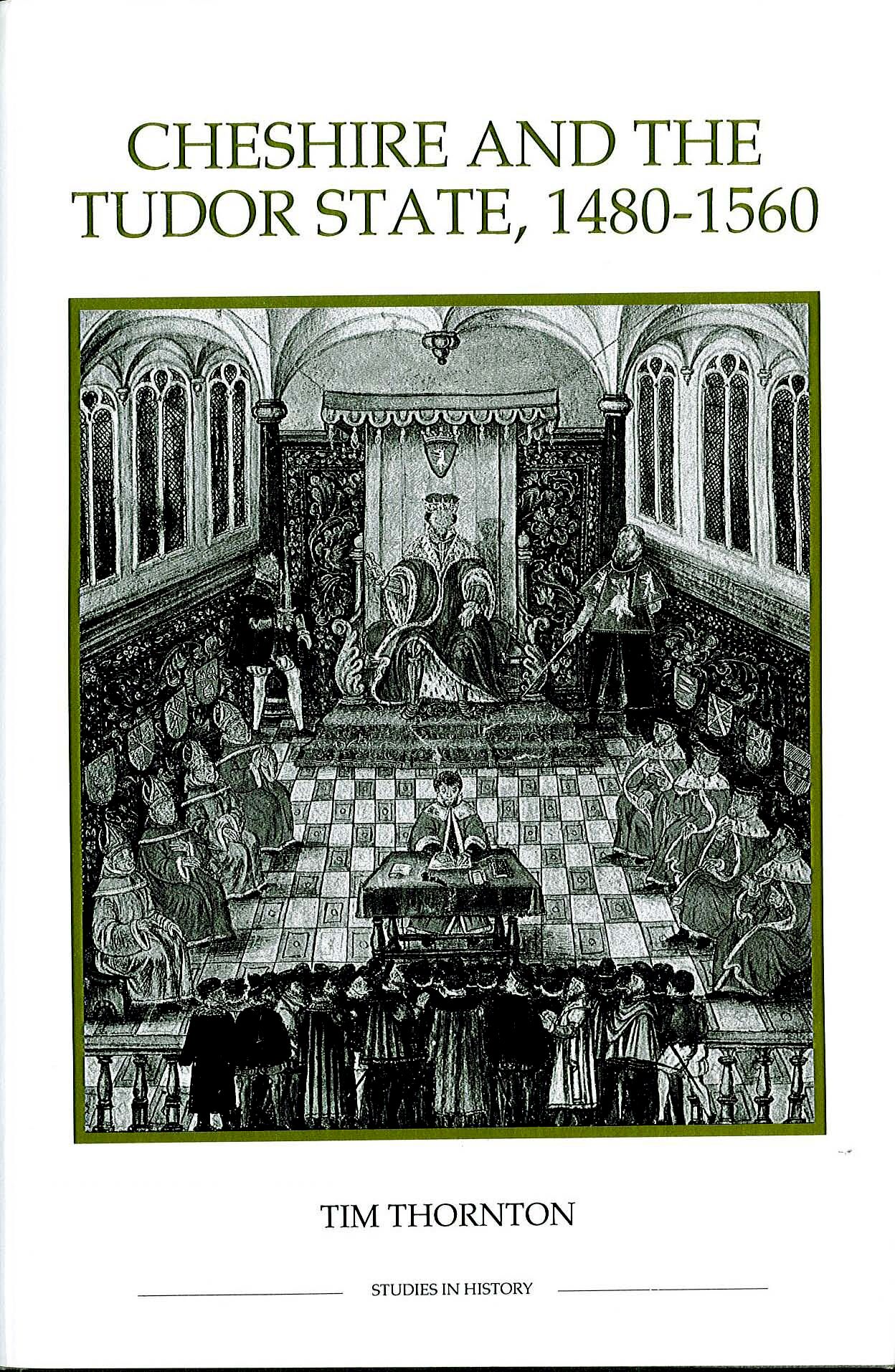
Cheshire and the Tudor State, 1480-1560
The palatinate of Chester survives Tudor centralisation.This book asserts the importance of the semi-autonomous political, administrative and judicial system of the palatinate of Chester, and of other similar jurisdictions, in the early Tudor period. Contrary to the impression conveyedin almost all recent writing, the culture of centre and locality justified and glorified the palatinate: taxation, a crucial issue, was still agreed through a local parliament and paid in the traditional manner; and the council of the earl of Chester was potent enough to tap the demand for equitable justice, giving birth to the Chester exchequer. Changes did occur, but despite political imperatives, administrative momentum, and the imperial ideal (presented particularly in the work of Thomas Cromwell) the Chester palatinate as a cultural, social and political institution emerged in the 1560s altered but still formidable.TIM THORNTON is Senior Lecturer and Head of History at the University of Huddersfield.
eBook