
Catalogue Search | MBRL


Are you sure you want to remove the book from the shelf?

{{itemTitle}}
17,923
result(s) for
"Executive ability"
Sort by:


Predicting Business Success
Going beyond the usual slicing and dicing of HR data, this book shows HR professionals how to definitively connect the dots between people data and business outcomes with a straightforward approach for scaling analytics to all leaders and all levels. --
eBook


Quantifying Managerial Ability: A New Measure and Validity Tests
We propose a measure of managerial ability, based on managers' efficiency in generating revenues, which is available for a large sample of firms and outperforms existing ability measures. We find that our measure is strongly associated with manager fixed effects and that the stock price reactions to chief executive officer (CEO) turnovers are positive (negative) when we assess the outgoing CEO as low (high) ability. We also find that replacing CEOs with more (less) able CEOs is associated with improvements (declines) in subsequent firm performance. We conclude with a demonstration of the potential of the measure. We find that the negative relation between equity financing and future abnormal returns documented in prior research is mitigated by managerial ability. Specifically, more able managers appear to utilize equity issuance proceeds more effectively, illustrating that our more precise measure of managerial ability will allow researchers to pursue studies that were previously difficult to conduct.
This paper was accepted by Mary E. Barth, accounting.
Journal Article

Lead
\"Lead is a different kind of book. Rather than being the \"last word\" on leading others, it is meant to be the \"first word\"--an invitation to the reader to reflect on what the leadership journey means to each and every individual. At its core, Lead will benefit anyone who seeks to inspire, influence, or lead others, whether they are coaches, teachers, pastors, community organizers, politicians--or are in the C-suite. Lead offers an exploration of the essential elements of leadership, which author Gary Burnison defines as: purpose, strategy, people, measure, empower, reward, anticipate, navigate, communicate, listen, and learn--all of which culminate in leading. Instead of taking the left-brain approach of \"paradigm shifts\" and \"leadership models,\" the author focuses on right-brain constants such as emotional connection, compassion, focusing on others, humility, and managing oneself. Lead readers will find inspiring stories, easy to digest analogies, reflective exercises and evocative images meant to give them pause, draw them in, and encourage introspection\"--Amazon.com, viewed September 16, 2013.
Book
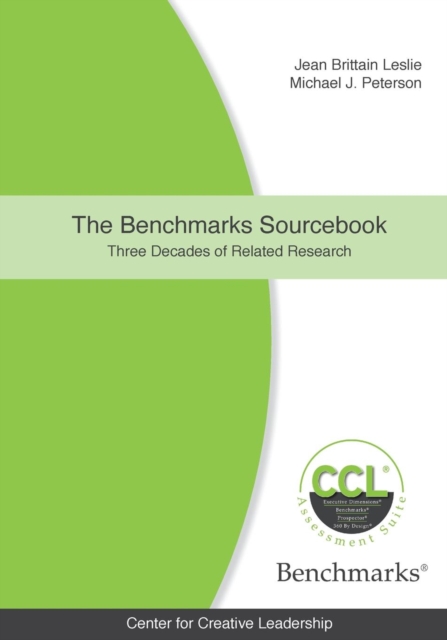
Benchmarks Sourcebook: Three Decades of Related Research
Benchmarks, a 360-degree assessment, has been used by approximately 16,000 organizations and over 200,000 managers. Data collected through its administration has resulted in large comprehensive databases that have provided the basis for numerous studies. These annotations on published research were written for anyone who is interested in the research leading to the development and refinement of Benchmarks, the interpretation of the assessment's results, or the relationship of Benchmarks to other psychological assessments.
eBook


Leaders in transition
Leaders in Transition brings a new perspective on why some leaders succeed more than others when taking charge of an organisation. Based on in-depth case studies, when four new leaders and their teams in large and complex international organisations were tracked for over a year, this book uncovers that success in managing transition is directly related to leaders' ability to balance tensions, appropriately to the context. The reasons for each leader's effectiveness are explored and analysed, allowing the authors then to extrapolate some general conclusions about the ways in which these tensions reveal themselves during all leadership transitions. Evidently, the success or failure of a new leader is the result of the way multiple actors (the new leader, his or her boss, his organisation and its stakeholders) behave, before and during the taking charge. These multiple interactions are revealed and discussed.
eBook
CEO Confidence and Unreported R&D
We investigate whether managerial traits influence corporate decisions to provide mandatory financial disclosures. The results indicate that firms with confident chief executive officers (CEOs) are 24% more likely to report their research and development (R&D) expenditures relative to firms with cautious CEOs. Exploiting staggered, state-level regulatory shocks and changes in CEO type, we find substantial evidence that cautious CEO firms fail to report R&D expenditures. After a plausibly exogenous shock to managerial reporting liability, cautious CEO firms exhibit a 35% larger reduction in unreported R&D relative to confident CEO firms. Interestingly, confident CEO firms do not exhibit more innovation than their cautious CEO counterparts after taking into account their differing propensities to report corporate R&D. Overall, our analysis suggests that the precision or reliability of mandatory disclosures systematically varies with managerial characteristics.
The Internet appendix is available at
https://doi.org/10.1287/mnsc.2017.2809
.
This paper was accepted by Amit Seru, finance.
Journal Article