
Catalogue Search | MBRL


Are you sure you want to remove the book from the shelf?

{{itemTitle}}
10
result(s) for
"Executive power United States History 20th century Congresses."
Sort by:


The Clinton Presidency and the Constitutional System
Presidential scholars, former and current policymakers, and a former president bring varied insights and analyses to consider the impact, influence, and legacy of the presidency of William Jefferson Clinton, the “'New Democrat' from Hope, Arkansas.
In the eight years between 1993 and 2001, the Clinton White House presided over a booming economy that included a budget surplus in Clinton’s second term, oversaw the most significant welfare reform since the New Deal, and wrestled with the challenge of developing a foreign-policy vision for the post–Cold War era.
Structurally, the Clinton presidency expanded the office and responsibilities of the First Lady and the Vice President to an unprecedented degree, prevailed in a budget battle with Congress that included two government shutdowns, briefly employed a line-item veto until the Supreme Court declared that power unconstitutional, and endured the second impeachment of the chief executive in American history.
The evolution and consequences of the increased power held by modern presidents became sharply evident during the Clinton years. In The Clinton Presidency and the Constitutional System, based on the Eleventh Presidential Conference at Hofstra University, readers are afforded a unique combination of scholarly analysis and the perspectives of former administration officials. Students and scholars of the presidency will glean important understandings from the balanced, judicious studies of the Clinton administration and their juxtaposition with firsthand recollections of some of the participants who defined and shaped those events.
eBook

Presidential Influence in an Era of Congressional Dominance
Research on presidential power focuses almost exclusively on the modern era, while earlier presidents are said to have held office while congressional dominance was at its peak. In this article, I argue that nineteenth-century presidents wielded greater influence than commonly recognized due to their position as head of the executive branch. Using an original dataset on the county-level distribution of U.S. post offices from 1876 to 1896, I find consistent evidence that counties represented by a president’s copartisans in the U.S. House received substantially more post offices than other counties, and that these advantages were especially large under divided government and in electorally important states. These results are robust across model specifications and when examining the Senate. The findings challenge key components of the congressional dominance and modern presidency theses, and have important implications for scholarship on interbranch relations, bureaucratic politics, and American political development.
Journal Article

Not Much Left
Tom Waldman's lively and sweeping assessment of the state of American liberalism begins with the political turbulence of 1968 and culminates with the 2006 takeover of Congress by the Democratic Party.Not Much Left: The Fate of Liberalism in Americavividly demonstrates how the progressive and liberal wing of the Democratic Party helped end a war, won the civil rights battle, and paved the way for blacks, women, gays, and other minorities to achieve full citizenship. Through reportage, anecdotes, and analysis-particularly of the disastrous defeat of Democrat George McGovern in 1972-Waldman chronicles how the grand coalition that achieved so much in the 1960s began to self-destruct in the early 1970s. Citing the Republican recovery from Barry Goldwater's 1964 defeat, Waldman demonstrates how the two parties' very different reactions to electoral debacle account for recent Republican dominance and Democratic impotence. Assessing liberalism's fate through the Carter and Reagan presidencies, the defeat of Michael Dukakis in the 1988 presidential election, and the on-again, off-again liberalism of the Clinton years, Waldman then brings the discussion up to date with analysis of the 2008 presidential campaign.
eBook

The gloss of war: Revisiting the Korean war's legacy
In war powers analysis, reliance on the interpretive method of historical practice, also called the \"gloss of history,\" has made history a technology of the forever war. This approach draws upon the history of U.S. military conflict to interpret the scope of presidential war power and embeds past actions into the separation of powers. There is a crucial flaw in this methodology, however. The understanding of history in historical gloss is not informed by the changing historiography of war. This has led to a divergence between the \"history\" in legal authority and the revised historical understanding in scholarly works of history. Whereas lessons of history in other contexts often serve as levers for reexamination of government action, in gloss-of-history analysis the past instead serves to legitimate settled practices. The consequence is that presidential overreach is not recognized and corrected, but instead built into the doctrine of expanding unilateral power.
This Article is the first to examine how static ideas about history in legal analysis have aggrandized presidential war power. It analyzes the most important example of this: President Harry S. Truman's unilateral actions in the Korean War and subsequent reliance on his example in executive branch legal opinions. The war is a principal precedent supporting the idea that presidents may use substantial military force without congressional authorization. This has legitimated unilateralism in less massive wars, and since that time all U.S. uses of military force have been in conflicts smaller than Korea, with the exception of the war in Vietnam. Decades of historical scholarship, however, have shown that Truman misunderstood the nature of the conflict and disregarded Congress's role, and that his advisors failed to seriously consider Congress's war authorization power until after force was deployed. Historians have also shown the devastating costs of war for Koreans, whose experience is not centered in the U.S. war powers literature. Historical revision did not prompt legal reconsideration, however. Instead, the Korean War is calcified as a significant precedent supporting executive unilateralism, undermining democratic limits, and enabling ongoing war. The Article argues that gloss of history analysis must be dynamic, attentive to the way understandings of the past change over time. An approach to gloss informed by historical revision could reassert history's role as a critical perspective on law.
Journal Article

Election 2014
The Republican party overwhelmingly carried the midterm elections of 2014, winning nearly every contested congressional and gubernatorial seat and taking the Senate after eight years of Democratic control. Many have characterized this sweep as a sign of a fundamental political shift toward the GOP. But acclaimed political commentator Ed Kilgore argues that the results of the midterm elections were a predictable outcome that was less an ideological watershed than the culmination of several long-term cyclical and historical trends.
Election 2014strips down conflicting and biased political narratives to present an accessible account of how and why Republicans triumphed so decisively. Kilgore crunches electoral data and evaluates such structural factors as the economy, presidential approval ratings, and voter turnout patterns. Ultimately, this bracing analysis sheds light on the election's implications for the future direction of American politics.
eBook

Aftermath: the Clinton impeachment and the presidency in the age of political spectacle
With the specter of prosecution after his term is over and the possibility of disbarment in Arkansas hanging over President Clinton, the Clinton-Lewinsky scandal and the events that have followed it show no sign of abating. The question has become what to do, and how to think, about those eight months. Did the President lie or was it plausible that he had truthfully testified to no sexual relationship? Was the job search for Monica just help for a friend or a sinister means of obtaining silence? Even if all the charges were true, did impeachment follow or was censure enough? And what are the lasting repercussions on the office of the Presidency? Aftermath: The Clinton Impeachment and the Presidency in the Age of Political Spectacle takes a multi-disciplinary approach to analyze the Clinton impeachment from political perspectives across the spectrum. The authors attempt to tease out the meanings of the scandal from the vantage point of law, religion, public opinion, and politics, both public and personal. Further, the impeachment itself is situated broadly within the contemporary American liberal state and mined for the contradictory possibilities for reconciliation it reveals in our culture. Contributors: David T. Canon, John Cooper, Drucilla Cornell, Jean Bethke Elshtain, Robert W. Gordon, Lawrence Joseph, Leonard V. Kaplan, David Kennedy, Kenneth R. Mayer, Beverly I. Moran, Father Richard John Neuhaus, David Novak, Linda Denise Oakley, Elizabeth Rapaport, Lawrence Rosen, Eric Rothstein, Aviam Soifer, Lawrence M. Solan, Cass R. Sunstein, Stephen Toulmin, Leon Trakman, Frank Tuerkheimer, Mark V. Tushnet, Andrew D. Weiner, Robin L. West.
eBook
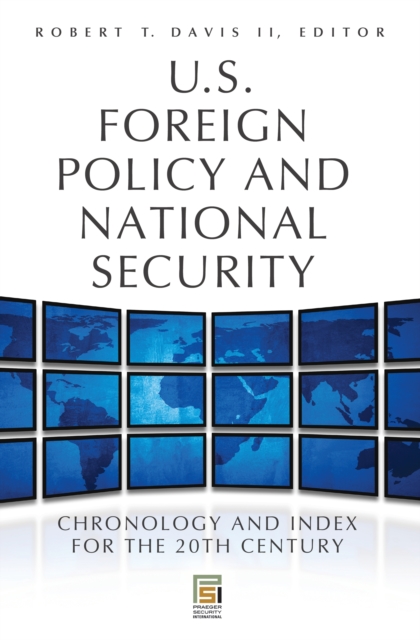
U.S. Foreign Policy and National Security
This guide provides an in-depth, chronological overview of issues and policy processes related to U.S. foreign, military, and national security policy during the 20th century. Foreign policy and security are obviously at the core of a nation’s very existence, determining its role in the world and often influencing domestic affairs. How did U.S. foreign policy develop and evolve during the all-important 20th century? Who were the players who shaped, not only the United States, but the world in which we now live? U.S. Foreign Policy and National Security: Chronology and Index for the 20th Century provides a unique compilation of data never before combined in a single volume. Key events and policy meetings are arranged in order by presidential administration, from the McKinley administration to that of President Obama. Each section begins with a concise list of policymakers, including Cabinet-level officials, members of the National Security Council, and senior ranks of the Department of State and Department of Defense, supplemented with bibliographic data. The bulk of each chapter is comprised of detailed lists of meetings of the president of the United States with key advisors and foreign dignitaries. These meetings include international conferences, meetings between the president and foreign leaders, meetings of the joint chiefs of staff in World War II, and meetings of the National Security Council since its creation in 1947. This unprecedented guide will be invaluable to researchers and, indeed, to anyone interested in the decisions that determined the course of U.S. history. Title Features • Includes lists of National Intelligence Estimates produced by the Central Intelligence Agency on the Soviet threat during the Cold War • Provides unique tables of key policymakers one and two levels below Cabinet members • Offers a comprehensive appendix containing brief biographical data of all the figures listed in the guide • Includes numerous cross-references to the Department of State's Foreign Relations of the United States Highlights • Brings together policymakers with the policy process in a manner that combines the best features of chronological and bibliographic guides • Bridges an important gap between foreign policy document collections, biographical encyclopedias, and encyclopedias of foreign policy • Offers numerous foreign policy-related meeting lists, such as a comprehensive list of the meetings of the National Security Council during the Cold War, in a single volume
eBook

Theodore Roosevelt, Congress, and the Military: U.S. Civil-Military Relations in the Early Twentieth Century
The presidency of Theodore Roosevelt marked a time of considerable tension in civil-military affairs. Roosevelt made the modernization of the armed services a top priority, but frequently he complicated civil-military relations in the process. Members of Congress worried about the executive treading on legislative prerogatives, and military officers actually found many presidential initiatives disruptive. In addition, Roosevelt's cultivation of popular support for his military programs reshaped civil-military relations. The press regularly rewarded the president with favorable coverage, but sometimes Roosevelt endured controversies that were largely his own making. Roosevelt and the other participants in civil-military debates lavished so much attention on reporters that the press essentially became a fourth member of the established civil-military troika of president, Congress, and military. This development, along with Roosevelt's work to modernize the military and the demands of great power responsibilities, formed the broad outlines of modern civil-military relations in the United States.
Journal Article
IN THE SHADOW OF BATISTA
The year 1936 marks an unheralded watershed in the history of the Cuban Republic and the career of Fulgencio Batista. The period of revolutionary turmoil was at an end. The general strike of 1935 was the last gasp of revolutionary forces seeking to redefine the core of Cuban society. As historian Robert Whitney puts it, Batista had succeeded “in disciplining the masses.”¹ The venue for political struggle now shifted from the battlefield of the streets to the halls of government and the backrooms where political deals were made. Reform, not revolution, would typify the next fifteen years of Cuban history.
Book Chapter